



BEIRUT: Many national celebrations for Lebanon’s 77th Independence Day on Sunday were canceled amid the coronavirus pandemic, the political divide, the economic downturn and the aftermath of Beirut’s port blast on Aug. 4.
However, several wreaths were laid on the graves of several independence statesmen, while Army Commander in Chief General Joseph Aoun laid a wreath on the memorial statue of the Lebanese Army martyrs.
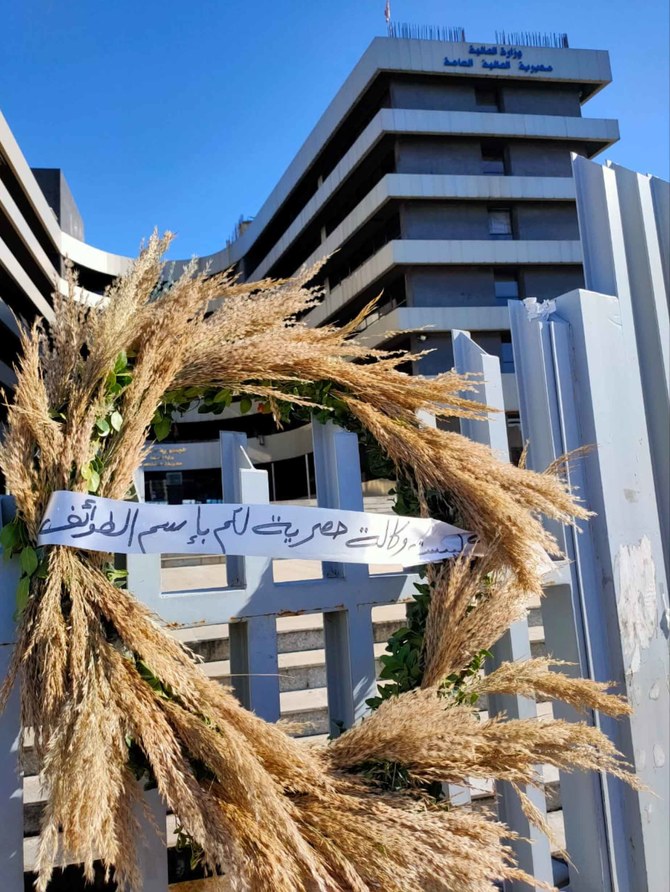
The civil movement celebrated the day in a different way, suspending brooms and wreaths of basil on the walls of public institutions such as the headquarters of the government, the parliament, the Ministry of Economy, the Bank of Lebanon, the Ministry of Health, the Ministry of Finance, the Palace of Justice, the Ministry of Foreign Affairs, Electricity of Lebanon, the Association of Banks and the Port of Beirut. Basil wreaths are usually placed on the graves of the dead but these carried the demands of the protesters.
“We chose this way of expression as we are unable to take to the streets again because of the COVID-19 pandemic. We are sending a clear message to officials that true independence will only be achieved by returning state institutions to the people who are the source of all powers. We wanted to mourn the corrupt authority,” activist Mahmoud Fakih told Arab News.
The Lebanese fear the collapse of their state in the light of corruption, the quotas that hinder the formation of the government and the failure to achieve the reforms required to support Lebanon from abroad. The chaos surrounding Lebanon’s economic crisis has deepened after international firm Alvarez & Marsal terminated its contract to audit the central bank’s accounts.
On Sunday, the black market exchange rate for dollars in Lebanon soared to more than 8,400 Lebanese pounds to the dollar.
HIGHLIGHT
The Lebanese fear the collapse of their state in the light of corruption, the quotas that hinder the formation of the government and the failure to achieve the reforms required to support Lebanon from abroad.
Many activists expressed their indignation on social media. Lawyer and activist Nizar Siagha wrote on Twitter: “The independence of the people from the leaders that have transformed the state into a fiesta is the independence for which we are fighting today, the independence of equality, justice and solidarity without discrimination.”
Dr. Suzanne Hosri, a researcher at the Issam Fares Institute for Public Policy and International Affairs at the American University of Beirut, wrote: “This year, I refuse to celebrate or even mention Independence Day. There is no independence before the liberation of the homeland from the corrupt and failed system. There is no sovereignty before holding leaders across the sectarian spectrum accountable for our fear, disease and death. There is no freedom before breaking the shackles of our intolerance and sectarianism toward an open and responsible citizenship capable of defending its dignity and rights. No to a fake and misleading Independence Day!”
Lebanese president Michel Aoun received congratulatory cables on the 77th anniversary from presidents and kings alike, including China’s President Xi Jinping, Iranian President Hassan Rouhani and Syrian President Bashar Assad. Many of these cables held implied political messages. US Secretary of State Mike Pompeo did not congratulate President Aoun or the government but simply said: “The United States is committed to supporting the people of Lebanon, and we will continue to stand by them through these unprecedented times.”
“Our reality today is not promising,” President Aoun said in a televised speech to mark Independence Day, adding that Lebanon was a prisoner of corruption, political scheming and external dictations.
“If we want statehood, then we must fight corruption and this begins by imposing the forensic financial audit,” he said, adding he would not “back off” on the issue.
Aoun made a veiled criticism of the prime minister in charge of forming the government, without naming him, saying: “Is it not yet time to free the process of forming the new government from conflicts and hiding behind rescue initiatives to break the rules and standards that must be respected and applied to all in order to establish the procedural authority and its work?”
There was also criticism from other Lebanese leaders. “Independence means Lebanon’s dissociation from regional conflicts toward establishing a policy of neutrality to promote its economy,” said Lebanese Maronite Patriarch Mar Bechara Boutros Al-Rahi.
Al-Rahi added: “If we form a government like its predecessors, it will produce total ruin, asking those who are hindering the formation of the government if they realize that we have lost an invaluable year of reform?”
The Grand Mufti of the Lebanese Republic, Sheikh Abdul Latif Derian, said that the anniversary of independence “comes at a time when the nation is suffering from an unprecedented collapse in the absence of the state and the work of its institutions. We fear the greatest and worst unless a government of national salvation is formed that will gain the trust of the people and the Arab and international community, or Lebanon shall be ruined!”
The Greek Orthodox Church of Antioch for the Archdiocese of Beirut, Metropolitan Elias Audi, called on the President of the Republic to restore “the prestige of the state by adopting accountability, activating the audit policy and stopping politicians from controlling the institutions and the judiciary systems.”
“The disruption of governance is a crime. Conflict of interests, wars of mutual abolition, the liquidation of absurd accounts and the implementation of external agendas only lead to destruction,” he warned.


