MOSES LAKE, Washington: The future of Boeing Co’s freshly approved 737 MAX is in the hands of nearly 700 workers toiling behind the gray doors of a three-bay hangar at a desert airport in Washington state.
Inside, over an endless 24-hour loop, 737 MAX planes are rolled in for maintenance, and upgrades of software and systems as mandated by the US Federal Aviation Administration in this week’s order lifting a flight ban imposed after two crashes, the airport’s director said.
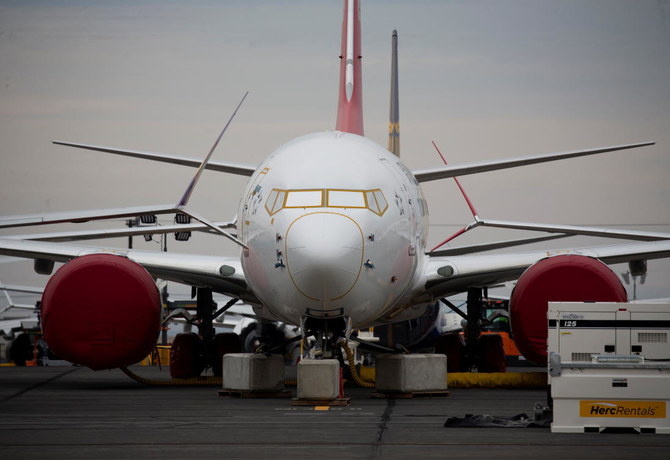
In front, workers in bright yellow vests inspect the roughly 240 jets stored in giant grids at Grant County International Airport in Moses Lake – more than half of an inventory worth about $16 billion, according to investment firm Jefferies.
Analysts say clearing the logjam of up to 450 stored jets in total is crucial before Boeing can resume meaningful production of its traditional cash cow – a task complicated by the fact that buyers have in some cases walked away during the grounding.
While parked on the tarmac, each jet is fitted with red engine and wheel covers, a windshield screen to block out the sun, and a small generator powering cycles of fresh air and electricity through its systems – the aviation equivalent of life support.
“It’s an enormous undertaking,” the airport’s director, Rich Muller, told Reuters. “But this go-ahead from the FAA has given them a real shot in the arm. It’s really energized everyone.”
The work at Moses Lake is a cornerstone of a global logistical and financial strategy under way at Boeing to clear a backlog of more than 800 mothballed 737 MAX jets. About 450 are Boeing property, and a further 387 were in airline service before the FAA’s grounding order in March 2019.
Across the globe, Boeing teams are hammering out delivery schedules – and financial terms – with airlines who last year had to scale back schedules and fly aging jetliners because they lacked the aircraft to meet strong demand as the MAX grounding dragged on longer than airline and Boeing executives expected.
But the jet is returning at a time when the coronavirus pandemic has hammered demand for air travel and new jets. Boeing also faces new European trade tariffs and palpable mistrust of one of the most scrutinized brands in aviation.
“Airlines and the supply chain do not see major deliveries until 2022,” said Arndt Schoenemann, managing director of supplier Liebherr-Aerospace Lindenberg. “Right now, COVID is the biggest problem for the industry.”
A Boeing spokesman declined to comment beyond listing preparation steps before 737 MAXs go to customers, which include installing a flight control software upgrade to deal with a system tied to both crashes, separating wiring bundles that posed a potential safety hazard, and multiple tests including a test flight before a final FAA inspection.
Airlines say it will take about two weeks to ready each plane for service with maintenance and software upgrades factored in, though Boeing has already deployed teams around the world to help companies get ready.
In a visual display of the jet demand slump, workers at Moses Lake on Thursday rolled a 737 MAX “white tail” – a jet without a buyer, or whose buyer has been changed – out of a long row of aircraft awash in the bright liveries of airline customers, ranging from customers American Airlines to Norwegian Air. This week, Norwegian sought bankruptcy protection in Ireland.
Reuters counted 12 white tails at Moses Lake on Thursday, though sources say Boeing is worried about 100 such aircraft in inventory, or more.
Boeing declined to comment.
Jets are also stored at Boeing property in the Seattle area and in San Antonio, Texas.
Boeing is in discussions with several airlines, including Southwest, Delta and Alaska, hoping to stimulate demand for the jet. Deals are expected to include significant discounts, industry sources have said. But analysts caution cutting prices too far could upset other customers.
A fire sale could also depress resale values of such single-aisle jets – the cornerstone of a complex system of financing that has attracted capital to the industry, powered by relatively strong returns on planes which are seen as mobile real estate.
To kickstart the recovery of the MAX and contain any fallout to the jet’s valuation while offering aggressive discounts to find new homes, Boeing is expected to line up a handful of large deals with marquee customers who will put them in long service.
The 737 MAX 8 has a list price of $122 million but the market long ago abandoned published prices as competition heated up. Most jets are privately sold well over 50% below the list price and the new MAX discount may be more, jet traders said.
Slowing the recovery, the FAA, which has faced accusations of being too close to Boeing in the past, has said it plans in-person inspections of each of the 450 planes, which could take at least a year to complete, prolonging the jets’ deliveries.
Grant County International has been a strategically important asset for Boeing at least since the 1960s, and every MAX built in the Seattle area is flown there for touch-and-go landings or other tests.
The airport and abutting Boeing property has absorbed nearly 700 employees and contractors to aid the ungrounding effort, up from only a handful, Muller said.
Meanwhile, Boeing is paying some $51,000 per plane a month to park its MAXs, he added.


![]()

Boeing 737 MAX jets undergo round-the-clock effort to clear inventory
Short Url
https://arab.news/vtyst
Boeing 737 MAX jets undergo round-the-clock effort to clear inventory
- Clearing the logjam of up to 450 stored jets in total is crucial before Boeing can resume meaningful production of its traditional cash cow


Latest updates






© 2026 SAUDI RESEARCH & PUBLISHING COMPANY, All Rights Reserved And subject to Terms of Use Agreement.