

Saudi-Pakistani ties 'stable' under King Salman's leadership — PM aide

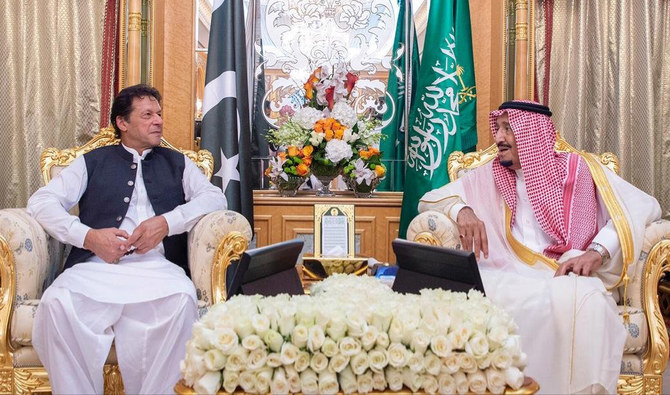
Pakistan's Prime Minister Imran Khan is talking to Saudi King Salman bin Abdulaziz on September 19, 2019. (Photo Courtesy: Consulate General of Pakistan Jeddah)
Short Url
Updated 02 August 2021
Follow

Saudi-Pakistani ties 'stable' under King Salman's leadership — PM aide

  • Bilateral ties getting stronger 'with each passing day', Ashrafi says
  • Says Islamabad committed to addressing challenges of Muslim world

ISLAMABAD: Prime Minister Imran Khan's Special Repre­sentative on Religious Har­mony and the Middle East, Hafiz Tahir Ashrafi, said that relations between Islamabad and Riyadh had "witnessed stability and harmony" under the leadership of Saudi King Salman.

"Both countries are knotted in relations of brotherhood and bilateral ties are getting stronger and stronger with each passing day," Ashrafi told Arab News on Sunday.

The Kingdom celebrated the sixth anniversary of King Salman's ascension to the throne earlier this week, with Ashrafi felicitating the Saudi royal on occasion.

“People of Pakistan pray for King Salman and Crown Prince Muhammed bin Salman to serve the Muslim Ummah,” he said.

In a statement released on Wednesday, Ashrafi said that Pakistan was "committed to addressing challenges of the Muslim world with the unity of Islamic countries".

“Pakistan aims (for) stable and strengthened relations with all Muslim countries and Pakistan's relations with the Kingdom of Saudi Arabia are very exemplary,” he said.

The two countries enjoy deep-rooted strategic ties, with nearly 2.5 million Pakistanis residing in the Kingdom.

In October 2018, during PM Khan's visit to the Kingdom, Saudi Arabia agreed to a bailout plan of $6 billion for Islamabad under which Saudi Arabia agreed to facilitate Islamabad overcome a deficit crisis.


Pakistan tax revenue rises in January as direct taxes drive growth

Updated 5 sec ago
Follow

Pakistan tax revenue rises in January as direct taxes drive growth

  • Federal tax collection grows 16% year-on-year at the outset of 2026, led by income tax gains
  • Seven-month revenues reach Rs.7.18 trillion as authorities bank on recovery in manufacturing

ISLAMABAD: Pakistan’s Federal Board of Revenue (FBR) on Saturday reported a strong pickup in tax collection in January, driven by a sharp rise in direct taxes, as the government seeks to shore up public finances under a reform-led revenue mobilization drive.

The tax authority collected a provisional Rs1.02 trillion ($3.65 billion) in January, up 16% from Rs.873 billion ($3.14 billion) in the same month last year, surpassing the six-month average growth rate of 10-11%, according to an official statement.

“This month’s tax performance reveals a nuanced and strategically significant fiscal outcome, characterized by substantial increase in direct taxation, modest growth in indirect and excise streams and an overall healthy and improved performance in January 2026,” the statement said.

“It also reinforces the credibility of reform-driven revenue mobilization and transformation plan of FBR,” it added.

Income tax collection rose 26% to Rs483 billion ($1.74 billion) from Rs381 billion ($1.37 billion) a year earlier, reflecting what the FBR described as the impact of enforcement measures and efforts to unlock revenue tied up in litigation.

Sales tax receipts increased 12% to Rs360 billion ($1.30 billion) from Rs322 billion ($1.16 billion) last year, which the tax authority linked to signs of recovery in large-scale manufacturing.

The FBR said the results underscored the effectiveness of its reform program, including the use of digital infrastructure and enforcement tools to improve compliance and expand the tax base, while encouraging voluntary taxpayer participation.

Cumulatively, the FBR collected Rs7.18 trillion ($25.83 billion) in the first seven months of the 2026 fiscal year, compared with Rs6.49 trillion ($23.36 billion) in the same period last year.

The tax authority said it was optimistic that continued recovery in manufacturing would help it meet its full-year revenue targets, adding that it aimed to maintain momentum in the remaining months of the fiscal year.