

Pakistan reports highest single-day death toll from COVID-19 since July

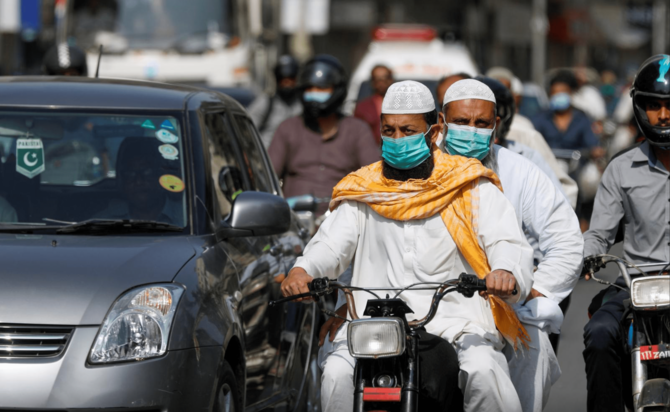
Men wear protective masks as they ride a motorcycle amid the outbreak of the coronavirus disease (COVID-19) in Karachi, Pakistan November 16, 2020. (Reuters)
Short Url
Updated 22 November 2020
Follow

Pakistan reports highest single-day death toll from COVID-19 since July

  • Nearly 60 fatalities recorded in past 24 hours; more than 2,600 test positive
  • Authorities begin imposing lockdowns in four "high-risk" Karachi districts 

ISLAMABAD: Pakistan on Sunday recorded 59 deaths from the coronavirus disease, the highest single-day fatality count recorded since July 15, with authorities linking the uptick in numbers to a second wave of the deadly outbreak across the country.

According to the health ministry's COVID-19 portal, 2,665 people had tested positive for the disease in the past 24 hours, taking the national caseload to 374,173 infections and 7,662 deaths since the outbreak was first reported in March.

In Karachi, officials began imposing smart lockdowns in four "high-risk" areas of the city – namely the South District, West District, Korangi District and Central District – after more than 850 people tested positive for the disease on Saturday night. 

The lockdown measures include a restriction on the movement of residents in the COVID-19 hotspots, in addition to a ban on gatherings at home.

For the past several weeks, authorities have been sounding the alarm over a second wave of the coronavirus outbreak.
Earlier this week, the National Command and Operation Center (NCOC), which leads the anti-COVID-19 efforts in the country, had made it mandatory for residents to wear masks in public places – failing which they would be fined – and ordered all business centers, wedding halls, eateries and shopping centers to close shop by 10 pm. 

The surge in infections follows Pakistan's move to ease restrictions on May 9, ahead of the Eid Al-Fitr festivities which marks the end of the fasting month of Ramadan and is celebrated with congregational prayers, family gatherings and feasting.

The country’s transportation sector and most businesses were reopened, though cinemas, theaters and schools remained closed.

More recently, however, the government warned that there was an uptick in infection numbers, telling people to take precautionary measures and announcing that Pakistan was witnessing the second wave of the pandemic which could prove more lethal than the first one.


Pakistan eyes collaboration with Saudi Arabia, Indonesia, China for local vaccine production

Updated 5 sec ago
Follow

Pakistan eyes collaboration with Saudi Arabia, Indonesia, China for local vaccine production

  • Pakistan last week held talks with a visiting Saudi delegation on partnering to manufacture vaccines locally
  • Government working on “war footing” to ensure local production of vaccines by 2030, says health minister

ISLAMABAD: Pakistan is eyeing collaboration with Saudi Arabia, Indonesia and China to produce vaccines locally, Health Minister Syed Mustafa Kamal said on Thursday, adding that Islamabad was exploring both government-to-government and business-to-business opportunities in this regard. 

Kamal told Arab News last week that Islamabad was “very close” to an agreement with Saudi Arabia that would enable Pakistan to manufacture vaccines locally. The development took place as a Saudi delegation, led by the Kingdom’s senior adviser to the minister of industry Nizar Al-Hariri, arrived in Pakistan last week and held talks with health officials on a partnership with Pakistan which would enable it to manufacture vaccines locally. 

The efforts take place amid Pakistan’s push to strengthen its health security and industrial capacity. The country of more than 240 million currently imports all vaccines used in its national immunization campaigns, relying heavily on international partners to help cover the costs.

“Mustafa Kamal said Pakistan is exploring collaboration with Saudi Arabia, Indonesia and China for local production of these vaccines,” state broadcaster Radio Pakistan reported. 

Kamal said the government is working on a “war footing” to ensure the local production of vaccines before 2030. 

The health minister reiterated that Pakistan has the potential to locally produce raw materials of the 13 vaccines that it provides free of cost. He added that the government will also export vaccines once it starts producing them at home. 

“Mustafa Kamal said the government is exploring both government-to-government and business-to-business collaboration to achieve our objectives in vaccine production,” Radio Pakistan said. 

Pakistan’s health ministry has said it imports all 13 vaccines that it provides masses for free at an annual cost of about $400 million.

International partners currently cover 49 percent of these costs, with the remainder borne by the Pakistani government. This external support, Kamal has warned, is expected to end after 2030.