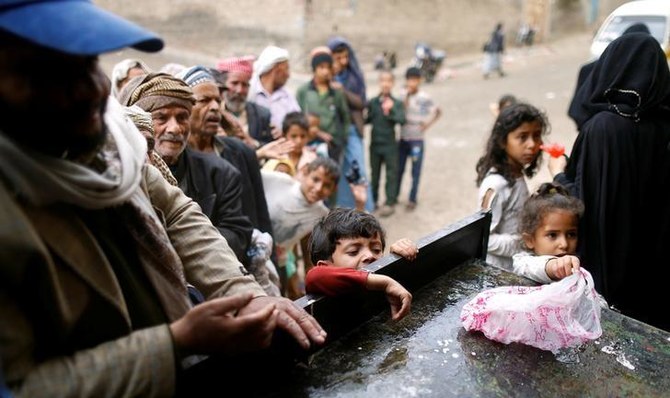
NEW YORK: UN Secretary-General Antonio Guterres warned on Friday that war-torn Yemen “is now in imminent danger of the worst famine the world has seen for decades.”
Guterres warning comes as the United States threatens to blacklist Yemen’s Iran-allied Houthi militia as part of its “maximum pressure” campaign against Tehran. Aid workers have raised fears such a move would prevent life-saving aid reaching the country.
“I urge all those with influence to act urgently on these issues to stave off catastrophe, and I also request that everyone avoids taking any action that could make the already dire situation even worse,” Guterres said in a statement.
An Arab coalition intervened in Yemen in 2015, backing government forces fighting the Houthis. UN officials are trying to revive peace talks to end the war as the country’s suffering is also worsened by an economic and currency collapse and the COVID-19 pandemic.
“In the absence of immediate action, millions of lives may be lost,” Guterres said.
The United Nations describes Yemen as the world’s largest humanitarian crisis, with 80% of the people in need of help.
A senior Western diplomat said a designation of the Houthis by the United States designated the Houthis “would certainly not contribute to progress on Yemen.” “It’s likely that they want to do whatever it takes to increase the pressure on Iran,” said the diplomat, speaking on condition of anonymity.
UN aid chief Mark Lowcock has said the United Nations has received less than half of what it needed this year — about $1.5 billion — for its humanitarian operations in Yemen. Last year it received $3 billion.
The Human Rights Office in Sanaa said the Houthi militia committed more than 24,000 violations against children, including murder, kidnapping and recruitment, Al Arabiya reported.
“We call on the international community to protect the children of Yemen from Houthi violations,” the office said.
Meanwhile, Saudi Ambassador to Yemen Mohammed bin Saeed Al-Jaber said that the Kingdom will resume its consular work at the embassy after a suspension due to the coronavirus pandemic.
The ambassador said in a tweet that the move was part of the Kingdom’s initiatives to support the Yemeni people in all governorates to provide them with job opportunities.
Al-Jaber also said that from mid-2018 up until the COVID-19 pandemic, the embassy issued more than 135,000 work visas, which have helped them “take care of their families in Yemen and transfer hard currency to support the Yemeni economy.”
(With Reuters)

UN chief warns Yemen in imminent danger of famine
Short Url
https://arab.news/wguvg
UN chief warns Yemen in imminent danger of famine
- US threatens to blacklist Houthis as part of its ‘maximum pressure’ campaign against Iran
- UN officials are trying to revive peace talks to end the war
MSF calls Israeli ban a ‘grave blow’ to Gaza aid
- Doctors Without Borders is among 37 foreign humanitarian organizations banned from the territory
- The group, which has hundreds of staff in Gaza, says: 'Denying medical assistance to civilians is unacceptable'
JERUSALEM: International charity Doctors Without Borders Friday condemned a “grave blow to humanitarian aid” after Israel revoked the status it needs to operate in Gaza for refusing to share Palestinian staff lists.
Israel on Thursday confirmed it had banned access to the Gaza Strip to 37 foreign humanitarian organizations for refusing to share lists of their Palestinian employees.
Doctors Without Borders (MSF), which has 1,200 staff members in the Palestinian territories, the majority of them in Gaza, said in a statement that “denying medical assistance to civilians is unacceptable under any circumstances.”
The medical organization argued that it had “legitimate concerns” over new Israeli requirements for foreign NGO registration, specifically the disclosing of personal information about Palestinian staff.
It pointed to the fact that 15 MSF staff had been “killed by Israeli forces,” and that access to any given territory should not be conditional on staff list disclosure.
“Demanding staff lists as a condition for access to territory is an outrageous overreach,” the charity said.
MSF also denounced “the absence of any clarity about how such sensitive data will be used, stored, or shared,” charging that Israeli forces “have killed and wounded hundreds of thousands of civilians” in Gaza during the course of the war.
It also charged that Israel had “manufactured shortages of basic necessities by blocking and delaying the entry of essential goods, including medical supplies.”
Israel controls and regulates all entry points into Gaza, which is surrounded by a wall that began to be built in 2005.
Felipe Ribero, MSF head of mission in the Palestinian territories, told AFP that all of its operations were still ongoing in Gaza.
“We are supposed to leave under 60 days, but we don’t know whether it will be three or 60 days” before Israeli authorities force MSF to leave, he said.
Prominent humanitarian organizations hit by the Israeli ban include the Norwegian Refugee Council (NRC), World Vision International and Oxfam, according to an Israeli ministry list.
The ban, which came into effect on December 31, 2025 at midnight, has triggered widespread international condemnation.
Israel says the new regulation aims to prevent bodies it accuses of supporting terrorism from operating in the Palestinian territories.
MSF says it currently supports one in five hospital beds in Gaza and assists one in three mothers in the territory, and urged the Israeli authorities to meet to discuss the ban.
Israel on Thursday confirmed it had banned access to the Gaza Strip to 37 foreign humanitarian organizations for refusing to share lists of their Palestinian employees.
Doctors Without Borders (MSF), which has 1,200 staff members in the Palestinian territories, the majority of them in Gaza, said in a statement that “denying medical assistance to civilians is unacceptable under any circumstances.”
The medical organization argued that it had “legitimate concerns” over new Israeli requirements for foreign NGO registration, specifically the disclosing of personal information about Palestinian staff.
It pointed to the fact that 15 MSF staff had been “killed by Israeli forces,” and that access to any given territory should not be conditional on staff list disclosure.
“Demanding staff lists as a condition for access to territory is an outrageous overreach,” the charity said.
MSF also denounced “the absence of any clarity about how such sensitive data will be used, stored, or shared,” charging that Israeli forces “have killed and wounded hundreds of thousands of civilians” in Gaza during the course of the war.
It also charged that Israel had “manufactured shortages of basic necessities by blocking and delaying the entry of essential goods, including medical supplies.”
Israel controls and regulates all entry points into Gaza, which is surrounded by a wall that began to be built in 2005.
Felipe Ribero, MSF head of mission in the Palestinian territories, told AFP that all of its operations were still ongoing in Gaza.
“We are supposed to leave under 60 days, but we don’t know whether it will be three or 60 days” before Israeli authorities force MSF to leave, he said.
Prominent humanitarian organizations hit by the Israeli ban include the Norwegian Refugee Council (NRC), World Vision International and Oxfam, according to an Israeli ministry list.
The ban, which came into effect on December 31, 2025 at midnight, has triggered widespread international condemnation.
Israel says the new regulation aims to prevent bodies it accuses of supporting terrorism from operating in the Palestinian territories.
MSF says it currently supports one in five hospital beds in Gaza and assists one in three mothers in the territory, and urged the Israeli authorities to meet to discuss the ban.
© 2026 SAUDI RESEARCH & PUBLISHING COMPANY, All Rights Reserved And subject to Terms of Use Agreement.