

Burkina Faso to vote in shadow of extremist threat

1 / 4
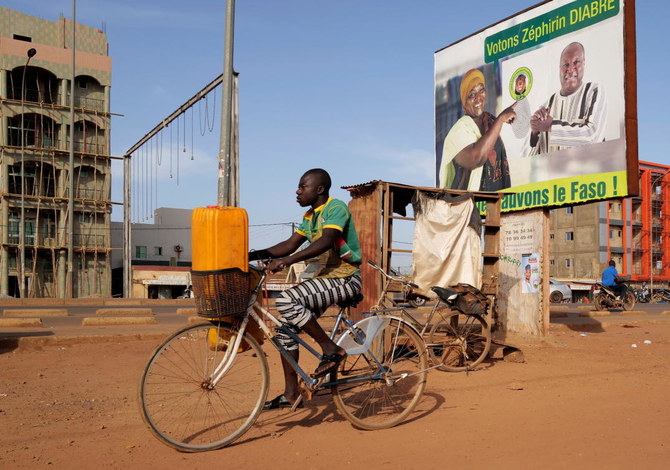
A man rides a bicycle past a campaign poster of presidential candidate Zephirin Diabre in Ouagadougou, Burkina Faso, November 20, 2020. (Reuters)
2 / 4
Women and children who fled from militant attacks in Soum province, sit on a pile of rocks that they will turn into powder for sale to construction workers, Ouagadougou, Burkina Faso, Nov. 19, 2020. (Reuters)
3 / 4
Burkina Faso President Roch Kabore attends a campaign rally in Bobo-Dioulasso, Nov. 5, 2020. (AP Photo)
4 / 4
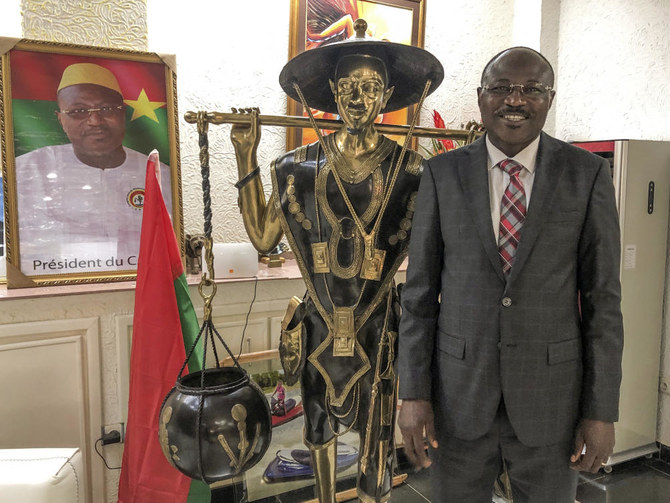
Burkina Faso’s opposition leader Eddie Komboigo, head of the Congress for Democracy and Progress party, at his office in Ouagadougou, Nov. 6, 2020. (AP Photo)
Short Url
Updated 20 November 2020
Follow

Burkina Faso to vote in shadow of extremist threat

  • Fourteen soldiers were killed in an ambush in the north claimed by the Daesh group earlier this month, one of the deadliest attacks on the military in the five-year insurgency
  • Emmanuel Macron — president of Burkina Faso’s former colonial ruler France, which has troops in the country — waded into the debate, ruling out negotiating with extremists

OUAGADOUGOU: Burkina Faso will vote in a general election Sunday in the shadow of a growing extremist insurgency, with President Roch Marc Christian Kabore expected to win re-election.

But no votes in the presidential and parliament polls will be cast in one-fifth of the country’s territory, where large swathes remain outside the state’s control and extremist attacks strike almost daily.

The violence has forced one million people — five percent of the 20 million population — from their homes in the last two years, and at least 1,200 have been killed since 2015.

The security crisis has dominated the campaign and voting will take place under heavy surveillance in the landlocked West African country, one of the world’s poorest.

Most of the 12 opposition candidates running against Kabore have criticized the incumbent’s failure to stem the bloodshed.

But the opposition did not unite behind a single candidate and Kabore is aiming for a first round victory — as he won in 2015 — to stave off a run-off vote.

He faces stiff competition from 2015’s runner-up, veteran opposition leader Zephirin Diabre, and Eddie Komboigo, standing for the party of former president Blaise Compaore.

Compaore, who was ousted by a popular uprising in 2014 after 27 years in power, is now in exile but some voters are nostalgic for his regime.

Komboigo told a rally in the capital Ouagadougou Friday that Compaore would “return with all honors,” praising his “sacrifice for the development of Burkina Faso.”

Fourteen soldiers were killed in an ambush in the north claimed by the Daesh group earlier this month, one of the deadliest attacks on the military in the five-year insurgency.

Days later, the Daesh propaganda arm published a picture of two extremists killing a man wearing an army uniform — but the military denied there had been a new attack.

Extremist violence in the north — as in neighboring Sahel states Mali and Niger — has become intertwined with clashes between ethnic groups.

The Fulani community has in particular been targeted for recruitment by extremists, and attacks regularly spark reprisal attacks, continuing the cycle of violence.

Humanitarian groups have condemned massacres of Fulani civilians by pro-government militias or the army.

Despite regularly claiming successes, the poorly equipped and trained army has slumped from loss to loss.

Security expert Mahamoudou Savadogo told AFP that the initial diagnosis of the threat “was poor and the response was neither adequate nor appropriate.”

Almost all of Kabore’s challengers have called for dialogue with the extremists to be explored — a suggestion Kabore has emphatically rejected.

Diabre said that “military action on its own has never been able to defeat terrorism in any part of the world.”

“Alongside military action, there must be other actions.”

Emmanuel Macron — president of Burkina Faso’s former colonial ruler France, which has troops in the country — waded into the debate on Friday, ruling out negotiating with extremist groups in the Sahel.

“We don’t talk with terrorists. We fight,” he said in an interview.

One of Kabore’s efforts has been the creation earlier this year of volunteer militias supervised by the state, called Volunteers for the Defense of the Nation (VDP).

Their role in Sunday’s election remains unclear, but a Western source in Ouagadougou said the presidential party “could be accused of using its troops” to push for Kabore votes.

A VDP leader in a central region assured that the militia will remain “neutral.”

“We will be there to support the army and protect polling stations,” the VDP leader said.

Political scientist Drissa Traore said that because the opposition “did not manage to unite behind a single candidate,” Kabore hopes to get more than 50 percent of the vote on Sunday to avoid facing only one of them in a in a second round.

Throughout the campaign, Kabore has promised to restore peace.

“Once the election is over, we will take care of serious matters,” he said in a meeting.

Around 6.5 million people will vote in Sunday’s election, with enrolment not taking place in nearly 1,500 of the country’s 8,000 villages, nor in 22 of more than 300 communes, because of the security risks.


Maduro’s fall tests Venezuela’s ruling ‘club’

Updated 5 sec ago
Follow

Maduro’s fall tests Venezuela’s ruling ‘club’

  • The ousting of Nicolas Maduro as Venezuela’s president puts to the test his “Chavista” factions that have governed the oil-rich nation for 27 years
CARACAS: The ousting of Nicolas Maduro as Venezuela’s president puts to the test his “Chavista” factions that have governed the oil-rich nation for 27 years.
What happens to the so-called “club of five” powerful leftist figures, now that two of its most important members — Maduro and his wife Cilia Flores — have been captured and sent to the United States to face trial?

’Club of five’
Anointed by his mentor Hugo Chavez before the latter’s death in 2013, Maduro kept a tight grip on power until his capture by US forces on Saturday.
Maduro ruled alongside Flores and three other powerful figures: former vice president Delcy Rodriguez — now Venezuela’s interim leader — her brother Jorge, and their rival: hard-line Interior Minister Diosdado Cabello.
“It’s like a club of five,” a diplomatic source in Caracas told AFP under the condition of anonymity.
“They can speak, they have a voice in the government, but Maduro was the one who kept the balance. Now that he’s gone, who knows?“
Maduro and ‘Super Cilita’
The image of Maduro handcuffed and blindfolded as US forces transported him to New York to face trial made headlines around the world.
During months in the crosshairs of US President Donald Trump, who accused him of being a drug trafficker, the 63-year-old former bus driver deflected pressure by dancing to techno music at near-daily rallies, always broadcast live, as he chanted the mantra “No war, yes peace!” — in English.
Frequently underestimated, Maduro managed to eliminate internal resistance and keep the opposition at bay.
Murals, songs and films celebrated him, as did the animated cartoon “Super Moustache,” in which he appeared as a superhero, fighting imperialism alongside “Super Cilita,” who is based on Flores.
Toy figurines of both characters were also produced.
The military swore absolute loyalty to him, led by Defense Minister Vladimir Padrino Lopez.
Though defiant at first and calling for Maduro’s return, Venezuela’s interim leader Rodriguez called for a “balanced and respectful relationship” between the South American country and the United States on Sunday.
“The top level of government has survival as its absolute priority,” Antulio Rosales, political scientist and professor at York University in Canada, told AFP.
The Rodriguez siblings
Rodriguez controlled the economy and the oil industry as vice president while her brother Jorge is the speaker of parliament.
They are known for their incendiary rhetoric, often mixing belligerence, irony and insults against the “enemies of the fatherland.”
But behind the scenes, they are skilled political operators.
Jorge Rodriguez was the chief negotiator with the opposition and the United States, and his sister represented Maduro in various international forums.
Experts also attribute purges within government to them, such as one that sent Tareck El Aissami, a powerful oil minister until 2023, to prison.
Rodriguez took over his post shortly afterwards.
The feared policeman
Diosdado Cabello meanwhile is widely feared in Venezuela. Under his ministry, some 2,400 people were detained during protests that followed Maduro’s disputed re-election in 2024, in a move that cowed the opposition.
Cabello is seen as representing the most radical wing of “Chavismo,” and some see him at odds with the pragmatism of the Rodriguez pair, though both sides have denied this.
Cabello acted as president for a few hours when Chavez was overthrown for two days in 2002.
He accompanied Chavez in a failed coup attempt in 1992. Today he is number two in the Socialist Party behind Maduro.
The US courts have now named Cabello among those wanted for trial alongside Maduro.
They have offered $25 million for his capture.
Having kept a low profile in the hours after Maduro’s capture, he appeared by Rodriguez’s side at her first cabinet meeting as acting president on Sunday.