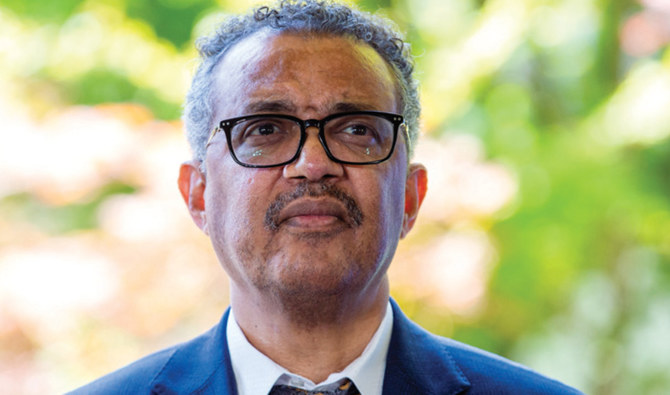
GENEVA: Ethiopia’s military accused the World Health Organization (WHO) chief Tedros Adhanom Ghebreyesus on Thursday of supporting and trying to procure arms and diplomatic backing for Tigray state’s dominant political party, which is fighting federal forces.
“He himself is a member of that group and he is a criminal,” army chief of staff Gen. Birhanu Jula said in a televised statement, before calling for him to be removed. Birhanu did not offer any evidence to support his accusations.
There was no immediate WHO comment on the allegation against Tedros, who is Ethiopian of Tigrayan ethnicity.
The accusations came at a time when the WHO is under considerable strain trying to coordinate global efforts against the COVID-19 pandemic after the US, its biggest donor, froze funding over a spat involving China. Cases and deaths are rising again in many countries around the world.
Tedros served as Ethiopia’s health minister and foreign minister from 2005-2016 in a ruling coalition led by the Tigray People’s Liberation Front (TPLF). The TPLF effectively ruled Ethiopia for decades as the most powerful part of the coalition, until Prime Minister Ahmed Abiy took office in 2018.
Abiy has since folded the other three regional parties into his own national party, but the TPLF refused to join.
Birhanu accused Tedros of using his international platform to try to get diplomatic support and weapons for the TPLF.
“He has been doing everything to support them, he has campaigned to get the neighboring countries to condemn the war. He has worked to facilitate weapons for them (the TPLF),” he said.
“He tried to lobby people by using his international profile and mission to get support for the TPLF junta.”
Birhanu did not give further specifics.
Unverified accusations from Ethiopia are not enough to remove Tedros, 55, from his post.
He was elected in May 2017 as the WHO’s first African director-general on a platform of promoting universal health care.
Earlier this year, President Donald Trump announced the US would withdraw from the WHO in July 2021 — in line with US law requiring a year’s notice — after accusing Tedros of not doing enough to hold China to account for what Trump described as initial attempts to cover up the COVID-19 outbreak.
Tedros has dismissed the suggestions, saying: “We are close to every nation, we are color-blind.”
The US was the biggest overall donor to the Geneva-based WHO, contributing more than $400 million in 2019, roughly 15 percent of its budget.

Ethiopia accuses WHO chief Tedros of backing Tigray rebels
Short Url
https://arab.news/gssja
Ethiopia accuses WHO chief Tedros of backing Tigray rebels
US NATO envoy says allies must ‘pull weight’ after Czech defense cut
PRAGUE, March 12 : The United States’ ambassador to NATO said on Thursday that all allies must “pull their weight,” after Czech lawmakers approved a 2026 budget that cuts defense outlays.
Czech Prime Minister Andrej Babis’ government, in power since December, pushed a revamped budget through the lower house on Wednesday evening which cut the defense ministry’s allocation versus a previous proposal to 154.8 billion crowns ($7.31 billion), or 1.73 percent of gross domestic product.
That is below a NATO target of 2 percent of GDP already expected before alliance members pledged last year in the Hague to raise defense spending to 3.5 percent of GDP plus 1.5 percent on other defense-relevant investments over the next decade.
The Czech Finance Ministry says total defense spending in the budget will reach 2.07 percent of GDP, but the country’s budget watchdog has warned that includes money earmarked elsewhere, like for the transport ministry for road projects, that may not be recognized by NATO.
“All Allies must pull their weight and honor The Hague Defense Commitment,” US Ambassador to NATO Matthew Whitaker said on X on Thursday with a picture of a news headline on the Czech budget approval.
“These numbers are not arbitrary. They are about meeting the moment — and the moment requires 5 percent as the standard. No excuses, no opt-outs.”
European NATO countries are under pressure to raise defense spending amid the Ukraine-Russia war and at US President Donald Trump’s urging.
Babis, whose populist ANO party won elections last year, said in February the country was “certainly not” on the path to raising core defense spending to the 3.5 percent target, saying there was a different focus, like on health care.
The budget watchdog on Thursday reiterated “strong doubts” that some spending deemed defense in this year’s budget would meet NATO’s definition.
President Petr Pavel, a former NATO official, has also said defense cuts risked a loss of trust from allies — but has signalled he would not veto the budget.
US Ambassador to Prague Nicholas Merrick said last week the Czech Republic may slip to the bottom of NATO’s defense-spending ranks.
Czech Prime Minister Andrej Babis’ government, in power since December, pushed a revamped budget through the lower house on Wednesday evening which cut the defense ministry’s allocation versus a previous proposal to 154.8 billion crowns ($7.31 billion), or 1.73 percent of gross domestic product.
That is below a NATO target of 2 percent of GDP already expected before alliance members pledged last year in the Hague to raise defense spending to 3.5 percent of GDP plus 1.5 percent on other defense-relevant investments over the next decade.
The Czech Finance Ministry says total defense spending in the budget will reach 2.07 percent of GDP, but the country’s budget watchdog has warned that includes money earmarked elsewhere, like for the transport ministry for road projects, that may not be recognized by NATO.
“All Allies must pull their weight and honor The Hague Defense Commitment,” US Ambassador to NATO Matthew Whitaker said on X on Thursday with a picture of a news headline on the Czech budget approval.
“These numbers are not arbitrary. They are about meeting the moment — and the moment requires 5 percent as the standard. No excuses, no opt-outs.”
European NATO countries are under pressure to raise defense spending amid the Ukraine-Russia war and at US President Donald Trump’s urging.
Babis, whose populist ANO party won elections last year, said in February the country was “certainly not” on the path to raising core defense spending to the 3.5 percent target, saying there was a different focus, like on health care.
The budget watchdog on Thursday reiterated “strong doubts” that some spending deemed defense in this year’s budget would meet NATO’s definition.
President Petr Pavel, a former NATO official, has also said defense cuts risked a loss of trust from allies — but has signalled he would not veto the budget.
US Ambassador to Prague Nicholas Merrick said last week the Czech Republic may slip to the bottom of NATO’s defense-spending ranks.
© 2026 SAUDI RESEARCH & PUBLISHING COMPANY, All Rights Reserved And subject to Terms of Use Agreement.


