

Pandemic adds to Italy migrant burden, minister says

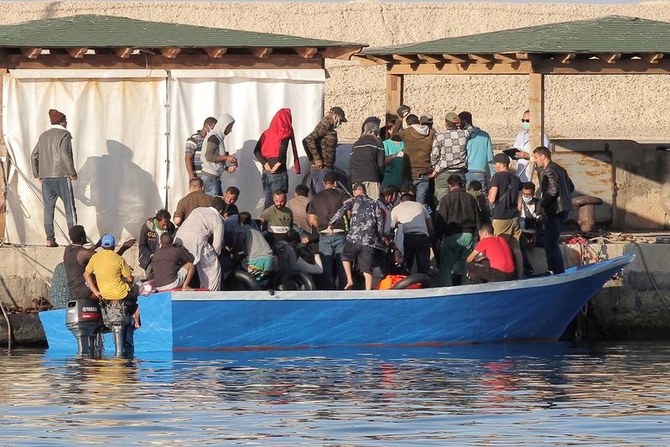
Migrants disembark a boat on the Sicilian Island of Lampedusa, Italy, July 24, 2020. (Reuters)
Short Url
Updated 19 November 2020
Follow

Pandemic adds to Italy migrant burden, minister says

  • Interior Minister Luciana Lamorgese: Facing the influx has been made more complicated by the pandemic
  • Lamorgese: Once they arrive in Italy, we organize repatriations – that’s the only way we have to save lives and avoid tragedies

ROME: North African migrant arrivals in Italy have trebled this year, with about 40 percent originating from Tunisia, the Italian government has said.

During questions in the Italian Chamber of Deputies, Interior Minister Luciana Lamorgese said: “Facing the influx has been made more complicated by the pandemic.”

She added that migrant arrivals in Italy increased to 32,000 this year, with a reported 38.7 percent of the new arrivals from Tunisia.

“Numbers of repatriations are always limited compared with the number of migrants arrivals,” she said.

There were 2,988 readmissions carried out this year, including 1,564 to Tunisia.

About 1,200 people were transferred following “the agreement recently signed between Italian and Tunisian authorities that allowed 10 additional flights on top of the usual two that are scheduled every month for repatriation purposes,” Lamorgese added.

“We are the border country with the most positive feedback in terms of readmissions,” she told the Italian Parliament.

The minister also mentioned the issue of illegal migrants in the so-called “CPR” migrant detention and repatriation centers. Sicily is home to many of the centers, as is the island of Lampedusa, which is easily reached from Tunisia.

The centers have faced severe overcrowding in recent months, with only 1,525 spaces available nationwide. Several NGOs have criticized the situation in statements to the Italian press.

Lamorgese said the overcrowding issue can be blamed on Italian legislation that allows detention of migrants for up to 180 days for identification and asylum request purposes.

The minister is planning to draft a law that will reduce the 180-day time period, but warned that existing infrastructure is “insufficient for the numbers on Italian territory and more CPR centers will need to be set up.”

Lamorgese said that during an EU Council of Interior Ministers meeting she “asked for agreements at a European level with African countries to have more impact on repatriations.”

She added that she was “absolutely satisfied” with a new pact on migration and asylum designed by the European Commission to replace the Dublin regulation.

However, she said: “This new pact does not satisfy the countries of first arrival. There are issues that we are bringing forward as part of our negotiations, but I think it will be difficult to conclude something beyond general guidelines. We still need intense negotiations on single aspects by European countries.”

The minister also announced that a new meeting with Tunisian authorities on migration issues “could take place in December.”

She will renew a proposal for cooperation with the Tunisian Coast Guard so that migrants can be rescued by the Italian military after being alerted of departures.

“Once they arrive in Italy, we organize repatriations. That’s the only way we have to save lives and avoid tragedies,” she said.

Lamorgese said that regular migration flow “should be encouraged at a government level in order to decrease the relevance of criminal networks that traffic human beings.”

She also reiterated the parliamentary majority supporting Prime Minister Giuseppe Conte’s work to lift the cap on the number of migrants allowed into Italy.

The cap was set two years ago by her predecessor in the Interior Ministry, the anti-migrant leader of the Northern League party Matteo Salvini.

The coronavirus pandemic has also been a “complicating factor for all states,” the minister said.

She said Italy has five quarantine ships on the Sicilian coast housing 2,730 people.

As of Nov. 17, 9 percent of people on quarantine ships had tested positive for coronavirus, while 1.56 percent tested positive in hosting centers.

Ben & Jerry’s risks ‘destruction’ under parent company Magnum, co-founder says

Updated 4 sec ago
Follow

Ben & Jerry’s risks ‘destruction’ under parent company Magnum, co-founder says

  • Ben Cohen’s remarks part of long-running dispute over ice cream maker’s freedom to pursue social mission
  • Company has long supported pro-Palestinian cause through business operations

LONDON: The co-founder of Ben & Jerry’s has said the ice cream brand will be destroyed if it remains with parent company Magnum, the BBC reported.

Ben Cohen’s remarks are the latest in a longtime feud between Ben & Jerry’s and Magnum over the former’s freedom to pursue its social mission and retain independence over its board.

The Magnum Ice Cream Co. on Monday began trading on the European stock market after spinning off from owner Unilever.

Magnum wants to strengthen Ben & Jerry’s “powerful, nonpartisan values-based position in the world,” a spokesperson said.

In 2000, Ben & Jerry’s was sold to Unilever as part of a deal that saw it retain an independent board and the right to pursue its social mission.

But the deal led to clashes between the Vermont, US brand and its owner.

The feud has now been inherited by Magnum.

Ben & Jerry’s has long supported the Palestinian cause. In 2021 it prohibited the sale of its products in areas occupied by Israel.

In response, its Israeli operation was sold by Unilever to a local licensee.

In October, Cohen said the brand was prevented from launching an ice cream product that expressed “solidarity with Palestine.”

Ahead of its spin-off from Unilever last month, Magnum said that Anuradha Mittal, chair of Ben & Jerry’s, “no longer met the criteria to serve.”

Mittal has held the position since 2018 but was encouraged to resign following an internal audit conducted by Magnum, which found a “series of material deficiencies in financial controls, governance and other compliance policies, including conflicts of interest,” according to a spokesperson.

“So far, the trustees have not fully addressed the deficiencies identified.”

Mittal, speaking to Reuters, said: “The so-called audit of the foundation was a manufactured inquiry, engineered to attempt to discredit me.

“It is important to understand that this is not simply an attack on me as chair, it is Unilever’s attempt to undermine the authority of the board itself.”

Cohen said that Magnum had “no standing to determine who the chair of the independent board should be.”

“Therefore, by trying to (change the chair of the board), I would say that Magnum is not fit to own Ben & Jerry’s.”

Ben & Jerry’s must be either owned by a “group of investors that support the brand” and sought to encourage its values, or Magnum should make a “180-degree turnaround and say they support the chairman of the independent board,” Cohen said.

Mittal said she had no plans to step down from the board ahead of Magnum’s share market entry this week.

Cohen is still an employee of Ben & Jerry’s and is the most high-profile spokesperson for the brand. But he told the BBC that under Magnum’s ownership, the ice cream maker could end up losing its most “loyal” customers.

“If the company continues to be owned by Magnum, not only will the values be lost but the essence of the brand will be lost,” he said.

Magnum CEO Peter ter Kulve told the Financial Times on Sunday that Ben & Jerry’s founders — Cohen and Jerry Greenfield — were in their 70s and “at a certain moment they need to hand over to a new generation.”

Greenfield left the company this year over concerns that its social mission was being stifled.

Cohen said: “As they destroy Ben and Jerry’s values, they will destroy that following and they will destroy that brand. It’ll become just another piece of frozen mush that is just going to lose a lot of market share.”
