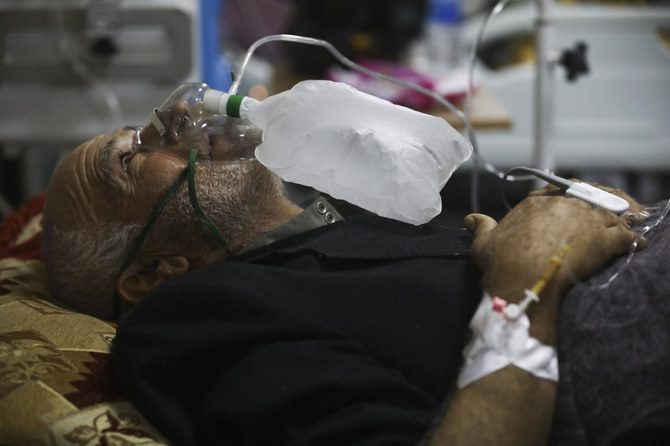
IDLIB, Syria: Nurses hover over a patient to insert a breathing tube as his condition suddenly deteriorates. ICU beds fill up almost overnight. As one patient dies of the coronavirus and is wheeled out, another is whisked in to take his place. An exhausted doctor leans against a wheelchair for a breather.
The pace is dizzying at the largest isolation hospital in Syria’s northwestern city of Idlib. There are no bombs falling outside and the wounded don’t crowd bloodstained corridors amid a shaky cease-fire in the country’s decade old civil war. Still, the intensive care unit staff is overwhelmed with beds full of elderly patients gasping for air.
COVID-19 infections in the last opposition-controlled territory in Syria have been increasing rapidly. Spared until July, the region is now recording 300-500 infections a day, and the number is rising fast.
The area, battered by repeated military offensives from the government of President Bashar Assad, is home to nearly 4 million people, most of them displaced and living in tent camps or unfinished buildings.
Infection rates jumped nearly twentyfold between September and October, the UN said. Since then, it has climbed 300 percent, with nearly 11,900 cases recorded by Nov. 16, up from 8,100 a week earlier.
The number of infections is probably much higher. Cities have been hit hardest, but workers fear the virus will take hold in overcrowded camps.
“There are many patients, most in very bad condition. We have no time to give them all they need,” said Aref Shabib, one of over 95 nurses and technicians in the 70-bed isolation hospital, one of two in the city of Idlib, now a virus hot spot.
The pandemic, which has severely tested even developed countries, is the biggest challenge yet for Syria’s health sector, already depleted by years of conflict. Authorities are pacing themselves, deploying equipment and supplies where needed in war-scarred areas.
Announcements of virus deaths on social media or mosque loudspeakers compete with posters honoring those killed in battle, with 95 fatalities linked to COVID-19.
As winter rains began, bringing with it renewed rumblings of war, fear is growing that exhausted medical teams may not be able to cope.
Nearly 17 percent of infections were among health workers, who were first to get the virus. At least three doctors and an administrator died. Medical workers who survived the battlefield find themselves fighting an invisible enemy that pushes their resilience to new limits.
Unlike the war wounded, an entire 24-hour shift can be devoted to just one COVID-19 patient, said Shabib, the ICU specialist.
“We could work for six or eight hours nonstop without even sitting down. It is very hard work,” he said.
In northwestern Syria, which has been outside government control for most of the last decade, dispersing aid is as complicated as the politics of the conflict.
According to the UN task force coordinating efforts, there are at least 142 ICU beds and 155 breathing machines in use in the area. The plan is to eventually have 219 ICU beds and 162 machines. Nearly 500 doctors and nurses are working in COVID-19 centers.
Seven of eight hospitals in northwestern Syria that are equipped to treat the virus are already overwhelmed.
“The increase in COVID infections, cases of hospitalization and nearing full occupancy of ICUs, brings us closer to a state of emergency,” said Salem Abdan, head of Idlib’s health directorate.

Coronavirus threat ‘a new terror’ in Syria’s scarred Idlib region
https://arab.news/p3eb2
Coronavirus threat ‘a new terror’ in Syria’s scarred Idlib region
- Pace is dizzying at the largest isolation hospital in Syria’s northwestern city of Idlib
- COVID-19 infections in the last opposition-controlled territory in Syria have been increasing rapidly
Israel confirms ban on 37 NGOs in Gaza
- UN has warned that this will exacerbate the humanitarian crisis in the war-ravaged Palestinian territory
- Several NGOS have said the requirements contravene international humanitarian law or endanger their independence
JERUSALEM: Israel on Thursday said 37 humanitarian agencies supplying aid in Gaza had not met a deadline to meet “security and transparency standards,” and would be banned from the territory, despite an international outcry.
The international NGOs, which had been ordered to disclose detailed information on their Palestinian staff, will now be required to cease operations by March 1.
The United Nations has warned that this will exacerbate the humanitarian crisis in the war-ravaged Palestinian territory.
“Organizations that have failed to meet required security and transparency standards will have their licenses suspended,” Israel’s Ministry of Diaspora Affairs and Combating Antisemitism said in a statement.
Several NGOS have said the requirements contravene international humanitarian law or endanger their independence.
Israel says the new regulation aims to prevent bodies it accuses of supporting terrorism from operating in the Palestinian territories.
Prominent humanitarian organizations hit by the ban include Doctors Without Borders (MSF), the Norwegian Refugee Council (NRC), World Vision International and Oxfam, according to a ministry list.
In MSF’s case, Israel accused it of having two employees who were members of Palestinian militant groups Islamic Jihad and Hamas.
MSF said this week the request to share a list of its staff “may be in violation of Israel’s obligations under international humanitarian law” and said it “would never knowingly employ people engaging in military activity.”
‘Critical requirement’
NRC spokesperson Shaina Low told AFP its local staff are “exhausted” and international staff “bring them an extra layer of help and security. Their presence is a protection.”
Submitting the names of local staff is “not negotiable,” she said. “We offered alternatives, they refused,” hse said, of the Israeli regulators.
The ministry said Thursday: “The primary failure identified was the refusal to provide complete and verifiable information regarding their employees, a critical requirement designed to prevent the infiltration of terrorist operatives into humanitarian structures.”
In March, Israel gave NGOs 10 months to comply with the new rules, which demand the “full disclosure of personnel, funding sources, and operational structures.”
The deadline expired on Wednesday.
The 37 NGOs “were formally notified that their licenses would be revoked as of January 1, 2026, and that they must complete the cessation of their activities by March 1, 2026,” the ministry said Thursday.
A ministry spokesperson told AFP that following the revocation of their licenses, aid groups could no longer bring assistance into Gaza from Thursday.
However, they could have their licenses reinstated if they submitted the required documents before March 1.
Minister of Diaspora Affairs and Combating Antisemitism Amichai Chikli said “the message is clear: humanitarian assistance is welcome — the exploitation of humanitarian frameworks for terrorism is not.”
‘Weaponization of bureaucracy’
On Thursday, 18 Israel-based left-wing NGOs denounced the decision to ban their international peers, saying “the new registration framework violates core humanitarian principles of independence and neutrality.”
“This weaponization of bureaucracy institutionalizes barriers to aid and forces vital organizations to suspend operations,” they said.
UN Palestinian refugee agency chief Philippe Lazzarini had said the move sets a “dangerous precedent.”
“Failing to push back against attempts to control the work of aid organizations will further undermine the basic humanitarian principles of neutrality, independence, impartiality and humanity underpinning aid work across the world,” he said on X.
On Tuesday, the foreign ministers of 10 countries, including France and Britain, urged Israel to “guarantee access” to aid in the Gaza Strip, where they said the humanitarian situation remains “catastrophic.”
A fragile ceasefire has been in place since October, following a deadly war waged by Israel in response to Hamas’s unprecedented October 7, 2023 attack on Israel.
Nearly 80 percent of buildings in Gaza have been destroyed or damaged by the war, according to UN data.
About 1.5 million of Gaza’s more than two million residents have lost their homes, said Amjad Al-Shawa, director of the Palestinian NGO Network in Gaza.


