New Zealand police introduce hijab for female Muslim officers

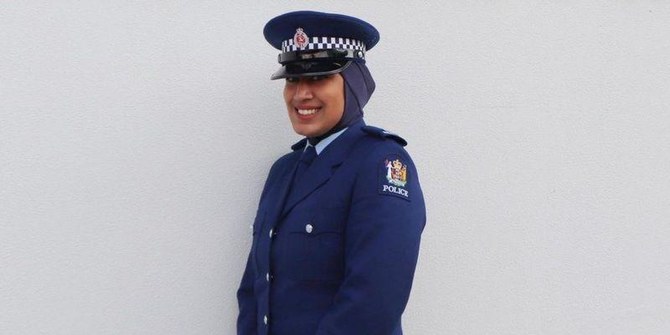
Constable Zeena Ali will become the first member of New Zealand Police to wear the hijab as part of her uniform. (New Zealand Police Instagram)
Short Url
Updated 18 November 2020
Follow

New Zealand police introduce hijab for female Muslim officers

  • Ali said that she had taken part in the design process for the hijab
  • She said the introduction of the hijab means Muslim women “who may not have previously considered policing can do so now”

LONDON: New Zealand’s police force has introduced a hijab option in its official uniform in a bid to encourage more Muslim women to join the service.
Constable Zeena Ali will become the force’s first member to wear the specially designed hijab as part of her uniform.
Ali, who gained her current rank in the wake of the Christchurch terror attack, said the introduction of the hijab means Muslim women “who may not have previously considered policing can do so now.”
“I was training to enter the police service when the Christchurch terror attack happened. If I has been a fully fledged constable then, I would have gone down to support the victims and their families,” she said.
Ali said that she had taken part in the design process for the hijab, and was grateful to the Royal New Zealand Police College staff for organizing halal meals and making a prayer room available during her training.
“I am thrilled the police went out of their way to make sure the hijab I have meets health and safety requirements as well as my own personal needs.”
The UK’s London Metropolitan Police approved a uniform hijab in 2001, with Police Scotland following 15 years later.
Victorian policewoman Maha Sukkar was the first officer in Australia to wear a hijab as part of her uniform in 2004.


Indonesia’s new state mosque to hold first Eid prayers this year

Worshippers pray at Masjid Negara in Nusantara, East Kalimantan for the first taraweeh this year on Feb. 18, 2025. (OIKN)
Updated 57 min 20 sec ago
Follow

Indonesia’s new state mosque to hold first Eid prayers this year

  • Mosque is located in Nusantara Capital City on Borneo island, a $32bn project set for 2045 completion
  • Famous sculptor Nyoman Nuarta designed mosque, other government structures in new capital

JAKARTA: The state mosque in Indonesia’s planned new capital city, Nusantara, will hold its inaugural Eid Al-Fitr prayer this year, as the $62 million facility opens for its first run of Ramadan programs.

The Indonesian government has plans to relocate the capital to Borneo island to replace the overcrowded and sinking Jakarta on Java island, with the $32 billion megaproject scheduled for completion in 2045.

With a capacity of about 60,000 people, the mosque in East Kalimantan opened to the public last month, at the beginning of Ramadan.

“This mosque symbolizes that we are building the Nusantara Capital City with careful attention to spiritual, social and environmental aspects,” Troy Pantouw, spokesperson for the Nusantara Capital City Authority — the agency overseeing the new capital city — told Arab News on Saturday.

“We will hold Eid Al-Fitr prayers here and we are hoping that it would mark a historic momentum of unity here at Nusantara Capital City.”

Locally known as Masjid Negara, construction of the state mosque began in 2024. Its design was spearheaded by Balinese sculptor Nyoman Nuarta at the request of former President Joko Widodo.

Nuarta is one of Indonesia’s most famous visual artists and creator of the country’s tallest statue, Garuda Wisnu Kencana, located in Bali.

The 72-year-old is also the designer behind other main structures in Nusantara, including the new state palace.

This Ramadan marked many firsts for Masjid Negara, including its first taraweeh on Feb. 18, which was attended by thousands of worshippers in East Kalimantan.

In the same complex where the state mosque is located, the government has plans to build Christian churches, and Buddhist, Hindu and Confucian temples.

Indonesia, home to the world’s largest population of Muslims, officially recognizes Islam, Protestantism, Catholicism, Buddhism, Hinduism and Confucianism as religions.

“A church is now being built in the complex, and in the future there will also be houses of worship belonging to other religions. This reflects Nusantara’s values of harmony and respect,” Pantouw said.

“From the start, this area was designed to represent inter-religious harmony. We want the Nusantara Capital City to stand as a concrete example of how physical developments can be parallel to efforts to build tolerance in society.”