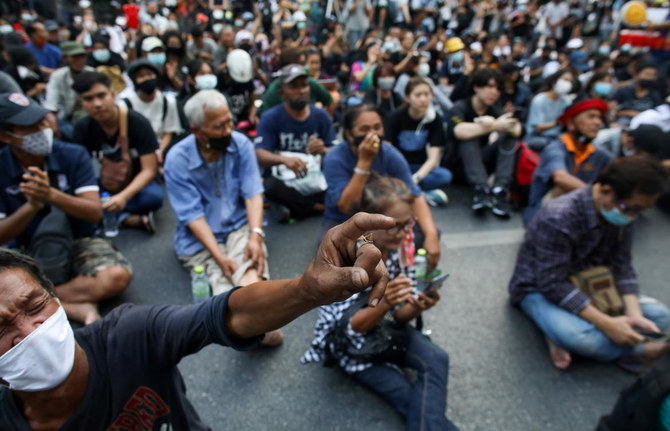
BANGKOK: Police in Thailand’s capital braced for possible trouble Wednesday, a day after a protest outside Parliament by pro-democracy demonstrators was marred by violence that left 55 people injured, including as many as six with gunshot wounds.
The protesters, enraged at what they regard as disproportionate use of force against them by police who employed chemical-laced water cannons and tear gas, gathered for another protest late Wednesday in central Bangkok.
Tuesday’s protest was held as a joint session of the House and Senate debated seven motions for amending the constitution. A vote on the motions was taking place Wednesday. Any that are passed will have to go through second and third votes after at least a month.
According to Erawan emergency services, 55 people at Tuesday’s protest were sent to hospitals, the largest number suffering from the effects of tear gas. It said four remained hospitalized Wednesday, including three of the six people it said had suffered gunshot wounds. The circumstances of the shootings were not announced.
Some of the injuries occurred during a brawl between the pro-democracy protesters and stone-throwing royalists who oppose constitutional change.
It was the worst violence during months of actions by the pro-democracy protesters, though police had previously employed water cannons at least twice. The protest movement has been staging increasingly determined mass rallies of thousands of people around the country.
Police at a news conference Wednesday spoke of only two people with gunshot wounds, and indicated that they were not responsible for them.
“We are in the process of an investigation into who might be behind the shootings,” said police deputy spokesperson Col. Kissana Phathanacharoen. “No rubber or live bullets were used by the police for yesterday’s police operation, that is confirmed.”
The planned venue of Wednesday’s protest, the Rajprasong intersection in the middle of the city’s upmarket shopping district, is just minutes away from the national police headquarters. Groups of police drilling and riot control vehicles could be seen in its courtyard Wednesday morning.
Tuesday’s protest was held to pressure lawmakers to approve the most comprehensive of the seven motions on amending the constitution. The motion, submitted by iLaw, the Internet Law Reform Dialogue, would allow all aspects of the charter to be changed, including articles dealing with the monarchy. It is almost certain to be voted down.
To Thailand’s royalist establishment, the monarchy is a untouchable institution that is the heart and soul of the nation. Public criticism of it is unprecedented, especially since a lese majeste law makes defaming the monarch and his immediate family punishable by up to 15 years’ imprisonment.
The protesters believe the monarchy holds too much power under what is supposed to be a constitutional democracy, and want to make the royal institution more transparent and accountable. They also want Prime Minister Prayuth Chan-ocha and his government to step down and for the constitution to be amended to make it more democratic, with less power given to unelected bodies such as the Senate.
Most of Tuesday’s violence occurred when police used tear gas and water cannons laced with irritating chemicals against the student-led demonstrators as they tried to push their way past barbed-wire and other barriers to enter the grounds of the legislature on the outskirts of Bangkok.
After about six hours of chaos, a protest leader, Parit “Penguin” Chiwarak, announced the end of the protest, saying the demonstrators had captured enough ground to declare they had achieved their goal of surrounding Parliament.


![]()


Thai police gird for trouble after chaotic political protest
Short Url
https://arab.news/bcgec
Thai police gird for trouble after chaotic political protest
- Tuesday’s protest was the worst violence during months of actions by the pro-democracy protesters
- Protesters believe the monarchy holds too much power under what is supposed to be a constitutional democracy


Machado seeks Pope Leo’s support for Venezuela’s transition during Vatican meeting
- Machado is touring Europe and the United States after escaping Venezuela in early 2025
- The pope called for Venezuela to remain independent following the capture of former President Nicolás Maduro by US forces
ROME: Pope Leo XIV met with Venezuelan opposition leader and Nobel Peace Prize winner María Corina Machado in a private audience at the Vatican on Monday, during which the Venezuelan leader asked him to intercede for the release of hundreds of political prisoners held in the Latin American country.
The meeting, which hadn’t been previously included in the list of Leo’s planned appointments, was later listed by the Vatican in its daily bulletin, without adding details.
Machado is touring Europe and the United States after she reemerged in December after 11 months in hiding to accept her Nobel Peace Prize in Norway.
“Today I had the blessing and honor of being able to share with His Holiness and express our gratitude for his continued support of what is happening in our country,” Machado said in a statement following the meeting.
“I also conveyed to him the strength of the Venezuelan people who remain steadfast and in prayer for the freedom of Venezuela, and I asked him to intercede for all Venezuelans who remain kidnapped and disappeared,” she added.
Machado also held talks with Vatican Secretary of State Pietro Parolin, who was Nuncio in Venezuela from 2009 to 2013.
Pope Leo has called for Venezuela to remain an independent country after US forces captured former President Nicolás Maduro in his compound in Caracas and took him to New York to face federal charges of drug-trafficking.
Leo had said he was following the developments in Venezuela with “deep concern,” and urged the protection of human and civil rights in the Latin American country.
Venezuela’s opposition, backed by consecutive Republican and Democratic administrations in the US, had vowed for years to immediately replace Maduro with one of their own and restore democracy to the oil-rich country. But US President Donald Trump delivered them a heavy blow by allowing Maduro’s vice president, Delcy Rodríguez, to assume control.
Meanwhile, most opposition leaders, including Machado, are in exile or prison.
After winning the 2025 Nobel Prize for Peace, Machado said she’d like to give it to or share with Trump.
Machado dedicated the prize to Trump, along with the people of Venezuela, shortly after it was announced. Trump has coveted and openly campaigned for winning the Nobel Prize himself since his return to office in January 2025.
The organization that oversees the Nobel Peace Prize — the Norwegian Nobel Institute — said, however, that once it’s announced, the prize can’t be revoked, transferred or shared with others.
“The decision is final and stands for all time,” it said in a short statement last week.
The meeting, which hadn’t been previously included in the list of Leo’s planned appointments, was later listed by the Vatican in its daily bulletin, without adding details.
Machado is touring Europe and the United States after she reemerged in December after 11 months in hiding to accept her Nobel Peace Prize in Norway.
“Today I had the blessing and honor of being able to share with His Holiness and express our gratitude for his continued support of what is happening in our country,” Machado said in a statement following the meeting.
“I also conveyed to him the strength of the Venezuelan people who remain steadfast and in prayer for the freedom of Venezuela, and I asked him to intercede for all Venezuelans who remain kidnapped and disappeared,” she added.
Machado also held talks with Vatican Secretary of State Pietro Parolin, who was Nuncio in Venezuela from 2009 to 2013.
Pope Leo has called for Venezuela to remain an independent country after US forces captured former President Nicolás Maduro in his compound in Caracas and took him to New York to face federal charges of drug-trafficking.
Leo had said he was following the developments in Venezuela with “deep concern,” and urged the protection of human and civil rights in the Latin American country.
Venezuela’s opposition, backed by consecutive Republican and Democratic administrations in the US, had vowed for years to immediately replace Maduro with one of their own and restore democracy to the oil-rich country. But US President Donald Trump delivered them a heavy blow by allowing Maduro’s vice president, Delcy Rodríguez, to assume control.
Meanwhile, most opposition leaders, including Machado, are in exile or prison.
After winning the 2025 Nobel Prize for Peace, Machado said she’d like to give it to or share with Trump.
Machado dedicated the prize to Trump, along with the people of Venezuela, shortly after it was announced. Trump has coveted and openly campaigned for winning the Nobel Prize himself since his return to office in January 2025.
The organization that oversees the Nobel Peace Prize — the Norwegian Nobel Institute — said, however, that once it’s announced, the prize can’t be revoked, transferred or shared with others.
“The decision is final and stands for all time,” it said in a short statement last week.
Latest updates


© 2026 SAUDI RESEARCH & PUBLISHING COMPANY, All Rights Reserved And subject to Terms of Use Agreement.