Britain to ban new petrol cars by 2030 on road to net zero emissions

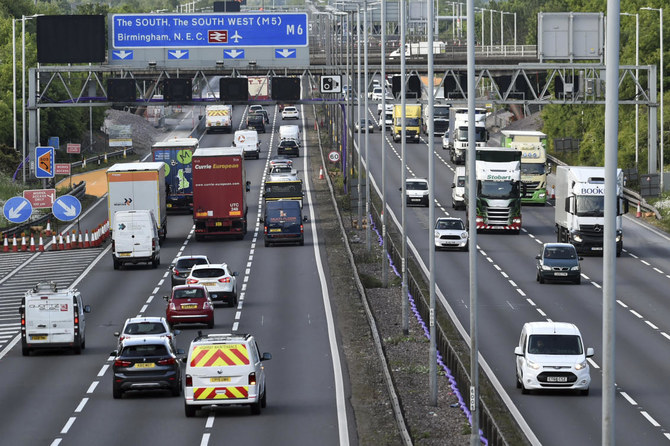
The new date for a ban on new petrol and diesel cars is five years earlier than the 2035 pledge that Prime Minister Boris Johnson made. (AP)
Short Url
Updated 18 November 2020
Follow

Britain to ban new petrol cars by 2030 on road to net zero emissions

  • Britain last year became the first G7 country to set in law a net zero emission target by 2050
  • The new date for a ban on new petrol and diesel cars is five years earlier than the 2035 pledge

LONDON: Britain will ban the sale of new petrol and diesel cars and vans from 2030, five years earlier than previously planned, as part of what Prime Minister Boris Johnson is casting as a “green revolution” to cut emissions to net zero by 2050.
Johnson, who is grappling with Europe’s most deadly COVID-19 crisis, Brexit trade negotiations and the departure of his most senior adviser, wants to underscore his green credentials as part of what he hopes will be a reset for his government.
“Now is the time to plan for a green recovery with high-skilled jobs that give people the satisfaction of knowing they are helping to make the country cleaner, greener and more beautiful,” Johnson said in a column published in the Financial Times on Tuesday.
Britain last year became the first G7 country to set in law a net zero emission target by 2050, which will require wholesale changes in the way Britons travel, use energy and eat.
In total the plan would mobilize $16 billion of government money, with as much as three times that amount coming from the private sector, and create and support 250,000 highly skilled green jobs by 2030, Johnson said.
The new date for a ban on new petrol and diesel cars is five years earlier than the 2035 pledge made by Johnson in February. The sale of hybrid cars and vans would be banned from 2035 under the new plan.
An extra $266.67 million would create industrial clusters mustering technology to capture, store and use carbon dioxide emissions by the mid-2020s. Another two hubs are projected by 2030, taking the total investment in the technology to $1.33 billion.
Johnson, who has promised to increase Britain’s offshore wind power to 40 gigawatts by 2030 from around 10 GW now, pledged up to $666.67 million for projects trialing the use of hydrogen including for home heating and cooking.
The government would also help to develop large- and small-scale nuclear plants.
Johnson’s plan was broadly welcomed by industry.
“It gives a springboard to the huge opportunities for UK-wide investment and green jobs that a true low-carbon economy can bring,” Josh Hardie, acting director at the Confederation of British Industry, said in a separate statement.


Fossils of ‘Java Man,’ first known Homo erectus, return to Indonesia

Updated 6 sec ago
Follow

Fossils of ‘Java Man,’ first known Homo erectus, return to Indonesia

  • Netherlands to repatriate more than 28,000 items in Dubois collection in 2026
  • Fossils excavated in Indonesia were ‘removed against will of people’  

JAKARTA: Prehistoric bones belonging to “Java Man” — the first known fossil evidence of Homo erectus — went on display at Indonesia’s National Museum on Thursday, more than 130 years after they were taken to the Netherlands during Dutch colonial rule.

The parts of the skeleton — a skull fragment, molar and thigh bone — were uncovered along the Bengawan Solo River on Java island in the late 19th century by Dutch anatomist and geologist Eugene Dubois. 

The three items, and a related shell that was scratched by early Homo erectus, are the first in the planned repatriation of more than 28,000 fossils and natural history objects originating in Java and Sumatra that Dubois had removed. 

“Repatriation is a national priority,” Indonesian Culture Minister Fadli Zon said during an official handover ceremony in Jakarta. 

“We bear the responsibility to protect cultural heritage, restore historical narratives and ensure public access to the cultural and scientific heritage that belongs to Indonesia.” 

Fossils of the Java Man, which was hand-carried in a GPS-tracked, climate-controlled suitcase with a diplomatic seal, were some of the first pieces of evidence showing links between apes and humans. 

The fossils are part of the larger Dubois collection that was managed by Naturalis Biodiversity Center, a 200-year-old scientific institution in Leiden. 

The rest of the collection will be transferred to Indonesia in 2026, the Dutch Embassy in Jakarta said in a statement, adding that Indonesia’s National Research and Innovation Agency will take a lead role in preserving and managing the items. 

“This handover marks the beginning of the next phase. We intend to repatriate thousands of items excavated in Indonesia over 130 years ago,” said Marcel Beukeboom, general director of Naturalis Biodiversity Center. 

“This fossil bears witness to an important link in human evolution, while also representing part of Indonesian history and cultural heritage,” he said.

Jakarta started to campaign for the Dutch government to return stolen Indonesian artifacts after declaring independence in 1945, but the Netherlands started to return stolen items only in small numbers in the 1970s. 

Recent efforts by the Indonesian Repatriation Committee have brought back home hundreds of artifacts since 2023, bringing the number to more than 2,000 items so far. 

The repatriation of the Dubois collection was first announced in September, following recommendation by the Netherlands’ Colonial Collections Committee. 

“The Colonial Collections Committee has concluded … that the Dutch state never owned the Dubois collection,” the Dutch government said in a news release issued at the time. 

“The committee believes that the circumstances under which the fossils were obtained means it is likely they were removed against the will of the people, resulting in an act of injustice against them.

“Fossils held spiritual and economic value for local people, who were coerced into revealing fossil sites.” 

The returned fossils are now a centerpiece of “Early History,” a new permanent exhibit at the National Museum in Jakarta that opened to the public on Thursday. 

It explores the history of human civilization throughout Indonesia, with displays including a replica of one of the world’s oldest cave paintings from South Sulawesi and inscriptions from the 4th-century Hindu Kutai Martadipura Kingdom in East Kalimantan.