

Pakistan PM to leave for Kabul on Thursday for talks on Afghan peace process

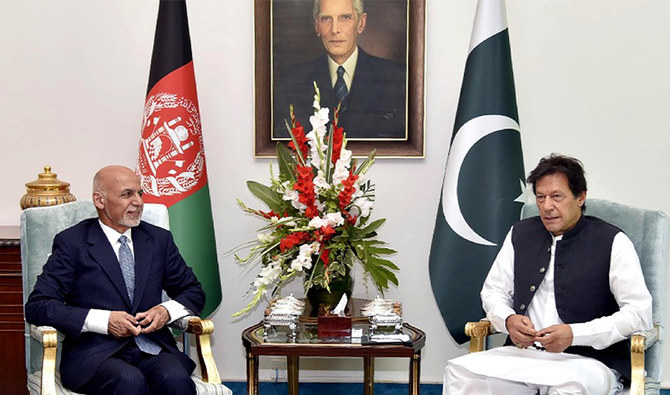
FILE PHOTO: In this handout picture released by Pakistan's Press Information Department (PID) on June 27, 2019, visiting Afghan President Ashraf Ghani (L) talks with Pakistani Prime Minister Imran Khan during a meeting in Islamabad. (AFP)
Short Url
Updated 18 November 2020
Follow

Pakistan PM to leave for Kabul on Thursday for talks on Afghan peace process

  • Kabul visit on the invitation of Afghan President Ashraf Ghani will be Imran Khan's first trip to Afghanistan since assuming office in 2018
  • PM’s adviser on commerce is already in Kabul for discussions on bilateral trade relations

ISLAMABAD: Pakistan Prime Minister Imran Khan is leaving for Afghanistan on Thursday for talks on the Afghan peace process, the PM’s office confirmed.
Khan's Kabul visit is on the invitation of Afghan President Ashraf Ghani and will be his first trip to Afghanistan since assuming office in 2018.
“The focus (of the visit) would be on further deepening the fraternal bilateral relations between Pakistan and Afghanistan, the Afghan peace process, and regional economic development and connectivity,” the PM's office said in a statement on Wednesday.
During the trip, Khan is going to meet with Ghani who visited Pakistan in June 2019. Earlier, the two leaders met on the sidelines of the 14th Organization of Islamic Cooperation Summit in Makkah in May 2019.
Foreign Minister Shah Mahmood Qureshi and the prime minister’s adviser on commerce, Abdul Razak Dawood will be in the delegation.

The prime minister will travel to Afghanistan at a time when ongoing peace negotiations between the Afghan government and the Taliban have hit a stalemate and violence is on the rise. Afghan officials and the United States — which is facilitating the peace talks — believe that Pakistan has influence over the Taliban and can convince its top leaders to move toward a ceasefire.
“The people of Pakistan and Afghanistan are linked through immutable bonds of history, faith, culture, kinship, values and traditions. The Prime Minister’s visit will help foster a stronger and multi-faceted relationship between the two brotherly countries,” the PM office's statement said.
Dawood is already in Kabul for talks on bilateral trade relations and the Afghanistan-Pakistan Transit Trade Agreement (APTTA), which allows Kabul to use Pakistan’s land to transport goods to India.
Pakistan and landlocked Afghanistan had signed a transit trade agreement in 1965 that was revised in 2010 to help facilitate movement of goods between the two countries.
The next APTTA meeting is going to take place in Islamabad in December.


US freezes immigrant visa processing for 75 countries, including Pakistan

Updated 15 January 2026
Follow

US freezes immigrant visa processing for 75 countries, including Pakistan

  • Immigrant visas to be suspended from Jan 21, tourist visas unaffected
  • Move targets “public charge” concerns as Trump revives hard-line immigration rules

ISLAMABA: The United States will pause immigrant visa issuances for nationals of 75 countries, including Pakistan, from January 21, the State Department said on Thursday, as President Donald Trump presses ahead with a hard-line immigration agenda centered on financial self-sufficiency.

In an update published on its website, the State Department said it was conducting a comprehensive review of immigration policies to ensure that migrants from what it described as “high-risk” countries do not rely on public welfare in the United States or become a “public charge.”

“The State Department will pause immigrant visa processing from 75 countries whose migrants take welfare from the American people at unacceptable rates. The freeze will remain active until the US can ensure that new immigrants will not extract wealth from the American people,” the department said.

The pause applies specifically to immigrant visas, which are issued to people seeking permanent residence in the United States. The department said applicants from affected countries may still submit applications and attend interviews, but no immigrant visas will be issued during the suspension.

According to the State Department, the affected countries include Pakistan, Afghanistan, Bangladesh, Iran, Iraq, Egypt, Nigeria, Russia, Somalia, Brazil, Thailand and dozens of others across Asia, Africa, the Middle East, Europe and Latin America.

The department said tourist and other non-immigrant visas are not affected, and that no previously issued immigrant visas have been revoked. Dual nationals applying with a valid passport from a country not on the list are exempt from the pause.

The State Department did not indicate how long the visa pause would remain in effect, saying it would continue until its review of screening and vetting procedures is completed.

The announcement underscores the breadth of the Trump administration’s renewed immigration crackdown. Since returning to office last year, Trump has revived and expanded enforcement of the “public charge” provision of US immigration law, which allows authorities to deny entry to applicants deemed likely to rely on public benefits.

During his previous term, Trump imposed sweeping travel restrictions on several Muslim-majority countries, a policy widely referred to as a “Muslim ban,” which was challenged in courts before a revised version was upheld by the Supreme Court and later rescinded under former president Joe Biden.

The visa freeze also comes amid an intensifying domestic enforcement push. US Immigration and Customs Enforcement (ICE) has expanded operations nationwide, drawing scrutiny over its tactics. Last week, an ICE agent shot and killed Renee Good, a US citizen, during a federal operation in Minneapolis, sparking protests and renewed debate over immigration enforcement under the Trump administration.