

Pakistan government confirms accepting all demands of protesting religious party

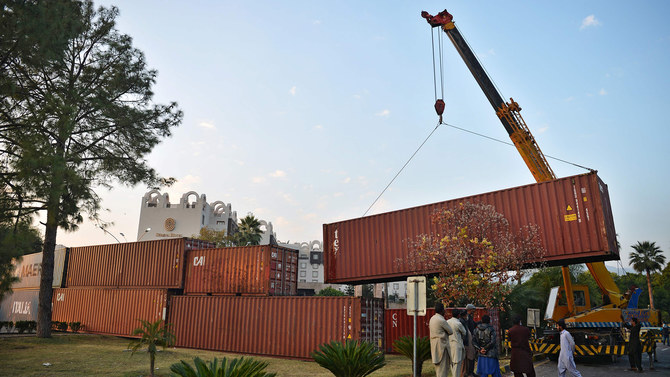
Truck drivers stand as workers remove a shipping container in front of the French consulate at the end of an anti-France demonstration by religious party Tehreek-e-Labbaik Pakistan (TLP), in Islamabad on Nov. 17, 2020. (AFP/File)
Short Url
Updated 17 November 2020
Follow

Pakistan government confirms accepting all demands of protesting religious party

  • The demands include expelling the French ambassador from Pakistan after parliamentary approval, government says will implement parliament's decision
  • Government has also agreed not to appoint new envoy to Paris, boycott all French goods officially, release arrested supporters of Tehreek-e-Labaik Pakistan

ISLAMABAD: Pakistan’s minister for religious affairs Pir Noor ul Haq Qadri confirmed on Tuesday an agreement between the government and a radical religious party, the Tehreek-e-Labaik Pakistan (TLP), saying a decision to expel the French ambassador from Pakistan as demanded by TLP would be taken by parliament and the government would implement whatever the assemblies decided. 

Tehreek-e-Labaik Pakistan, which led thousands of protesters to Islamabad for a sit-in on Sunday, released a copy of an agreement with the government on Monday night, saying it was calling off its protest after the government had agreed to meet all its demands, including that it would expel the French ambassador from Pakistan within three months.

“The decision regarding French ambassador in Pakistan will be taken by parliament as it is the biggest forum and voice of the people,” Qadri told Arab News. “The decision of the parliament will be implemented by the government.”

The Pakistani foreign office and the French embassy in Islamabad could not be reached for comment. 

The TLP-led protesters arrived on the outskirts of Islamabad on Sunday night, calling for the government to end diplomatic ties with France against the printing of images depicting the Prophet Muhammad (pbuh).

Muslims around the world have protested against France and President Emmanuel Macron, who has vowed to stand firm against what he has described as attacks on French values and freedom of expression by radicals.

TLP said the three other demands met by the government were that Pakistan would not appoint a new ambassador to France, it would work to boycott all French goods at the official level and also release all arrested supporters of the TLP.

“We don’t have any ambassador in France at the moment and have decided that we will not send one soon,” Qadri said. 

On boycotting French goods officially, Qadri said many Pakistani businesses had already shunned them in their personal capacity. 

“Now the government has decided to talk to all chambers of commerce across the country for boycott of French products at the national level,” he said, adding that the government had also released all arrested members of TLP as per Monday night’s agreement. 

The interior ministry issued a notification on Monday ordering the release of all TLP supporters arrested during the past two days. At least 400 people were arrested just in Rawalpindi on Sunday, Geo News reported.

Talks between the government and the protest leaders were ordered by Prime Minister Imran Khan, the religious affairs ministry said.

On Sunday, police fired teargas on stone-pelting protesters in clashes in which dozens of policemen and protesters were injured, Dawn newspaper said.

The protesters, who numbered in the thousands, had sent up camp at the Faizabad Interchange, which connects major highways between the twin cities of Islamabad and Rawalpindi.

Rawalpindi’s 24 entry points were sealed with shipping containers and as many as 16 entry points into Islamabad also blocked. There was no mobile phone service in Rawalpindi and Islamabad since late Saturday night and all through the day on Sunday.

The TLP had vowed it would continue its protests until Islamabad announced cutting all diplomatic and economic ties with Paris.


Pakistan PM calls PIA privatization ‘vote of confidence’ as government pushes reforms

Updated 24 December 2025
Follow

Pakistan PM calls PIA privatization ‘vote of confidence’ as government pushes reforms

  • The loss-making national flag carrier was sold to a Pakistani consortium for $482 million after two failed attempts
  • Finance minister vows to continue economic reforms, engage international partners through trade and investment

KARACHI: Prime Minister Shehbaz Sharif said on Tuesday the privatization of state-owned Pakistan International Airlines marked a “vote of confidence” in the country’s economy, as the government presses ahead with structural reforms aimed at easing pressure on public finances and attracting investment.

The sale of the loss-making national carrier by a Pakistani consortium, which secured a 75 percent stake for Rs135 billion ($482 million), follows two previous attempts to privatize PIA. The development comes as Pakistan seeks to build on macroeconomic stabilization after a prolonged balance-of-payments crisis, with authorities trying to shift the economy toward export-led growth and policy continuity.

“It was our firm commitment to the people of Pakistan that speedy and concrete steps would be taken to privatize loss-making state-owned enterprises that have been a burden on the economy,” Sharif said in a post on X. “The successful completion of the transparent and highly competitive bidding process for the privatization of PIA marks an important milestone in fulfilling that commitment.”

“The strong participation of our leading business groups and some of Pakistan’s most seasoned and respected investors is a powerful vote of confidence in our economy and its future,” he added.

The government has made privatization of state-owned enterprises a key pillar of its reform agenda, alongside changes to taxation, energy pricing and trade policy, as it seeks to stabilize the economy and restore investor confidence.

Meanwhile, Finance Minister Muhammad Aurangzeb told an international news outlet Pakistan had reached a critical turning point, with macroeconomic stability and sustained reforms helping shift the economy from stabilization toward growth.

“Macroeconomic stability, sustained reforms and policy continuity are restoring confidence, shifting the economy from stabilization to export-led growth,” he said in an interview with USA Today, according to a statement issued by the finance ministry, adding that the government was opening new opportunities for domestic and global investors.

Aurangzeb said inflation had eased sharply, external balances had improved and foreign exchange reserves had risen above $14.5 billion, while Pakistan had recorded both a primary fiscal surplus and a current account surplus for the first time in several years.

The finance minister noted that economic growth remained insufficient to meet the needs of a fast-growing population, pointing out the importance of continuing structural reforms and encouraging investment in sectors such as agriculture, minerals, information technology and climate resilience.

Despite ongoing risks from global commodity prices, debt pressures and political uncertainty, Aurangzeb said the government remained committed to staying the reform course and engaging international partners through trade and investment.
