

Euro heroes Scotland’s unbeaten run ended in Slovakia

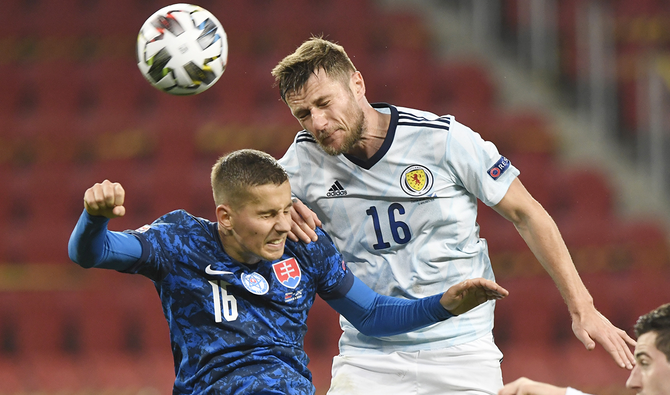
Scotland’s Liam Cooper with Slovakia’s Lubomir Satka during their match. (Reuters)
Short Url
Updated 16 November 2020
Follow

Euro heroes Scotland’s unbeaten run ended in Slovakia

  • Clarke made eight changes from the side that beat Serbia on penalties on Thursday to reach the European championships

TMAVA, Slovakia: Scotland failed to follow up their heroics of reaching a first major tournament for 22 years as Steve Clarke’s men were beaten 1-0 by Slovakia on Sunday, their first defeat in 10 games.

Jan Gregus’s deflected strike on 32 minutes separated the meeting of two teams who qualified for Euro 2020 this week as a much-changed Scotland were left to rue not taking a series of chances.

Clarke made eight changes from the side that beat Serbia on penalties on Thursday to reach the European championships.

However, the visitors still enjoyed the better of the chances and will feel aggrieved not to have at least extended their unbeaten run.

Oli McBurnie scored one of Scotland’s five successful penalties in midweek but the Sheffield United striker is still searching for his first international goal from open play and wasted two huge chances to give his side the lead.

Craig Gordon returned in goal for the first time in over two years but was helpless when Gregus’s shot clipped Kenny McLean and flew into the bottom corner.

Stuart Armstrong was inches away from an equalizer just before half-time as he flicked Ryan Christie’s excellent through ball wide.

After the break, it was Slovak goalkeeper Marek Rodak who ensured his side took all three points.

First, the Fulham stopper made an incredible save to deny McLean’s header from Kieran Tierney’s cross.

Then with the last action of the game, Leigh Griffiths thought he had earned a point with a powerful low shot that Rodak turned behind.

Scotland still top Group B2 of the Nations League with a four-point lead over the Czechs, who they will face in their opening game of the Euros.

Slovakia, who qualified for Euro 2020 with a playoff win over Northern Ireland on Thursday, remain bottom of the group with four points from five games.


How international academies are shaping Saudi football’s next generation

Updated 05 January 2026
Follow

How international academies are shaping Saudi football’s next generation

  • Building a unified national footballing philosophy in Saudi Arabia is no simple task

Saudi Arabia’s football transformation has been impossible to ignore since the arrival of Cristiano Ronaldo at the end of 2022. An influx of global stars followed, and with it, unprecedented attention on the Saudi Pro League.

Yet beneath the spotlight, a more pressing question emerged amongst domestic fans: “What is the long-term strategy for developing local players?”

Building a unified national footballing philosophy in Saudi Arabia is no simple task. The sheer size of the Kingdom presents logistical challenges unlike those faced by smaller neighbouring nations, making grassroots development harder to centralize. In this landscape, the work of individual institutions can contribute significantly to the broader football ecosystem.

One such contributor is Juventus Academy Saudi Arabia, an official extension of one of world football’s most historic clubs, operating under the umbrella of Al-Shoaibi Group. Arab News spoke to head of public relations at Juventus Academy, Malak Al-Awami, based in Alkhobar, to understand how the academy fits into the Kingdom’s long-term football vision.

“Saudi Arabia is experiencing a transformational moment under Vision 2030, prioritizing youth development and active lifestyles,” Al-Awami explained. “The  academy arrives at a perfect time to contribute to a world-class methodology while helping nurture the next generation of Saudi footballers.”

At Juventus Academy, success is deliberately defined beyond results and trophies.

“We’re not just training players,” Al-Awami said. “We’re shaping future leaders for the Kingdom.”

That philosophy has been reflected in how the academy balances Juventus’ global philosophy with local Saudi culture. While all coaches undergo Juventus’ training standards, cultural understanding remains a priority.

“All of our coaches are guided to respect Saudi values, culture and communication styles,” Al-Awami said. “Technical excellence matters, but the coach’s character is just as important as their certification.”

One of the academy’s defining features has been its inclusivity and cultural awareness. Players can join as young as four years old and continue until the age of 18, with programs open to both boys and girls.

That inclusivity has had a tangible impact. Juventus Academy played a role in the formation of Khobar FC, a women’s team that competed in the inaugural season of the SAFF Women’s Second Division League.

“We even used the same kit style as Juventus, getting approval from the club itself,” revealed Al-Awami.

Operating as an extension of the academy, the team finished just a few points behind established clubs like Al-Nahda and Al-Fateh in their regional group.

Al-Awami noted that the group is also exploring complementary initiatives aimed at elite player development beyond the academy itself. Among them is the planned Superior Striker Project, a specialized program designed to bring international attacking expertise to Saudi Arabia through short-term clinics for youth and professional players.

It is this broader contribution that highlights the growing importance of international academies in Saudi Arabia. Beyond providing structured training, they are helping build communities, instil values and strengthen the foundations of the domestic football pyramid. 

When asked about what success would look like for Juventus Academy in 5-10 years, Al-Awami was clear. “It is definitely not about trophies or big contracts,” he said, before adding, “it is the legacy we leave behind. If, in 10 years we see confident young Saudi players competing at elite levels, local coaches growing through our programs, and families trusting football as a tool for personal development, then we will know that we have truly succeeded.”

Juventus Academy Saudi Arabia builds on Al-Shoaibi Group’s original ambition in 2018: to create meaningful football opportunities for families in the Kingdom. Today, that ambition has evolved into a structured pathway contributing to Saudi football future, blending global expertise with local identity to help shape the next generation.