Britain’s Prince Charles attends German remembrance ceremony

1 / 5
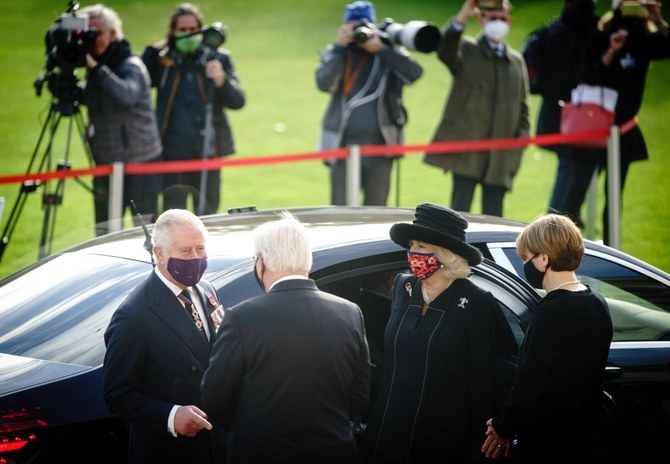
Britain's Prince Charles (R) and Camilla, Duchess of Cornwall arrive to a wreath laying ceremony on national Memorial Day at the Neue Wache in Berlin, on November 15, 2020. (AFP)
2 / 5
German President Frank-Walter Steinmeier (2ndL) and his wife Elke Buedenbender (R) welcome Britain's Prince Charles, Prince of Wales (L) and Camilla, Duchess of Cornwall at their arrival at the presidential Bellevue palace in Berlin, on November 15, 2020. (AFP)
3 / 5
Camilla, Duchess of Cornwall arrives with her husband Britain's Prince Charles for a meeting with German President Frank-Walter Steinmeier at Bellevue Palace in Berlin, Germany, Sunday, Nov. 15, 2020. (AP)
4 / 5
Britain's Prince Charles (2ndL), Prince of Wales and Camilla (L), Duchess of Cornwall pose for a picture next to German President Frank-Walter Steinmeier (R) and his wife Elke Buedenbender (2ndR) prior a meeting at the presidential Bellevue palace in Berlin, on November 15, 2020. (AFP)
5 / 5
German President Frank-Walter Steinmeier, right, and his wife Elke Buedenbender, left, welcome Britain's Prince Charles, center right, and his wife Camilla, Duchess of Cornwall, center left, at Bellevue Palace in Berlin, Germany, Sunday, Nov. 15, 2020. (AP)
Short Url
Updated 15 November 2020
Follow

Britain’s Prince Charles attends German remembrance ceremony

  • Britain and Germany were enemies in World Wars I and II, but have since forged close diplomatic, economic and military ties
  • Wearing masks and the customary remembrance poppy, Charles arrived in Berlin with his wife Camilla

BERLIN: Prince Charles is attending ceremonies on Germany’s traditional day of remembrance Sunday, seen as part of Britain’s diplomatic outreach to Europe’s biggest economy days before a deadline to strike a post-Brexit deal with the European Union.
Wearing masks and the customary remembrance poppy, Charles arrived in Berlin with his wife Camilla, the Duchess of Cornwall, late Saturday, where they were welcomed by Britain’s new ambassador, Jill Gallard, who tweeted that the prince was a “true friend of Germany.”
Britain and Germany were enemies in World Wars I and II, but have since forged close diplomatic, economic and military ties.
The royal couple were received Sunday by German President Frank-Walter Steinmeier and his wife, Elke Buedenbender, at Bellevue Palace. The palace was built in the late 18th century by Prince Augustus Ferdinand of Prussia, to whom Charles is distantly related through his family’s German line.
Charles and Camilla will observe the traditional wreath laying ceremony at Berlin’s Neue Wache. Originally designed as a site to commemorate those who died in the Napoleonic Wars it is now Germany’s Central Memorial for the Victims of War and Tyranny.
Queen Elizabeth II’s eldest son is scheduled to later deliver a speech at a memorial event in the Bundestag, Germany’s parliament.
The heir apparent has visited Germany more than 30 times since 1962, both in an official and private capacity, according to British officials, most recently in 2019.
Charles’ latest trip comes as Britain and the EU remain locked in difficult talks over a post-Brexit trade deal. There is growing anxiety that Britain may find itself without favorable access to its biggest trading partner when a transition agreement with the EU expires at the end of the year.
Steinmeier, who was Germany’s foreign minister when Britain held a referendum on Brexit in 2016 before assuming the largely ceremonial role as head of state a year later, has in the past dismissed British Prime Minister Boris Johnson’s efforts to renegotiate existing agreements with the EU.
Charles, 72, is exempt due to the diplomatic nature of his trip from Germany’s rules requiring him to go into quarantine on arrival from Britain. The prince has himself recovered from a coronavirus infection in March.


Pakistan is latest Asian country to step up checks for deadly Nipah virus

Updated 2 sec ago
Follow

Pakistan is latest Asian country to step up checks for deadly Nipah virus

  • Vietnam, Thailand, Singapore, Hong Kong, Malaysia and Indonesia have also tightened screening
  • Nipah has high mortality rate but not easily transmitted; there is also no vaccine for it
LAHORE/HANOI: Authorities in Pakistan have ordered enhanced screening of people entering the country for signs of infections of the deadly Nipah virus after India confirmed two cases, adding to the number of Asian countries stepping up controls.
Thailand, Singapore, Hong Kong, Malaysia, Indonesia and Vietnam have also tightened screening at airports.
The Nipah virus can cause fever and brain inflammation and has a high mortality rate. There is also no vaccine. But transmission from person to person is not easy and typically requires prolonged contact with an infected individual.
“It has become imperative to strengthen preventative and surveillance measures at Pakistan’s borders,” the Border Health Services department said in a statement.
“All travelers shall undergo ⁠thermal screening and clinical assessment at the Point of Entry,” which includes seaports, land borders and airports, the department added.
The agency said travelers would need to provide transit history for the preceding 21-day period to check whether they had been through “Nipah-affected or high-risk regions.”
There are no direct flights between Pakistan and India and travel between the two countries is extremely limited, particularly since their worst fighting in decades in May last year.
In Hanoi, the Vietnamese capital’s health department on Wednesday ⁠also ordered the screening of incoming passengers at Noi Bai airport, particularly those arriving from India and the eastern state of West Bengal, where the two health workers were confirmed to have the virus in late December.
Passengers will be checked with body temperature scanners to detect suspected cases. “This allows for timely isolation, epidemiological investigation,” the department said in a statement.
That follows measures by authorities in Ho Chi Minh City, Vietnam’s largest city, who said they had tightened health controls at international border crossings.
India’s health ministry said this week that authorities have identified and traced 196 contacts linked to the two cases with none showing symptoms and all testing negative for the virus.
Nipah is a rare viral infection that spreads largely from infected ⁠animals, mainly fruit bats, to humans. It can be asymptomatic but it is often very dangerous, with a case fatality rate of 40 percent to 75 percent, depending on the local health care system’s capacity for detection and management, according to the World Health Organization.
The virus was first identified just over 25 years ago during an outbreak among pig farmers in Malaysia and Singapore, although scientists believe it has circulated in flying foxes, or fruit bats, for thousands of years.
The WHO classifies Nipah as a priority pathogen. India regularly reports sporadic infections, particularly in the southern state of Kerala, regarded as one of the world’s highest-risk regions for Nipah.
As of December 2025, there have been 750 confirmed Nipah infections globally, with 415 deaths, according to the Coalition for Epidemic Preparedness Innovations, which is funding a vaccine trial to help stop Nipah.