

DUBAI: Three female artists have joined forces in Jardin en Soi (Inner Garden) in a show running until Nov. 30 at the Loft Art Gallery in Casablanca to uphold the importance of traditional textiles from their homeland. In one of the first exhibitions dedicated to the use of African textiles in contemporary art, each work by Moroccan artists Amina Agueznay and Ghizlane Sahli, and Joana Choumali from Ivory Coast offers a powerful marriage of contemporary forms and artisanal traditions. The artists believe in the preservation of age-old textile techniques as a way of also preserving their country’s heritage and identity.
The Healers by Joana Choumali
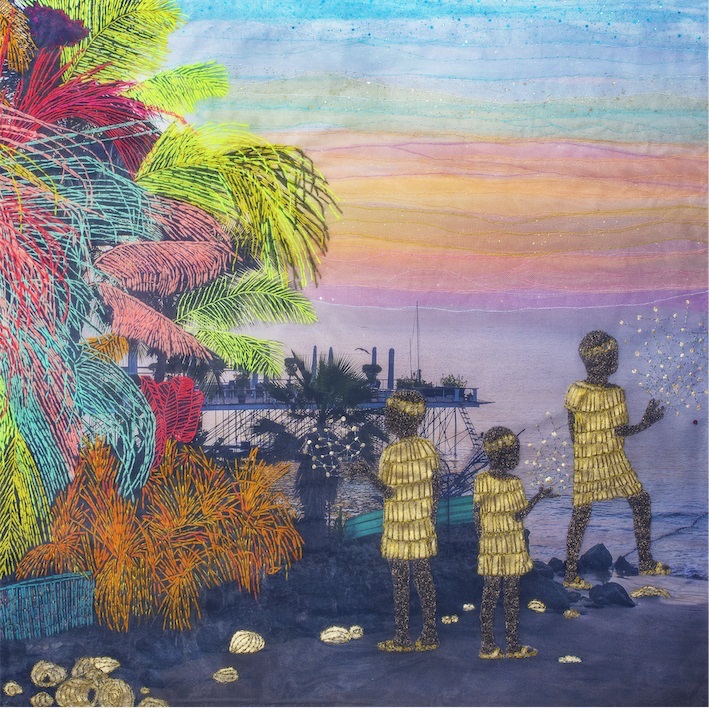
The work is part of the Ivorian artist Joana Choumali’s body of work entitled Albahian. (Supplied)
Three children dressed in golden pleated outfits complete with golden bands around their head stand in a dreamy tropical landscape of lush palm trees with a vibrant mix of colors. Titled The Healers, as if in reference to the name of the artwork, the children appear to beam with joy and hope, signaling the dawn of a new day. The work is part of the Ivorian artist Joana Choumali’s body of work entitled Albahian, which in the Agni language of the Akan group in the Ivory Coast, means “the first light of day.” “Every morning, I start my day with a walk at dawn,” Choumali said. “I then immerse myself in what surrounds me, in what I see and feel. During these walks, I also listen to my emotions and to what I feel.”
The work, like Choumali’s other artworks, is close to her previous series Ça va aller and Translation. “The intention here is different,” she said. “It is more intimate and introspective.” Choumali, the first African to win the prestigious Prix Pictet photography prize, created Albahian using mixed media composed of embroidery, quilting, collage and photomontage. In the creation of the work, like others in the series, she superimposed layers of transparent fabric on photographs of passers-by, silhouettes and still-lives that she took during the early morning. Here, real and imaginary worlds are woven together with a heightened sensitivity to the surrounding natural and cityscape of Chouamli’s hometown of Abidjan, the economic capital of Ivory Coast. “Like the morning light at the beginning of each new day, I observe and become aware of the change in my thoughts and my perception of realities. It is like a daily pilgrimage,” said Choumali. “My work becomes the materialisation of memories and dreams I had while walking and exploring the city.”
A Garden Inside by Amina Agueznay
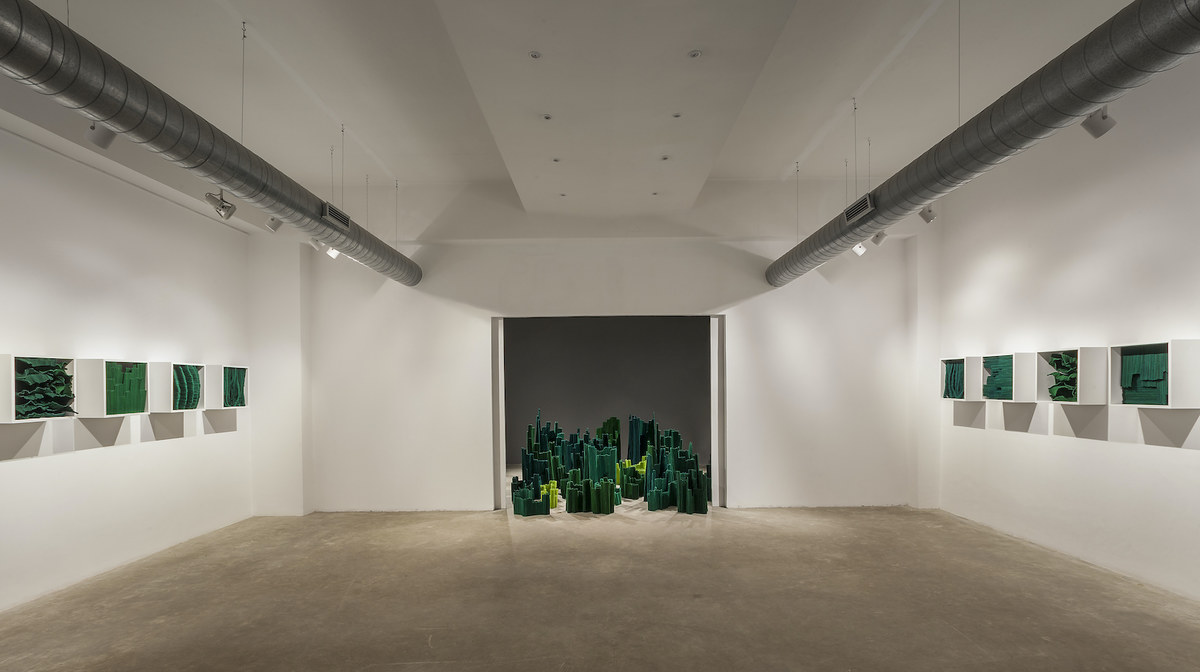
The installation is made of textiles incorporating traditional Moroccan techniques. (Supplied)
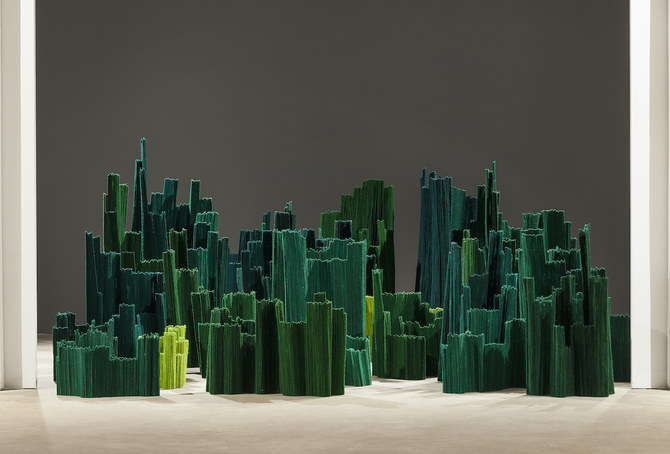
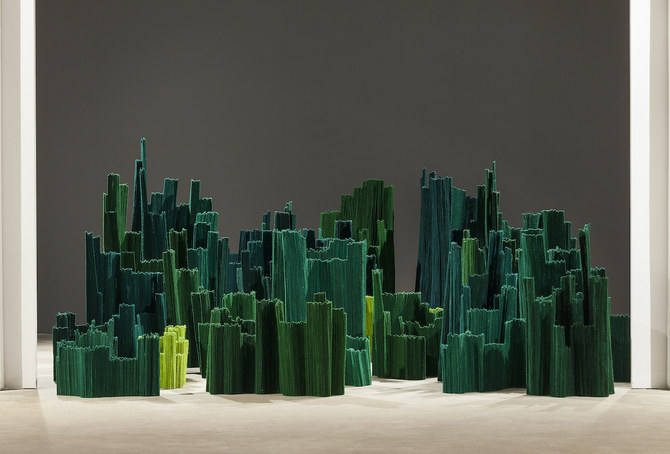
A garden made of various shades of green natural dye spun wool shoots up from the floor of the gallery. Made by Moroccan artist Amina Agueznay, the work, with its uneven sized rectangular forms in varying heights, could also be a cityscape, albeit colored green. Agueznay, who trained as an architect and is also jewelry designer, is dedicated to preserving the craft of skilled artisans from her homeland. The installation, with its intricate pathways between the symbolic green rectangles, is made of textiles incorporating traditional Moroccan techniques. “As soon as I have obtained from the material the infinite freedom that I am looking for, I begin the work from a manual approach,” said Agueznay. “It is the hand that tames the material and it is the hand that also freezes it.” The artist’s “garden” is individualistic in nature—no two forms are alike and yet they merge as part of a greater whole—just like the idea of preserving one’s heritage through contemporary art.
Histoire de Tripes by Ghizlane Sahli
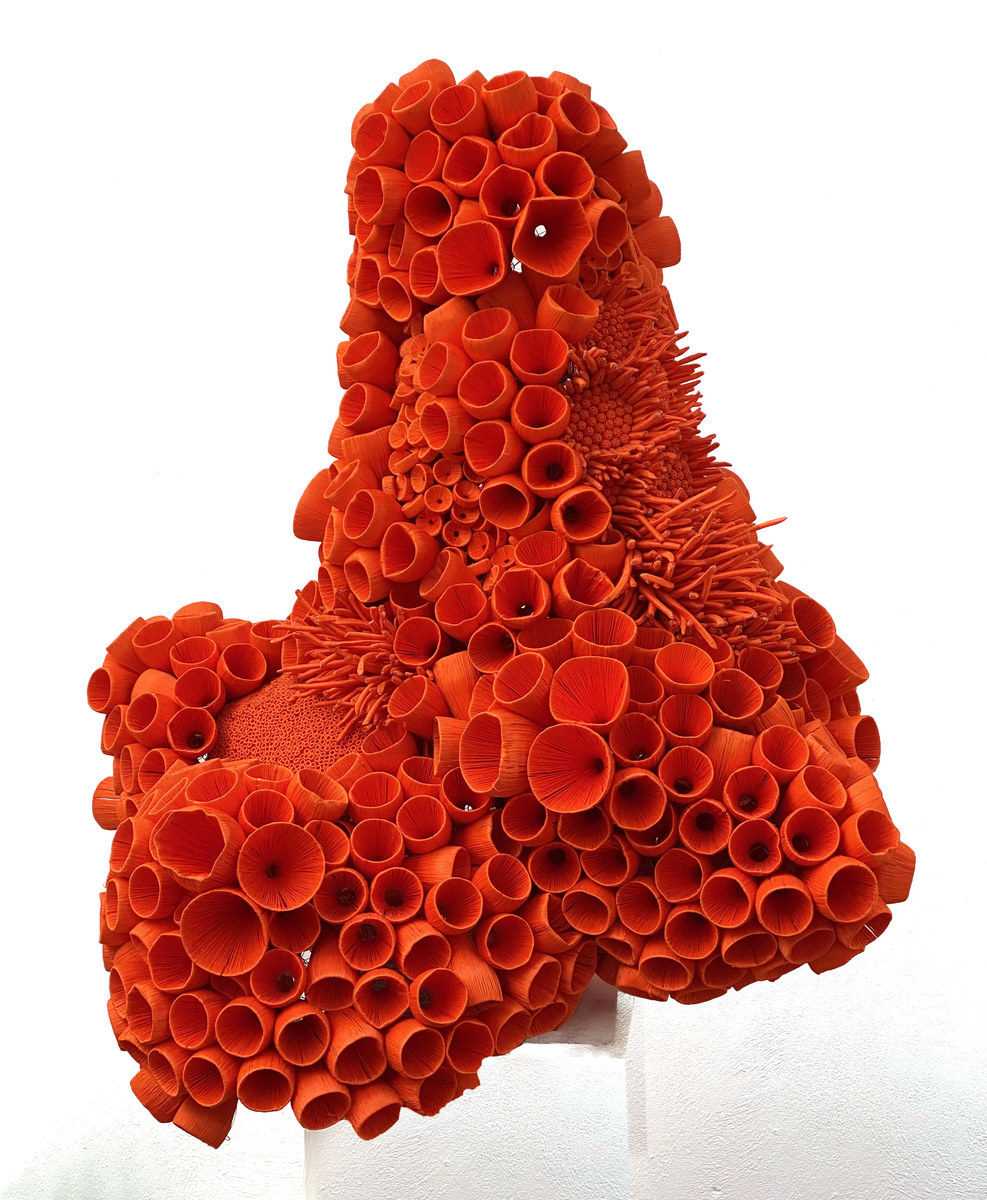
The piece is a work by Moroccan artist Ghizlane Sahli made in silk threads on plastic and metal from her series Histoire de Tripes. (Supplied)
An unordered mix of red cell-like forms comes together to form an anamorphic shape, similar to that of a human organ. The piece is a work by Moroccan artist Ghizlane Sahli made in silk threads on plastic and metal from her series Histoire de Tripes, in which she collected recycled plastic bottles, cleaned and cut them up, and then coated them in vegetable silk thread with the help of local Moroccan female artisans. Sahli referred to these silk-wrapped bottle tops as “the Alveoles”, which is the French word for “cells” or “alveoli.” Sahli’s abstract sculpture refers to French author Antonin Artaud’s 1947 work Body without Organs, which challenged the human body or individual’s social call for status in society. Artaud, like Sahli, challenges the notion of behavioral conditioning in favor of a free individual not confined by preset physical or mental notions. “I imagine a great hand that would grasp the human body and shake it vigorously in order to rid it of all its pollution acquired through religion, education, society and gender,” said Sahli. “I wanted Histoires de Tripes to address the inner purity of being.”


