

Little Amal — a giant puppet’s long walk for refugee children

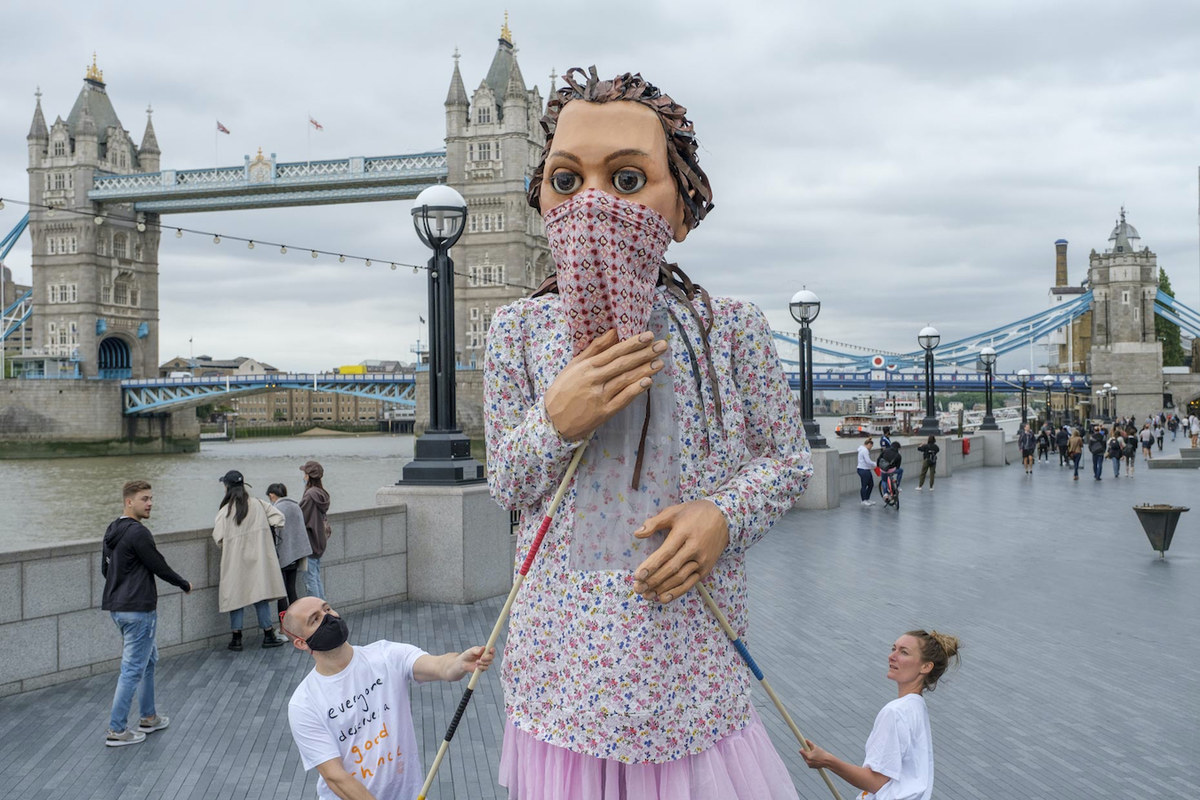
Little Amal will ‘walk’ through Turkey, Greece, Italy, Switzerland, Germany, Belgium and France. (Supplied)
Short Url
Updated 12 November 2020
Follow

Little Amal — a giant puppet’s long walk for refugee children

PARIS: On Tuesday 30th March next year, a 3.5-meter-high puppet called Little Amal will embark on an 8,000-kilometer journey from Gaziantep on the Turkish-Syrian border to Manchester in England, stopping at around 70 towns and cities on the way. 

This endeavor, known as “The Walk,” originated from Joe Murphy and Joe Robertson’s play “The Jungle,” based on the refugee camp in Calais, France. Following successful runs in London’s West End then Broadway, director Stephen Daldry and producer David Lan decided to focus a project on Amal, a nine-year-old refugee who was one of the play’s lead characters. The puppet, Little Amal, was created by Handspring Puppet Company in South Africa, and Amir Nizar Zuabi was appointed as artistic director of “The Walk.” 


The journey will end in the UK on July 4, 2021, where Little Amal’s arrival will mark the opening of the Manchester International Festival. (Supplied)

Little Amal will ‘walk’ through Turkey, Greece, Italy, Switzerland, Germany, Belgium and France accompanied by 15 puppeteers, interacting with local communities along the way. The journey will end in the UK on July 4, 2021, where Little Amal’s arrival will mark the opening of the Manchester International Festival. 


Little Amal will be accompanied by 15 puppeteers, interacting with local communities along the way. (Supplied)

“I'm not a refugee myself. As a Palestinian, I didn't move, my country moved,” Zuabi told Arab News from Stockholm, where he is currently producing his latest play. “I inherently connect with ‘The Walk’ and have been involved since its inception, so it was easy to figure out where I wanted to take it. The artistic ambition is unique, because we're creating huge, participatory events in the cities we’re passing through. We’re not naïve — part of the appeal is that this is an endurance race meets an arts event, on a scale that is almost unheard of, almost audacious. There's something absolutely beautiful about a community coming together to welcome, celebrate or empower a vulnerable refugee, who proves much less vulnerable once you get to meet her. How we receive refugee children — the opportunities we offer them — will mean they are not refugees anymore, they can become whatever they’re encouraged to be. Who knows where the next genius or great idea is coming from? It might be from Gaza, Shatila, or one of the camps in Turkey. The community events are joyful. As someone involved in the arts, I'm a true believer in beauty. Beauty is the way divinity shows itself. Maybe, in this moment of isolation, the ability to bring people together to dream with a project of this scale is just what we need.”


This endeavor, known as “The Walk,” originated from Joe Murphy and Joe Robertson’s play “The Jungle,” based on the refugee camp in Calais, France. (Supplied)

Little Amal is a feisty role model for kids — appealing, funny and resilient. And “The Walk” focuses not on the tragic plight of refugee children, but on their untapped potential. 


Sistine Chapel sketch by Michelangelo goes on show in Dubai

Updated 13 January 2026
Follow

Sistine Chapel sketch by Michelangelo goes on show in Dubai

DUBAI: A previously unknown study by Italian Renaissance artist Michelangelo for perhaps his most famous work, the frescoes on the Sistine Chapel ceiling, went on show in Dubai this week, with Christie’s specialist Giada Damen on hand to convey the significance of the find to Arab News.

The sketch of the right foot of the Libyan Sibyl, whose final form is at the far east end of the Sistine Chapel ceiling in the Vatican, will go under the hammer at a Feb. 5 auction in New York, with an estimate of $1.5 million to $2 million.

This is the first time a work by Michelangelo has gone on show in the UAE. A significant degree of grit and determination went into identifying and verifying the small sketch, which first came to light after an unsuspecting owner sent a photograph to Christie’s online Request an Auction Estimate portal.

The sketch of the right foot of the Libyan Sibyl, whose final form is at the far east end of the Sistine Chapel ceiling in the Vatican, will go under the hammer at a Feb. 5 auction in New York. (Supplied)

Of the roughly 600 sheets by Michelangelo that survive today — only a fraction of the thousands of drawings he must have produced — this is one of only 50 studies relating to the Sistine Chapel.

“This drawing is the only preparatory (drawing) for the Sistine Chapel that has ever come on the market,” Damen explained, adding that the prolific artist was known for burning sketches after a painting had been completed.

“There are so many clues attached to this drawing that point to the fact that it is a real drawing by Michelangelo,” she added, pointing to the red chalk used in the small sketch — typical of the sketches Michelangelo  did in the run-up to the second half of the Sistine Chapel ceiling — as well as a sister sketch housed in New York’s Metropolitan Museum of Art.

“He made the first part of the Sistine ceiling starting in 1508, and it took two years. Then the scaffolding was removed and only at that point, Michelangelo was able to see the ceiling from a distance from the floor of the chapel (and he) realized that actually the figures that he had made, those scenes, they were too crowded and with too small figures that you couldn’t really see all these details,” Damen said of the first half of the ceiling.

“From here on, he decided in the second phase to do bigger figures and less details … and the (Libyan) Sibyl is part of this second phase.”

The figure of the female seer is depicted by Michelangelo in a dynamic, twisted pose, with her toes pressing down against a platform supporting her weight as she holds a book of prophecies.  

 Michelangelo Buonarroti (1475-1564) is one of the foremost figures in global art history, famous for his work as a sculptor, architect, painter and thinker. His frescoes on the ceiling and back wall of the Sistine Chapel are among his most famous works.