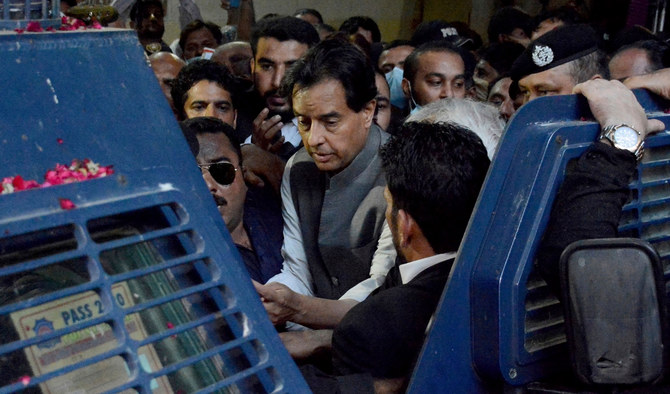
ISLAMABAD: The Pakistani military said on Tuesday it had concluded its probe into the arrest of the son–in-law of ousted Prime Minister Nawaz Sharif last month and decided to removed officers from the paramilitary Rangers and the ISI spy agency who had acted “zealously” in the incident.
The probe, ordered by the country’s army chief, General Qamar Javed Bajwa, came after local politicians alleged that Sindh province’s top police official, Mushtaq Ahmed Mahar, had been abducted by paramilitary troops, taken to the office of a local ISI official, and coerced into signing an order to arrest opposition leader Muhammad Safdar, a member of the Pakistan Muslim League (PML-N) party.
Safdar was arrested by officials who barged into his hotel room, as seen in cellphone footage, the day after a protest by an opposition alliance in Karachi, capital of the southern province of Sindh. He was subsequently released on bail.
“Based on the recommendations of the Court of Inquiry, it has been decided to remove the concerned officers from their current assignments for further departmental proceedings and disposal at GHQ [general headquarters],” the military said in a statement.
It said the Rangers and ISI officers were “experienced enough to have acted more prudently and could have avoided creating an unwarranted situation that led to misunderstanding between the two state institutions.”
Last week, the PML-N and an alliance of opposition parties kicked off nationwide protests against the government of Prime Minister Imran Khan and accused the military of interference in Pakistani politics - an allegation the army vociferously denies. Safdar was among those leading the protests.
The Sindh government, under which the Sindh police operate, said it had not ordered Safdar’s arrest and that the police had been pressured into taking the action.
“The police chief’s phones were seized. He was taken to the sector commander’s office and asked to sign the arrest orders,” Maryam Nawaz, Safdar’s wife and Sharif’s daughter, told media. Mahar was reported to have been allowed to leave on Monday after signing the arrest order.
Bilawal Bhutto Zardari, whose Pakistan Peoples Party rules Sindh, publicly called for the army and intelligence chiefs to investigate the matter, saying the incident had “crossed a red line”.

Pakistan army says will remove Rangers, ISI officers who arrested Nawaz Sharif's son-in-law
https://arab.news/w5pnt
Pakistan army says will remove Rangers, ISI officers who arrested Nawaz Sharif's son-in-law
- Safdar was arrested by officials who barged into his hotel room a day after a protest by an opposition alliance in Karachi
- Army ordered a probe after politicians alleged Sindh’s top police official had been abducted by Rangers and coerced into signing the arrest order
At least two persons killed, over two dozen injured in separate IED blasts in Pakistan
- The blasts occurred near a vehicle carrying cement factory workers in Khyber Pakhtunkhwa and in a busy market in Balochistan
- The incidents highlight Pakistan’s security woes in the regions bordering Afghanistan, where it has been fighting twin insurgencies
PESHAWAR/QUETTA: At least two persons were killed and more than two dozen others were injured in two separate improvised explosive device (IED) blasts in Pakistan’s Khyber Pakhtunkhwa (KP) and Balochistan provinces that border Afghanistan, police officials said on Monday.
The first blast occurred near a vehicle transporting employees of a cement factory in KP’s Lakki Marwat district at around 6:30am, according to district police spokesman Shahid Marwat. It killed one person and injured nine others, several of whom were in critical condition.
“Initial investigations suggest the device had been planted by militants,” Marwat said. “A rapid police response force was immediately deployed to the scene to evacuate the dead and wounded, secure the area and collect evidence.”
No group has so far claimed responsibility for the attack. However, the Pakistani Taliban, or the Tehreek-e-Taliban Pakistan (TTP), have claimed responsibility for similar attacks in the past against Pakistani law enforcers and civilians in the northwestern province.
Separately, one person was killed and 16 others sustained injuries as a result of another blast in Panjgur city of the southwestern Balochistan province, Pangur police station in-charge Shoaib ur Rehman said.
The blast occurred in the city’s busy Chitkarn market.
“A man was killed and 16 others were injured after a remotely controlled IED fitted inside a motorbike exploded,” Rehman told Arab News. “Four critically injured are being shifted to Karachi, while others were admitted to the District Headquarter Hospital (DHQ) Panjgur.”
No group immediately claimed the attack in Balochistan, where ethnic Baloch separatist groups, mainly the Baloch Liberation Army (BLA) and Baloch Liberation Front (BLF), have often targeted security forces and police as well as political and tribal leaders.
Rehman said police or security forces had not been on the move in the area, when the blast occurred.
“Police and other law enforcement agencies have been investigating the attack,” he added.
Both blasts highlight Pakistan’s parallel security challenges in the two provinces, where it has been facing twin insurgencies waged by religiously motivated groups like the TTP and the ethnic Baloch separatists like the Balochistan Liberation Army (BLA).
The South Asian country has witnessed a sharp surge in militant attacks in recent months. According to statistics released last month by the Pakistan Institute for Conflict and Security Studies (PICSS), combat-related deaths in 2025 rose by 73 percent to 3,387, compared with 1,950 deaths in 2024.
These deaths included 2,115 militants, 664 security forces personnel, 580 civilians, and 28 members of pro-government peace committees, the think tank said. Most of the attacks took place in Khyber Pakhtunkhwa’s Pashtun-majority districts and southwestern Balochistan province, the PICSS noted.
Islamabad accuses the Afghan government of harboring militants who launch attacks against Pakistan, a charge Kabul repeatedly denies. The surge in militant attacks in Pakistan has strained ties between the two neighbors, with Islamabad urging Kabul to take steps to dismantle militant outfits allegedly operating from its soil. Pakistan also blames India of backing these militant groups, an allegation New Delhi denies.


