Hong Kong journalist charged as press freedom fears grow

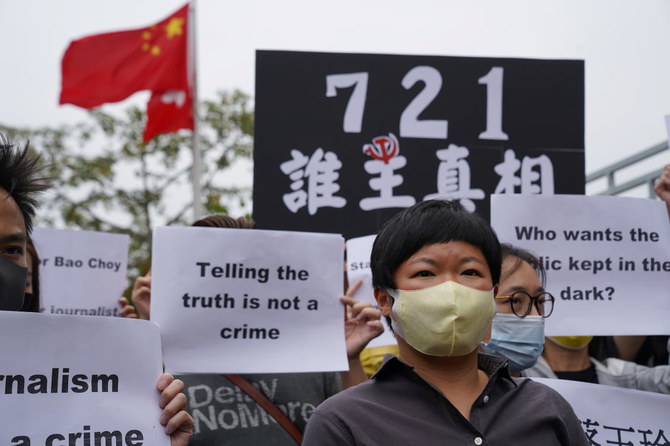
Choy Yuk-ling, above, was previously involved in the production of an investigative documentary into the behavior of Hong Kong police during last year’s anti-government protests. (Reuters)
Short Url
Updated 10 November 2020
Follow

Hong Kong journalist charged as press freedom fears grow

  • Choy Yuk-ling, a producer at public broadcaster Radio Television Hong Kong, was arrested earlier this month on charges of making false statements

HONG KONG: A Hong Kong journalist appeared in court Tuesday on charges of making false statements while obtaining information from a vehicle database, amid growing concerns that press freedom is at risk in the semi-autonomous Chinese city.
Choy Yuk-ling, a producer at public broadcaster Radio Television Hong Kong, was arrested earlier this month on charges of making false statements about why she was obtaining license plate information from a publicly accessible database.
She was previously involved in the production of an investigative documentary into the behavior of Hong Kong police during last year’s anti-government protests, after the force was accused of not intervening during a violent clash between protesters and a mob of men in a subway station.
Ahead of her court appearance, Choy told reporters the case was a matter related to public interest and press freedom in Hong Kong.
“There has been a very strong social understanding … that journalists are free to obtain public information for the sake of public interest,” she said. “I didn’t see any reason that the government has to restrict the flow of information.”
She said that many scholars, unions and lawyers have expressed concerns as to whether the police are using the law to suppress press freedom.
Members from an RTHK union, as well as supporters and pro-democracy activists, held up placards in support of Choy, some of which read “Journalism is not a crime” and “Without fear of favor.”
Choy’s case was adjourned until Jan. 14 to give the police more time to investigate, and she was released on bail.
Media groups are concerned Hong Kong’s new security law, which outlaws secession, subversion and foreign collusion to interfere in the city’s internal matters, could be used against journalist reporting on issues thought to be related to national security.
The US and others have denounced the law imposed by Beijing as an attack on Hong Kong’s autonomy and freedoms. The US State Department on Monday announced sanctions against additional Chinese officials over the crackdown.


More than 200 political prisoners in Venezuela launch hunger strike

Updated 3 sec ago
Follow

More than 200 political prisoners in Venezuela launch hunger strike

GUATIRE: More than 200 Venezuelan political prisoners were on hunger strike Sunday to demand their release under a new amnesty law that excludes many of them.
The inmates at the Rodeo I prison, about 40 kilometers (25 miles) east of capital Caracas, shouted to their loved ones as part of the protest, an AFP journalist witnessed.
“Freedom!,” “release us all!” and “Rodeo I on strike” were among the cries from the prisoners that were audible from outside the facility.
The amnesty law was approved by Venezuela’s congress on Thursday as part of a wave of reforms encouraged by the United States after it ousted and captured former president Nicolas Maduro on January 3.
The hunger strike, which began Friday night, came about after inmates complained they would not benefit from the law because it excludes cases involving the military, which are the most common ones at that facility.
“Approximately 214 people in total, including Venezuelans and foreigners, are on hunger strike,” said Yalitza Garcia, mother-in-law of a prisoner named Nahuel Agustin Gallo.
Gallo, an Argentine police officer, is accused of terrorism, another category that is excluded.
“They decided Friday to go on hunger strike because of the scope of the amnesty law, which excludes many of them,” said Shakira Ibarreto, the daughter of a policeman arrested in 2024.
On Sunday, a team from the International Committee of the Red Cross (ICRC) visited the Rodeo I prison.
“This is the first time they have allowed us to approach that prison,” Filippo Gatti, the ICRC’s health coordinator for Venezuela, told family members. “It’s a first step, and I think we’re on the right track.”
Not all the inmates at the prison were joining the hunger strike, the relatives said.

- Amnesty law criticized -

The amnesty law was engineered by interim leader Delcy Rodriguez under pressure from Washington after US commandos attacked Venezuela on January 3, snatched Maduro and his wife and took them to the United States for trial on drug trafficking charges.
Opposition figures have criticized the new legislation, which appears to include carve-outs for some offenses previously used by authorities to target Maduro’s political opponents.
The law also excludes members of the security forces convicted of activities related to what the government considered terrorism.
But the amnesty extends to 11,000 political prisoners who, over nearly three decades, were paroled or placed under house arrest.
More than 1,500 political prisoners in Venezuela have already applied for amnesty under the bill, the head of the country’s legislature said Saturday.
Hundreds of others had already been released by Rodriguez’s government before the amnesty bill was approved.
On Sunday, a handful of inmates were released from Rodeo I, carrying release papers in their hands. They were greeted with applause.
“I’m out, I love you so much, my queen! I’m doing well,” Robin Colina, one of the freed prisoners, said excitedly into a mobile phone.
Armando Fusil, another released prisoner, told AFP: “Right now there are quite a few people on hunger strike because they want to get out.”
The 55-year-old police commissioner from the western state of Maracaibo said he was “arrested for no reason” in October 2024.
He said loved ones came to visit him every Friday since his arrest, taking a nearly 40-hour trip just for a little bit of face time each week.
Now, they’re coming to pick him up for good.
“We all help each other,” Fusil said about his fellow detainees. “It’s created a beautiful brotherhood.”
The NGO Foro Penal, dedicated to the defense of political prisoners, reported 23 releases on Sunday.
Maduro ruled Venezuela between March 2013 and January 2026, silencing opposition and activists under his harsh leftist rule.
Maduro and his wife are in US custody awaiting trial. Maduro, 63, has pleaded not guilty to drug trafficking charges and declared that he is a prisoner of war.