



JEDDAH: Archaeologists in Saudi Arabia are getting a whole new perspective on the peninsula’s ancient desert civilizations with the help of the latest eye-in-the-sky technology.
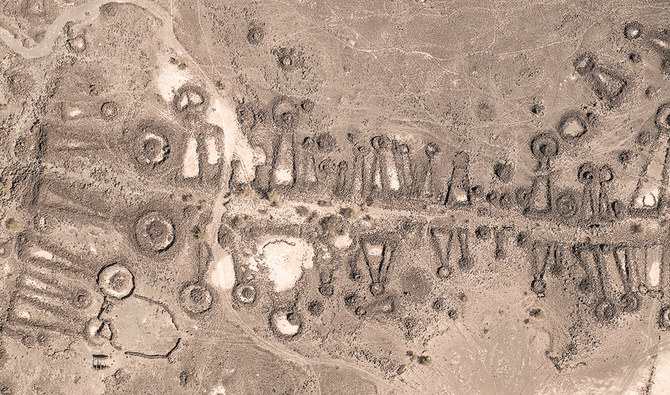
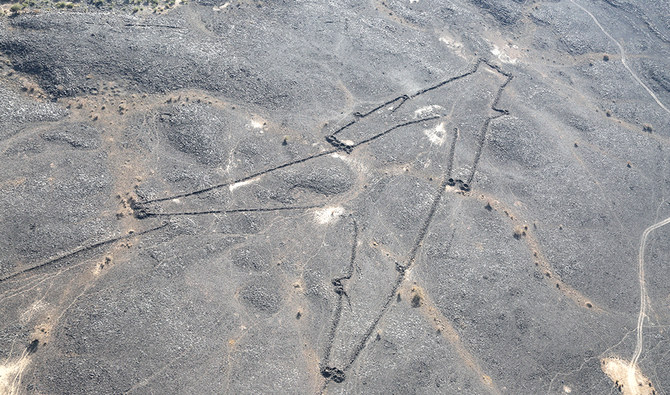
Increased access to aerial photography and satellites has opened up high-resolution windows to the map of Arabia and its surrounding region revealing an impressive array of rock structures known as desert kites.
The dry stone-built structures comprising long walls ending in an enclosed area were first discovered in the 1920s when World War I pilots flying over the Levantine and northern Saudi deserts reported seeing constructions resembling polygons, funnels, and triangles.
Scholars have various theories on the purpose of the kites, some believing them to be villages or traps for herding animals, while others consider them to have been burial grounds or tombs.
Spread throughout the western region of the Kingdom, the structures are thought to be Neolithic and are highly concentrated near Harrat Khaybar, one of the largest lava fields on the peninsula.
Aerial surveys have found that the kites’ various shapes could be an indicator of their functions, and they are believed to have been built by early engineers from pastoral tribes over a span of thousands of years.
According to a research study conducted by David Kennedy, Rebecca Banks, and Mathew Dalton, there are an estimated 917 kites around Khaybar built in varying shapes and sizes and some dating back to between the fifth and seventh centuries B.C. They resemble gates, triangles, kites, bull’s eyes, and keyholes. Capt. Abdulazeez Al-Dakheel, a businessman and keen pilot, has been mapping the kites since 2015 from the cockpit of his two-seater aircraft. Together with colleagues, his aerial photography of the structures has been focused across the western region of Saudi Arabia.
Using Google maps and other satellite imaging websites, Al-Dakheel has spent long flying hours pinpointing their approximate locations.
“The structures differ in shape depending on location, some are articulately engineered while others are randomly designed. It’s extremely difficult to confine them in one category or in one area and requires a lot of effort,” he said.
Though most of the structures are believed to be concentrated around the Khaybar lava field, they can also be found as far south as the Empty Quarter.
Artist and explorer, Moath Alofi, has been intrigued by the structures ever since joining up with Al-Dakheel and his team five years ago.
With the help of satellite technology, he said the team had been able to document the structures across the desert landscapes and high-resolution images had enabled archaeologists to further develop their understanding of the structures’ purposes and the engineers behind them.
FASTFACTS
• Globally, 5,809 desert kites have been discovered across Armenia, Saudi Arabia, Jordan, Kazakhstan with the highest concentration found in Syria with 2,500 kites.
• The dry stone-built structures comprising of long walls ending in an enclosed area were first discovered in the 1920s when World War I pilots flying over the Levantine and northern Saudi deserts reported seeing constructions resembling polygons, funnels, and triangles.
“Some of them are very sophisticated and well-engineered. You can find them on the ground, and on the sides of mountain slopes, and the number of kites around Harrat Khaybar is huge,” Alofi added.
In 2017, he unveiled his “People of Pangaea” series of aerial photographs highlighting the desert structures.
Hidden between volcanic craters and lost in the darkness of basalt fields, the shapes can be seen as animals, flat pyramids, wolves howling in the moonlight, and even Christmas trees.
Alofi said: “I’ve been hunting them intensively and have been studying for a long time. It’s an enigma, and the surreal thinking behind it attracts me and dazzles me.
“Just when you think you’ve found it all, you discover new things and it’s a long way to go and explore more.
“The kites are not a recent discovery, they’ve been well known for years but with the help of satellite imagery and aerial photography, the people of Saudi Arabia can be introduced to something unique that helps tell the story of historic civilizations that lived in this land. Our land is riddled with mysteries that are yet to be discovered,” he added.


