

Pakistan says will finalize North-South Gas Pipeline agreement with Russia next week

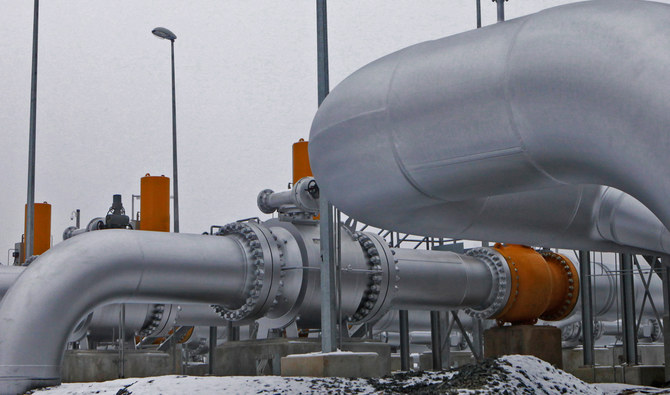
The North-South pipeline would be the biggest infrastructure deal with Russia since the early 1970s, when the Soviet Union set up the Pakistan Steel Mills industrial complex at Port Qasim, near Karachi. (Photo courtesy: ISGS website/File)
Short Url
Updated 02 March 2021
Follow

Pakistan says will finalize North-South Gas Pipeline agreement with Russia next week

  • The project, estimated to cost over $2 billion, will deliver gas from Pakistan’s coastal regions to industrial areas in the north
  • Pipeline has been held up since 2015 due to disagreement over fees and US sanctions against Russian state conglomerate Rostec

KARACHI: Pakistan and Russia are expected to finalize an agreement to start work on the over $2 billion North-South Gas Pipeline Project (NSGPP) during the visit of a Russian delegation to Pakistan next week, Pakistani officials said on Monday.

The agreement will be the latest in a series of energy-related pacts between Pakistan and Russia, former Cold War foes who have grown closer in recent years.

The North-South pipeline to deliver gas from Pakistan’s coastal regions to industrial areas in the north has been held up since 2015 due to a disagreement over fees and United States sanctions against Russian state conglomerate Rostec. 

“The discussions with Russians is at a much advanced stage and their delegation is coming to Pakistan and we hope that as per an inter-governmental agreement, an agreement will materialize,” Sajid Mehmood Qazi, the spokesman of Pakistan’s Ministry of Energy, told Arab News on Monday.  
 
The Russian technical delegation will be in Pakistan from November 16-18 and hold discussions with Pakistan authorities on the pipeline project, officials at Pakistan’s embassy in Moscow confirmed to Arab News via phone.  
 
The cost of the 1,100 kilometer long project was initially estimated at $2 billion, with an annual capacity to transport 12.4 billion cubic feet of gas from Karachi in the north of the country to Lahore in the south. 
 
The energy ministry spokesman declined to share the exact cost of the project, saying the design of the pipeline had changed since it was first conceived. 

“It is now not the pipeline which was initially designed, with 42 inches diameter,” Qazi said. “Now it would be 48 or 56 inches and according to the new estimates of its compressor size and technical requirements, its cost could be anything between $2 and $3 billion ... but I can’t say exactly about it at this stage”.   
 
The energy ministry spokesman said the government was eager to “make progress” on the project before the next year.
 
Indigenous natural gas contributes around 38 percent to Pakistan’s total primary energy supply mix. Pakistan produces around 4 billion cubic feet per day (bcfd) against an unconstrained demand of 6 bcfd and imports gas to meet the deficit, particularly when demand peaks in winters.   
 
The North-South pipeline would be the biggest infrastructure deal with Russia since the early 1970s, when the Soviet Union set up the Pakistan Steel Mills industrial complex at Port Qasim, near Karachi. 
 
Apart from the North-South pipeline project, Pakistani officials also say work is being expedited on the multibillion-dollar Turkmenistan-Afghanistan-Pakistan-India (TAPI) gas pipeline project to import gas from Turkmenistan through Afghanistan and Pakistan up to Pakistan’s border with India. 
 
Turkmenistan’s ambassador to Pakistan, Atadjan Movlamov, said on Sunday the TAPI project, with design capacity of 3.2 billion cubic feet of natural gas per annum (Bcfd), was in the stage of “practical implementation.” 


Pakistan’s deputy PM says country seeks to convert $1 billion UAE deposit into investment

Updated 28 December 2025
Follow

Pakistan’s deputy PM says country seeks to convert $1 billion UAE deposit into investment

  • Ishaq Dar says the UAE will acquire shares in Pakistani companies using the amount, with transaction to be completed by March 31
  • The UAE’s remaining $2 billion in deposits, part of funds used to shore up Pakistan’s foreign reserves, are due for rollover in January

ISLAMABAD: Pakistan is seeking to convert part of its financial support from the United Arab Emirates into long-term investment to reduce external debt, Deputy Prime Minister Ishaq Dar said on Saturday, following talks with UAE President Sheikh Mohamed bin Zayed Al Nahyan during his visit to Islamabad.

Dar said Pakistan was engaged with the UAE on converting $1 billion in deposits into equity investment, potentially involving stakes in companies linked to the Fauji Fertilizer Group, a move that would end Pakistan’s repayment obligation on that portion of the funds.

The UAE has been one of Pakistan’s key financial backers in recent years, providing $3 billion in deposits to the central bank as part of a broader effort to stabilize the country’s external finances and unlock support from the International Monetary Fund.

Speaking at a year-end briefing, Dar said Pakistan had already begun discussions with the UAE on rolling over the first $1 billion tranche, but Islamabad now wanted to replace short-term borrowing with investment.

“They will be acquiring some shares, and this liability will end,” Dar said, adding that discussions were under way for the transaction to be completed by March 31.

Dar said the Fauji Foundation Group was taking the lead in the process, with plans for partial disinvestment by Fauji-linked and other companies to facilitate the deal.

He added that Pakistan also raised the issue of a separate $2 billion rollover due in January during talks with the UAE leadership, saying Islamabad had conveyed that converting debt into investment would be preferable to repeated rollovers.

The issue was discussed during Al Nahyan’s visit, which Dar described as cordial, adding that the UAE had expressed willingness to expand its investment footprint in Pakistan.

Pakistan has relied on repeated rollovers of deposits from friendly countries to manage its balance-of-payments pressures, a practice economists say provides short-term relief but adds to debt vulnerabilities unless replaced with foreign direct investment.

The country acquired $5 billion from Saudi Arabia and $4 billion from China, which, along with the UAE, helped shore up its foreign reserves and meet IMF conditions at a time when its external account was under severe pressure.

Dar said Pakistan was now focused on shifting from temporary financing toward longer-term capital inflows to stabilize its economy and reduce reliance on external borrowing.