RIYADH: With the whole world experiencing a swift digital transformation amid the coronavirus disease (COVID-19) pandemic, Saudi Arabia, as the G20 host, shoulders the responsibility to help the world move forward by swiftly adopting new health protocols and setting an example, said Indonesian Ambassador to Saudi Arabia Agus Maftuh Abegebriel.
In an interview with Arab News, Abegebriel said: “Saudi Arabia did not let the pandemic become an unfortunate moment. The G20 swiftly adopted new health protocols, and an online mechanism was prepared for the upcoming summit in November. The extraordinary summit in March ran well online — evidence of how well Saudi Arabia handled the G20’s meetings during the pandemic. I hope that we can learn from the Saudi presidency for handling the G20 in 2023.
“The G20 was born out of crisis back in 1999, and was again challenged in 2008-2009 by the global financial crisis. That crisis came alongside the European sovereign debt crisis, and several eurozone members were unable to repay or refinance their government debt. World GDP growth had fallen from 4.3 percent in 2007 to 1.8 percent in 2008, and then continued to minus 1.6 percent in 2009.
“The G20 has played an essential role in enabling international cooperation, and taken responsibility for global leadership in times of crisis. World GDP growth in 2010 successfully returned to 4.3 percent, with an average level of 2-3 percent in the next several years,” he added.
“Now, COVID-19 has had a more adverse impact on activity in 2020 than anticipated, and the recovery is projected to be slower than previously predicted,” he said.
“It is important to collaborate to ensure universal and equitable access to vaccines. It is important to work together to safeguard the global economy and avoid global depression. It is important to send a strong message that global recovery after the pandemic must be aligned with the 2030 UN Sustainable Development Goals to create more inclusive and sustainable growth,” he added.
Abegebriel continued that the G20 Summit in Riyadh would face major issues and high expectations, especially in areas devastated by COVID-19.
“G20 members face many common and pressing challenges, even more now with COVID-19. Consequently, the theme brought by Saudi Arabia, “Realizing opportunities of the 21st century for all,” is … relevant with the situation today. This is the time when countries share their collective efforts and responsibilities to address those challenges together, to make sure no one is left behind,” said the ambassador.
Abegebriel underscored that empowering people needed good decisions, and that the pandemic had reversed decades of progress on closing the gender gap in the labor market. It was important, he said, to put this issue in every aspect of new policy.
“We view that achieving women’s empowerment is essential to achieve sustainable and equitable development, which is in line with the Agenda 2030 framework,” he said.

Indonesian Ambassador to Saudi Arabia Agus Maftuh Abegebriel. (Photo/Supplied)
Furthermore, the environment and its preservation remains of major importance. “We support the initiative by the Saudi presidency to support existing efforts to prevent land degradation and habitat loss, as well as the initiative to accelerate scientific knowledge and technology development in support of coral reef survival, conservation, resilience, adaptation and restoration,” he said.
On an urgent need for the G20 to take steps that lead to more employment and growth, the envoy said: “Absolutely, in the long run, the deep recessions triggered by this pandemic (are) most likely to leave an eternal scar across sectors and fields, such as the disruption of global trade, fragmentation of supply chains, lower investment and affect people-to-people connectivity.”
Pressure on weak health care systems, loss of trade and tourism, declining remittances, subdued capital flows and tight financial conditions amid mounting debt will daunt many countries, he added. The pandemic has gravely impacted the labor market, especially for the most vulnerable: Low-paid workers, young people, women, under-represented groups, the self-employed and informal sector workers.
“Strengthening social protection systems is vital to prevent a more severe situation that could occur during the crisis period,” he said.
“There are reasons why the G20 Summit hosted by Saudi Arabia is historic. First, the summit is being held amid the deepest global recession in decades. Second, this summit is the first in the history of G20 convened online. As Saudi Arabia is the only country in the Middle East to be a member country of the G20, it is important to represent and show Saudi leadership in the region. We congratulate the Kingdom for its able leadership and its utmost effort in leading this forum to ensure the relevance of the G20 during the crisis,” Abegebriel said.
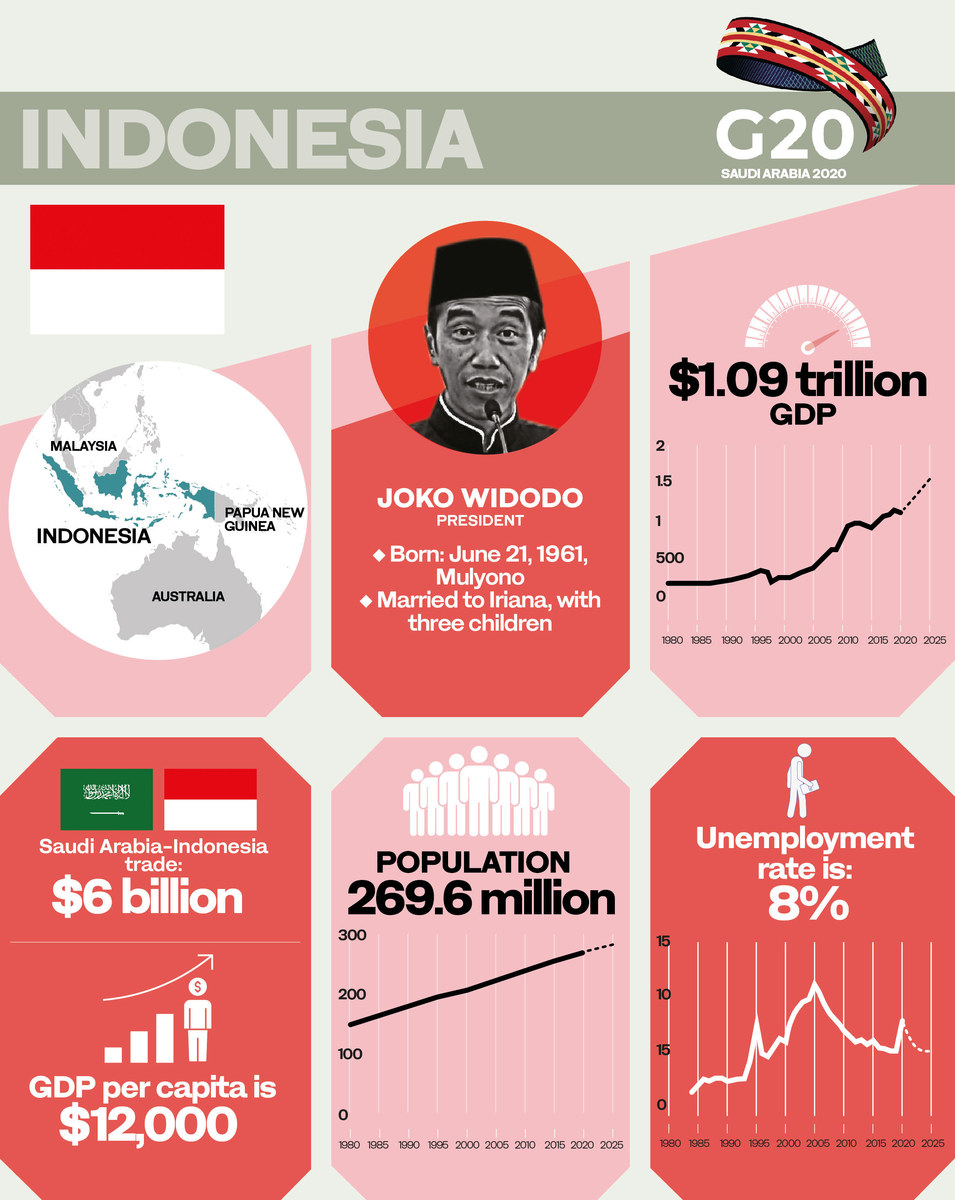
“Indonesia, which has a predominantly Muslim population, has a strong relationship with Saudi Arabia. The state visits by President Joko Widodo in 2015, 2018 and 2019 mark the importance of Saudi Arabia for the people of Indonesia. The historic visit by King Salman to Indonesia in 2017 showed the remarkable cooperation between the two countries,” he added. “I hope cooperation between Saudi Arabia and Indonesia will strengthen.
“Saudi Arabia has prepared the G20 Summit very well. Indonesia is keen to learn from Riyadh, to prepare ourselves for hosting the G20 Summit in 2023.”