Indonesians return to roots by farming during pandemic

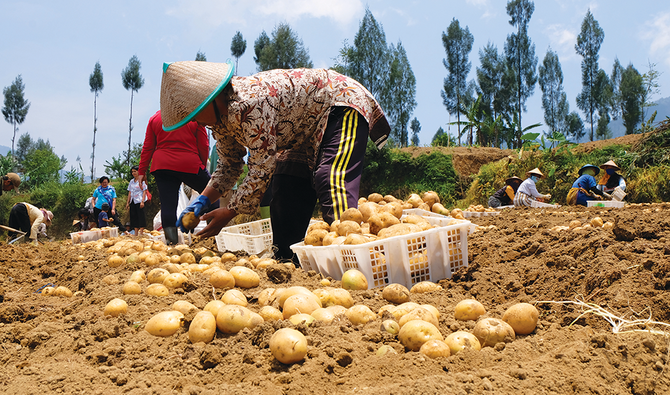
Farmers harvesting potatoes at a plantation in Dieng plateau, Wonosobo, central Java, Indonesia. (Shutterstock)
Short Url
Updated 09 November 2020
Follow

Indonesians return to roots by farming during pandemic

  • People who lost their jobs in the cities returned to their villages and became farmers

JAKARTA: When Galih Ainun Najib was fired from his job as a staff member at a hostel in Central Java’s Dieng Plateau in late March due to a drop in tourism numbers triggered by the coronavirus outbreak, he turned to farming to make ends meet.

Today, the 27-year-old Indonesian is a full-time farmer earning up to 15 million rupiahs ($1,055) by harvesting potatoes on his parents’ farming plots, across an area of 0.5 hectares, in the Kepakisan village of the Banjarnegara district.

“I became a full-time farmer in April, growing potatoes and carrots on my parents’ lands. I earn up to 15 million rupiahs from harvesting potatoes every three months,” Najib told Arab News on Tuesday.

It is a tedious process with a 30 to 40-day harvesting break between each plot.

“While waiting for the next planting season on our land, I also work as a farmworker on a daily basis on other people’s farmlands before their harvest,” Najib said. The main reason, he says, is because farming and agriculture have not been “much affected during the pandemic.”

“We are still producing and harvesting as there are still demands for our produce. People would still need to eat, anyway, and Dieng potato is among the best quality in the market,” he said.

While other sectors were battered by the pandemic — which struck Indonesia in March — agricultural activities were able to contribute about 15 percent growth to the country’s gross domestic product (GDP) in the second quarter of this year, an increase from the average 12 percent growth reported in 2019, Nunung Nuryartono, dean of School of Economics and Management at Bogor Agricultural University said.

“People who lost their jobs in the cities returned to their villages and became farmers. Even in the cities, people turned to urban farming too, when they had to isolate during the social restrictions, while demand for agriculture and farming produce, such as fish, vegetables, or herbal plants to boost immunity was on the rise,” he told Arab News.

The sector’s resilience during the pandemic was the main point of focus in Agriculture Minister Syahrul Yasin Limpo’s address during the virtual G20 Agriculture Ministers’ Meeting hosted by Saudi Arabia on Sept. 12.

“I called on fellow G20 agriculture ministers to collaborate in mitigating the impact of the pandemic on the global food security,” Limpo said.

He added that the sector was able to provide jobs for almost half of Indonesia’s workforce during the pandemic as it was “able to create jobs in rural areas, provide social security, increase farmers’ earnings, and ensure national food security.”

With farming acting as a “solace for burnt-out young urban workers” during the pandemic, the Agriculture Ministry has shifted focus to the occupation by setting up a program to boost the number of millennial farmers to 2.5 million people, its spokesman Kuntoro Boga Andri told Arab News.

“It is part of the ministry’s long term program to ensure a sustainable development in the agriculture sector,” Andri said.


Jordan’s industry fuels 39% of Q2 GDP growth

Updated 31 December 2025
Follow

Jordan’s industry fuels 39% of Q2 GDP growth

JEDDAH: Jordan’s industrial sector emerged as a major contributor to economic performance in 2025, accounting for 39 percent of gross domestic product growth in the second quarter and 92 percent of national exports.

Manufactured exports increased 8.9 percent year on year during the first nine months of 2025, reaching 6.4 billion Jordanian dinars ($9 billion), driven by stronger external demand. The expansion aligns with the country’s Economic Modernization Vision, which aims to position the country as a regional hub for high-value industrial exports, the Jordan News Agency, known as Petra, quoted the Jordan Chamber of Industry President Fathi Jaghbir as saying.

Export growth was broad-based, with eight of 10 industrial subsectors posting gains. Food manufacturing, construction materials, packaging, and engineering industries led performance, supported by expanded market access across Europe, Arab countries, and Africa.

In 2025, Jordanian industrial products reached more than 144 export destinations, including emerging Asian and African markets such as Ethiopia, Djibouti, Thailand, the Philippines, and Pakistan. Arab countries accounted for 42 percent of industrial exports, with Saudi Arabia remaining the largest market at 955 million dinars.

Exports to Syria rose sharply to nearly 174 million dinars, while shipments to Iraq and Lebanon totaled approximately 745 million dinars. Demand from advanced markets also strengthened, with exports to India reaching 859 million dinars and Italy about 141 million dinars.

Industrial output also showed steady improvement. The industrial production index rose 1.47 percent during the first nine months of 2025, led by construction industries at 2.7 percent, packaging at 2.3 percent, and food and livestock-related industries at 1.7 percent.

Employment gains accompanied the sector’s expansion, with more than 6,000 net new manufacturing jobs created during the period, lifting total industrial employment to approximately 270,000 workers. Nearly half of the new jobs were generated in food manufacturing, reflecting export-driven growth.

Jaghbir said industrial exports remain among the economy’s highest value-added activities, noting that every dinar invested generates an estimated 2.17 dinars through employment, logistics, finance, and supply-chain linkages. The sector also plays a critical role in narrowing the trade deficit and supporting macroeconomic stability.

Investment activity accelerated across several subsectors in 2025, including food processing, chemicals, pharmaceuticals, mining, textiles, and leather, as manufacturers expanded capacity and upgraded production lines to meet rising demand.

Jaghbir attributed part of the sector’s momentum to government measures aimed at strengthening competitiveness and improving the business environment. Key steps included freezing reductions in customs duties for selected industries, maintaining exemptions for production inputs, reinstating tariffs on goods with local alternatives, and imposing a 16 percent customs duty on postal parcels to support domestic producers.

Additional incentives in industrial cities and broader structural reforms were also cited as improving the investment climate, reducing operational burdens, and balancing consumer needs with protection of local industries.