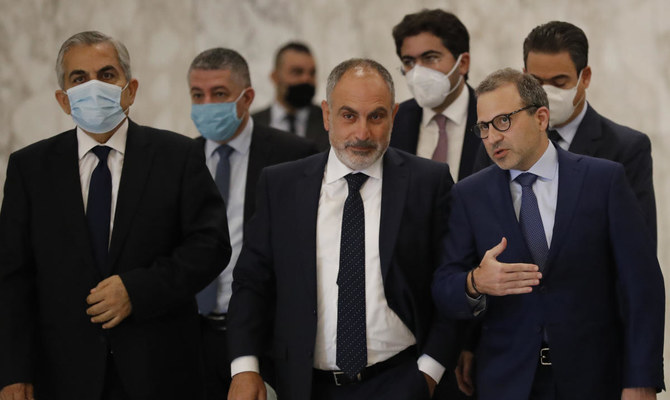
NEW YORK: Gebran Bassil may be the first Lebanese politician to be subjected to sanctions under the Magnitsky Act — designed to punish corruption and human rights violations — but he certainly won’t be the only one.
According to a US official source — who asked to remain anonymous — 23 other Lebanese politicians and individuals have also been blacklisted.
Two months ago, the State Department contacted those designated — in addition to Bassil — and set an ultimatum for them to alter behavior or face isolation through sanctions.
The official told Arab News that, while four managed to get off the list, the other 19 had tried to get around the requirements “by going around, offering to strike deals, hoping to outsmart the US administration.”
Some with close ties to Bassil did not relent in “backstabbing Bassil, thinking that would get them off the hook. It didn’t work out.”
However, the official warned that “no Lebanese politician should be feeling happy. Some of the individuals blacklisted are close to Saad Hariri (the Lebanese Prime Minister), as well. So, no one feels happy about Bassil’s misfortune. Many more Lebanese politicians and their allies will follow. All corruption will be met with sanctions.”
He added that the State Department contacted Bassil again ten days ago and asked him to publicly distance himself from Hezbollah.
Bassil, the head of the Free Patriotic Movement, who is at the center of government formation effort, tried to reason with the Americans: His alliance with Hezbollah could yield benefits that are otherwise impossible to achieve, arguing about the important role he played in facilitating the maritime borders talks between Israel and Lebanon.
But the Americans would have none of it. That was the last Bassil heard from them before sanctions were enacted.
On Friday, Bassil said on Twitter that he was not “scared” of the sanctions and had not been “tempted” by promises.
In September, the US blacklisted two ex-Lebanese government ministers, Hassan Khalil and Youssef Fenianos for providing material support for Hezbollah and engaging in government corruption.


More Lebanese officials to face sanctions after Gebran Bassil
https://arab.news/53kca
More Lebanese officials to face sanctions after Gebran Bassil

- No Lebanese politician should be feeling happy, says US source
- Bassil tried to reason with the Americans but they would have have none of it, the source added


Hundreds mourn in Syria’s Homs after deadly mosque bombing
- Officials have said the preliminary investigations indicate explosive devices were planted inside the mosque but have not yet publicly identified a suspect
HOMS: Hundreds of mourners gathered Saturday despite rain and cold outside of a mosque in the Syrian city of Homs where a bombing the day before killed eight people and wounded 18.
The crowd gathered next to the Imam Ali ibn Abi Talib Mosque in the Wadi Al-Dhahab neighborhood, where the population is predominantly from the Alawite minority, before driving in convoys to bury the victims.
Officials have said the preliminary investigations indicate explosive devices were planted inside the mosque but have not yet publicly identified a suspect.
A little-known group calling itself Saraya Ansar Al-Sunna claimed responsibility for the attack in a statement posted on its Telegram channel, in which it indicated that the attack intended to target members of the Alawite sect, an offshoot of Shia Islam whom hard-line Islamists consider to be apostates.
The same group had previously claimed a suicide attack in June in which a gunman opened fire and then detonated an explosive vest inside a Greek Orthodox church in Dweil’a, on the outskirts of Damascus, killing 25 people as worshippers prayed on a Sunday.
A neighbor of the mosque, who asked to be identified only by the honorific Abu Ahmad (“father of Ahmad“) out of security concerns, said he was at home when he heard the sound of a “very very strong explosion.”
He and other neighbors went to the mosque and saw terrified people running out of it, he said. They entered and began trying to help the wounded, amid blood and scattered body parts on the floor.
While the neighborhood is primarily Alawite, he said the mosque had always been open to members of all sects to pray.
“It’s the house of God,” he said. “The mosque’s door is open to everyone. No one ever asked questions. Whoever wants to enter can enter.”
Mourners were unable to enter the mosque to pray Saturday because the crime scene remained cordoned off, so they prayed outside.
Some then marched through the streets chanting “Ya Ali,” in reference to the Prophet Muhammad’s cousin and son-in-law whom Shiite Muslims consider to be his rightful successor.


