Lebanon’s president seeks evidence behind US sanctions on son-in-law

The US Treasury Department accused Bassil of being at the “forefront of corruption in Lebanon.” (AFP)
Short Url
Updated 07 November 2020
Follow

Lebanon’s president seeks evidence behind US sanctions on son-in-law

  • Aoun asked Lebanon’s caretaker foreign minister to obtain the evidence and documents
  • The sanctions could complicate efforts by Prime Minister-designate Saad Al-Hariri to navigate Lebanon’s sectarian politics

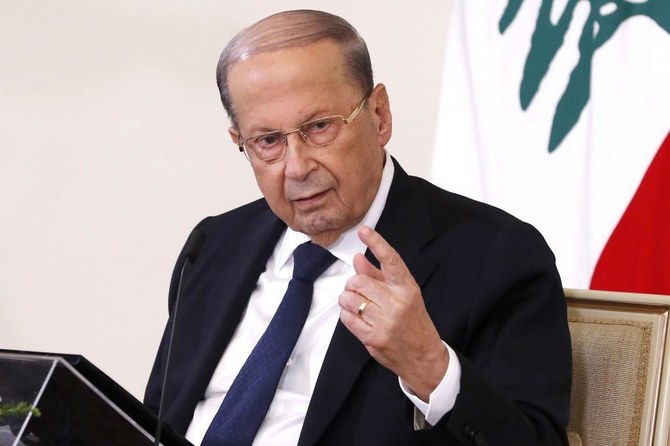
BEIRUT: Following the sanctions that hit Lebanese lawmaker Gebran Bassil, President Michel Aoun has called for proof of the accusations against his son-in-law.

Aoun called on the Minister of Foreign Affairs in the caretaker government of Charbel Wehbe to make calls to the US Embassy in Lebanon and the Lebanese Embassy in Washington to obtain the documents and evidence that led the US Treasury to accuse Bassil of corruption and impose sanctions against him.

Aoun said the documents must be referred to the Lebanese judiciary to take the necessary measures in the event the accusations turned out to be true.

Leader of the Free Patriotic Movement (FPM) and the president’s son-in-law, Bassil is the first Lebanese politician to be subjected to sanctions under the Magnitsky Act — designed to punish corruption and human rights violations.

The sanctions include seizing the properties and funds of targeted people and those who deal with them (companies, entities and individuals), closing their bank accounts as well as their family members’ accounts, and banning them from entering the US.

Economist Violette Balaa told Arab News: “Bassil will not be the only one. According to my sources at the US administration, a new list will be issued in one or two weeks with names of other top politicians.”

Balaa added: “The sources confirmed that the list will include officials from the FPM, the Future Movement and the Amal Amovement, as well as businessmen, and will be issued by the US Treasury before the new president takes office. The timing was carefully chosen.”

US Treasury Secretary Steven Mnuchin said in a statement: “The systemic corruption in Lebanon’s political system exemplified by Bassil has helped to erode the foundation of an effective government that serves the Lebanese people. Lebanon has long suffered from corruption and economic mismanagement by power brokers who advance their own interests at the expense of the Lebanese people they are supposed to represent.”

Public opinion in Lebanon was divided on the sanctions against Bassil. Activists in the civil movement in Lebanon voiced their support on social media for any sanctions imposed on corrupt officials, while FPM supporters insisted that Bassil was only sanctioned for rejecting US deals to distance himself from Hezbollah and settle Syrian refugees.

The FPM issued a statement on Saturday where it expressed its “total rejection of the sanctions” and called on its supporters, “who are staging spontaneous protests,” not to go anywhere near the US Embassy in Awkar.

The statement called the sanctions “a blatant slander and clear attempt to use the American law to seek revenge from a political leader for refusing to do something that goes against his national convictions, principles, choices.”

The statement stressed that the FPM “will remain free and will not obey any local or foreign instructions, choosing the national unity over satisfying the foreign authorities and standing by any Lebanese national against any attack.”

Deputy Speaker Elie Ferzli claimed that Aoun and Bassil knew about the sanctions two weeks before their announcement.

“If the parties concerned had formed a Lebanese government after naming Hariri, this may have helped with canceling these sanctions. But it did not happen,” he said.

Former minister Ghassan Hasbani said: “The sanctions under the Magnitsky Act will not be lifted, as it is a law related to misusing authority and influence and corruption” and doubted that “anyone from the Lebanese Forces Party will be subjected to these sanctions.”

Kataeb’s Deputy President Salim Al-Sayegh said that “a good response to these sanctions would be forming a government of independent technocrats, holding early elections, implementing economic reforms and declaring neutrality.”

As soon as the sanctions against Bassil were announced, Hezbollah declared solidarity with its ally and condemned the decision of the US Treasury, considering it “a purely political decision and a blatant and gross interference in Lebanon’s internal affairs, aiming to force a large Lebanese political team to submit to the US conditions and dictates on Lebanon.”

Former MP Fares Souaid said Bassil “is paying the price for the political choice he made in 2006, by becoming a Hezbollah ally.”

“Bassil has turned from a politician into a mail box between Iran and the US,” he added.


US and Iran slide towards conflict as military buildup eclipses nuclear talks

Updated 28 min 13 sec ago
Follow

US and Iran slide towards conflict as military buildup eclipses nuclear talks

  • Washington building up one of its biggest military deployments in the region since the invasion of Iraq in 2003
  • Iran is expected to submit a written proposal in the coming days, a US official says

Iran and the United States are sliding rapidly towards military conflict as hopes fade for a diplomatic solution to their standoff over Tehran’s nuclear program, officials on both sides and diplomats across the Gulf and Europe say.

Iran’s Gulf neighbors and its enemy Israel now consider a conflict to be more likely than a settlement, these sources say, with Washington building up one of its biggest military deployments in the region since the invasion of Iraq in 2003.

Israel’s government believes Tehran and Washington are at an impasse and is making preparations for possible joint military action with the United States, though no decision has been made yet on whether to carry out such an operation, said a source familiar with the planning.

It would be the second time the US and Israel have attacked Iran in less than a year, following US and Israeli airstrikes against military and nuclear facilities last June.

Regional officials say oil-producing Gulf countries are preparing for a possible military confrontation that they fear could spin out of control and destabilize the Middle East.

Two Israeli officials told Reuters they believe the gaps between Washington and Tehran are unbridgeable and that the chances of a near‑term military escalation are high.

Some regional officials say Tehran is dangerously miscalculating by holding out for concessions, with US President Donald Trump boxed in by his own military buildup - unable to scale it back without losing face if there is no firm commitment from Iran to abandon its nuclear weapons ambitions.

“Both sides are sticking to their guns,” said Alan Eyre, a former US diplomat and Iran specialist, adding that nothing meaningful can emerge “unless the US and Iran walk back from their red lines - which I don’t think they will.”

“What Trump can’t do is assemble all this military, and then come back with a ‘so‑so’ deal and pull out the military. I think he thinks he’ll lose face,” he said. “If he attacks, it’s going to get ugly quickly.”

Two rounds of Iran-US talks have stalled on core issues, from uranium enrichment to missiles and sanctions relief.

When Omani mediators delivered an envelope from the US side containing missile‑related proposals, Iranian Foreign Minister Abbas Araghchi refused even to open it and returned it, a source familiar with the talks said.

After talks in Geneva on Tuesday, Araghchi said the sides had agreed on “guiding principles,” but the White House said there was still distance between them.

Iran is expected to submit a written proposal in the coming days, a US official said, and Araghchi said on Friday he expected to have a draft counterproposal ready within days.

But Trump, who has sent aircraft carriers, warships and jets to the Middle East, warned Iran on Thursday it must make a deal over its nuclear program or “really bad things” will happen.

He appeared to set a deadline of 10 to 15 days, drawing a threat from Tehran to retaliate against US bases in the region if attacked. The rising tensions have pushed up oil prices.

US officials say Trump has yet to make up his mind about using military force although he acknowledged on Friday that he could order a limited strike to try to force Iran into a deal.

“I guess I can say I am considering that,” he told reporters.

The possible timing of an attack is unclear. US Secretary of State Marco Rubio is due to meet Israeli Prime Minister Benjamin Netanyahu on February 28 to discuss Iran. A senior US official said it would be mid-March before all US forces were in place.