

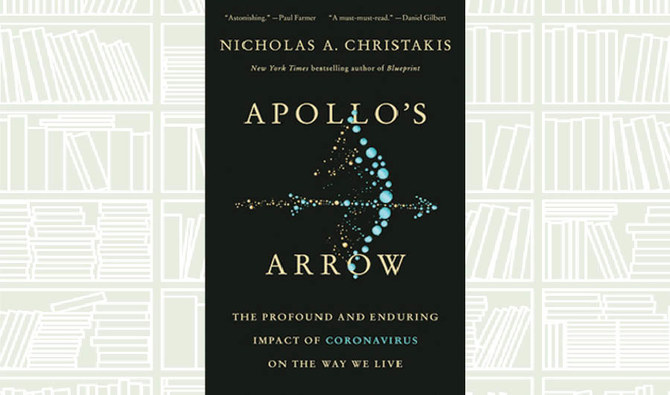
What We Are Reading Today: Apollo’s Arrow

Short Url
Updated 07 November 2020
Follow

What We Are Reading Today: Apollo’s Arrow

Author: Nicholas A. Christakis

Apollo’s Arrow offers a riveting account of the impact of the coronavirus pandemic as it swept through American society in 2020, and of how the recovery will unfold in the coming years.
“Featuring new, provocative arguments and vivid examples ranging across medicine, history, sociology, epidemiology, data science, and genetics, Apollo’s Arrow envisions what happens when the great force of a deadly germ meets the enduring reality of our evolved social nature,” said a review in goodreads.com.
“This is a piercing and scientifically grounded look at the emergence of the coronavirus pandemic and how it will change the way we live — this year’s must-must-read.” it added.
“It is still too early to know,” Christakis writes, how the COIVD-19 virus might mutate.
“It is indeed early, and many more books will offer to help us understand the pandemic. But Apollo’s Arrow is a good start,” said David Quammen in a review for The New York Times.
Quammen says Apollo’s Arrow “is a useful contribution to this initial wave of Covid books, sensible and comprehensive, intelligent and well sourced, albeit a little programmatic and dull.”


What We Are Reading Today: Three Roads Back by Robert D. Richardson

Updated 06 March 2026
Follow

What We Are Reading Today: Three Roads Back by Robert D. Richardson

In “Three Roads Back,” Robert Richardson, the author of magisterial biographies of Ralph Waldo Emerson, Henry David Thoreau, and William James, tells the connected stories of how these foundational American writers and thinkers dealt with personal tragedies early in their careers. 
For Emerson, it was the death of his young wife and, 11 years later, his five-year-old son; for Thoreau, it was the death of his brother; and for James, it was the death of his beloved cousin Minnie Temple. 

Filled with rich biographical detail and unforgettable passages from the journals and letters of Emerson, Thoreau, and James, these vivid and moving stories of loss and hard-fought resilience show how the writers’ responses to these deaths helped spur them on to their greatest work, influencing the birth and course of American literature and philosophy.
As Richardson shows, all three emerged from their grief with a new way of seeing, one shaped by a belief in what Emerson called “the deep remedial force that underlies all facts.”