

Saudi plans to relax foreign workers’ sponsorship terms will benefit Pakistanis — envoy

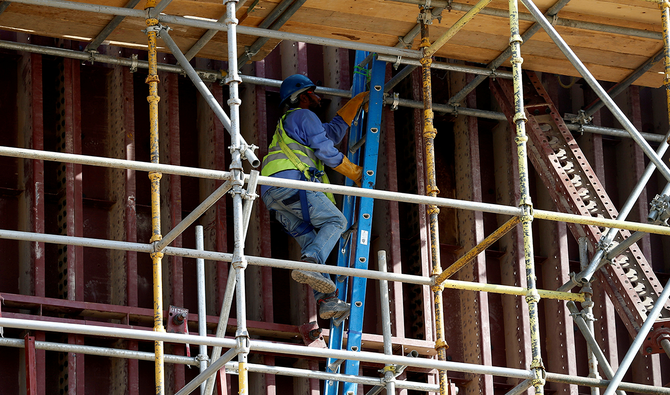
An Asian laborer climbs a ladder as he works at the construction site of a building in Riyadh, Saudi Arabia. (Reuters/File)
Short Url
Updated 07 November 2020
Follow

Saudi plans to relax foreign workers’ sponsorship terms will benefit Pakistanis — envoy

  • Kingdom has announced new plans to ease foreign laborers’ contractual restrictions, abolishing a seven-decade-old sponsorship system known as kafala
  • The plans, to take effect in March 2021, will grant foreign workers the right to change jobs and leave the country without employers’ permission

ISLAMABAD: Pakistan’s top diplomat in Riyadh, Raja Ali Ejaz, on Thursday praised recently announced Saudi labor reforms that will ease foreign workers’ contractual restrictions, saying they would significantly benefit Pakistani workers in the kingdom.

Saudi Arabia announced this week that it would abolish a seven-decade-old sponsorship system known as kafala. The reforms, to take effect in March 2021, aim to make the Saudi labor market more attractive by granting over 10 million foreign workers the right to change jobs and leave the country without employers’ permission.

Saudi Arabia, which chairs the Group of 20 major economies (G20) this year, is seeking to boost its private sector as part of an ambitious plan to diversify its oil-dependent economy.

“The reforms are expected to benefit Pakistani workers and we congratulate the Ministry of Human Resource and Social Development,” Ejaz told Arab News on Thursday.

The new initiative will base the relation between employers and workers on a standard contract that needs to be certified by the government, and will allow workers to apply directly for services via an e-government portal, instead of a mandatory employers’ approval.

The ministry aims to certify the contracts of all foreign workers by the end of the first quarter of 2021.

Ejaz said the reforms were grounded in best international practices, and the new system would activate the employer-employee contractual agreement through digital documentation, which would resolve administrative glitches.

“The new initiative will alleviate the problems of those workers who sign work agreements in Pakistan and are then asked to sign another agreement in the kingdom,” Ejaz said, adding that the new system would also help Pakistani workers search for new jobs on the expiry of their contracts while still residing in the kingdom.

“We all have a sense of freedom and empowerment now,” said Javed Chaudhry, a Pakistani expatriate from Gujrat who has been working in the kingdom for the last four decades. “I have worked in Saudi Arabia for the last 40 years. It was our dream to get such a facility.”

“For the first time, I will not be under any obligation to seek approval from anyone to visit my family in Pakistan,” Chaudhry told Arab News via phone from Jeddah. “I will be able to travel more freely to see them and perform my job without undue pressure.”

Another Pakistani worker, Syed Qamar Abbas, who works in an electric equipment factory in Dammam, said the new labor policy promised more rights to workers.

“It will give us more rights and freedom. Until now, we were at the mercy of our sponsor for everything,” he said. “Now the sponsor’s name will be removed from iqama [work permit] … We will also be able to take up another job once our contract with our company comes to an end.”

Saudi Arabia’s Vision 2030 reform plan is a package of economic and social policies designed to free the kingdom from reliance on oil exports.

The currently applicable kafala system generally binds a migrant worker to one employer, a system that rights groups say leaves workers vulnerable to abuses.


Six cops killed as IED explosion targets police vehicle in northwestern Pakistan 

Updated 6 sec ago
Follow

Six cops killed as IED explosion targets police vehicle in northwestern Pakistan 

  • Blast in northwestern Tank district kills inspector, additional sub-inspector, driver and three members of elite force personnel, says police official 
  • Attack takes place as Islamabad grapples with surge in militant attacks in northwestern Khyber Pakhtunkhwa province bordering Afghanistan

PESHAWAR: Six cops were killed in an improvised explosive device (IED) blast that targeted a police vehicle in Pakistan’s northwestern Tank district on Monday, a police official said as Islamabad struggles to contain surging militant attacks in the Khyber Pakhtunkhwa (KP) province. 

The IED explosion targeted an armored police vehicle on the Gomal-Jutta Road near the Kot Wali Canal area, Tank police spokesperson Younas Khan said. The blast killed an inspector, an additional sub-inspector, the driver of the vehicle and three members of the police’s elite force personnel. 

“The armored police vehicle was completely damaged in the explosion,” Khan said. 

He said senior police officials, including District Police Officer (DPO) Tank Shabbir Hussain Shah reached the site of the blast to collect evidence and carry out an operation in the nearby rugged terrain.

Prime Minister Shehbaz Sharif expressed sorrow over the incident, directing authorities to carry out an investigation into the incident. 

“The terrorists responsible for this attack will be brought to their logical end at the earliest,” Sharif was quoted as saying by his office. 

KP Chief Minister Sohail Afridi praised police for their sacrifices against militancy, vowing to bring all those involved in the incident to justice. 
 
“Anti-peace elements would not succeed in their nefarious designs by targeting the police force,” Afridi said as per a statement released from his office. 

No group has claimed responsibility for the attack. However, the Tehreek-e-Taliban Pakistan (TTP) militant outfit has claimed responsibility for some of the deadliest attacks targeting law enforcement personnel in KP in the past. The TTP has frequently targeted convoys of security forces, police stations and check-posts besides kidnapping government officials in the region.

Islamabad has frequently accused Afghanistan of allowing the use of its soil to armed outfits such as the TTP. It has also alleged that India backs militant groupswho carry out attacks against Pakistan. Kabul and New Delhi have consistently denied this.