

Damascus fair offers hope for exports-starved Aleppo artisans

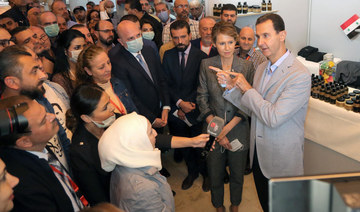
Visitors tour a trade fair dedicated to war-hit businesses from Aleppo looking to make a revival, in the Syrian capital Damascus’ Tekkiyeh Sulimaniyeh complex. (AFP)
Short Url
Updated 06 November 2020
Follow

Damascus fair offers hope for exports-starved Aleppo artisans

DAMASCUS: Under the elegant arches and domes of an Ottoman-era compound, Joseph Tobjian displays his aromatic Aleppo soap at a trade fair designed to revive Syria’s exports-starved arts and crafts. 

The soap maker is among more than 130 merchants taking part in the state-sponsored fair in Damascus for small businesses from Aleppo, northern Syria. 

“I’ve spent my entire life around laurel oil and soap. Their scent does not leave my lungs,” Tobjian told AFP. 

“We’re in Damascus looking for an alternative to foreign markets, after exports stopped,” he said, soap bottles and natural cosmetics lining the table in front of him. 

The 61-year-old said he was surprised by the high number of visitors at the fair, including Damascus traders interested in his beauty products. 

Aleppo, Syria’s pre-war economic hub, is famed for its ancient crafts, hit hard by the conflict that broke out in 2011. 

Goods ranging from traditional soaps, furniture and garments to made-in-Syria marshmallows are on show in the capital’s Tekkiye Al-Sulaymaniyah complex. 

SPEEDREAD

Aleppo, Syria’s pre-war economic hub, is famed for its ancient crafts, hit hard by the conflict that broke out in 2011.

The Tobjian family fled to Canada from Aleppo in 2012, leaving behind a soap workshop that employed about 40 workers in its heyday. 

Unhappy with life in exile, the Syrian Armenian family returned in 2018 to find both their workshop and city in ruins. 

They relocated to a modest workshop and employed two workers to resume production of Aleppo soap, once a top export also popular among tourists. 

“We inherited this craft from our fathers and grandfathers,” said Tobjian, wearing a T-shirt bearing the image of Syria’s Bashar Assad. 

“We must do everything we can to revive our workshops and factories.” 

Aleppo’s centuries-old covered bazaar, situated in its Old City, a UNESCO World Heritage Site, once teemed with thousands of stalls. 

The Old City saw some of the heaviest battles of Syria’s war, before Russian-backed regime forces recaptured rebel-held districts of Aleppo in December 2016. 

A gradual regime-led restoration program has revived parts of Aleppo’s bazaar but the scars of war remain. 

In Aleppo’s industrial zone, the largest in Syria, most factories and workshops were also ravaged by fighting. 

With state support, some 70 small workshops have reopened but business is slow amid an economic crisis compounded by Western sanctions and the collapse of the Syrian pound against the dollar. 

“The war destroyed the infrastructure of industries in Aleppo,” said Alaa Hilal, director of the week-long Damascus fair. 

Western sanctions, which hinder fuel imports, have also made it tough for factories to operate. 

This is why Aleppo craftsmen are looking “for opportunities to make sales, sign contracts and market their products in Damascus,” Hilal said. 

Western sanctions have pushed Syrian businesses to find alternatives. 

At the fair, Sonali Ghazal shows off marshmallows scented with rose water or pistachios from Aleppo. 

“We managed to make marshmallow in Syria, and we gave them an Aleppo touch,” the 42-year-old teacher said. 

Sonali said she used to buy them for her students before marshmallows vanished from the market because of the war and sanctions. 

She came up with a home-grown alternative, “but this time, with the flavour of Aleppo pistachios.”

Israel’s Netanyahu agrees to join Trump’s Board of Peace

Updated 4 sec ago
Follow

Israel’s Netanyahu agrees to join Trump’s Board of Peace

  • Prime Minister Benjamin Netanyahu of Israel says he’s agreed to join Trump’s Board of Peace. Netanyahu made the announcement Wednesday from his office
  • The announcement came after Israel said the makeup of the Board’s Gaza executive body did not align with Israel’s interests
JERUSALEM: Prime Minister Benjamin Netanyahu of Israel said Wednesday he had agreed to join US President Donald Trump’s Board of Peace, after his office earlier criticized makeup of the board’s executive committee.
The board, chaired by Trump, was originally envisioned as a small group of world leaders overseeing the Gaza ceasefire plan. The Trump administration’s ambitions have appeared to balloon into a more sprawling concept, with Trump extending invitations to dozens of nations and hinting it will soon broker global conflicts.
Netanyahu’s office had previously said the executive committee — which includes Turkiye, a key regional rival — wasn’t coordinated with the Israeli government and “is contrary to its policy,” without clarifying its objections. Israel’s far-right finance minister, Bezalel Smotrich, has criticized the board and called for Israel to take unilateral responsibility for Gaza’s future.
Others who have joined the board are the UAE, Morocco, Vietnam, Belarus, Hungary, Kazakhstan and Argentina. Others, including the UK, Russia and the executive arm of the European Union, say they have received invitations but have not yet responded.
It came as Trump traveled to the World Economic Forum meeting in Davos, Switzerland, where he is expected to provide more details about the board. There are many unanswered questions. It was not immediately clear how many or which other leaders would receive invitations.
When asked by a reporter Tuesday if the board should replace the UN, Trump said, “It might.” He asserted that the world body “hasn’t been very helpful” and “has never lived up to its potential” but also said the UN should continue ”because the potential is so great.”
That has created controversy, with some saying Trump is trying to replace the UN French Foreign Minister Jean-Noel Barrot said Tuesday, “Yes to implementing the peace plan presented by the president of the United States, which we wholeheartedly support, but no to creating an organization as it has been presented, which would replace the United Nations.”
Told late Monday that French President Emmanuel Macron was unlikely to join, Trump said, “Well, nobody wants him because he’s going to be out of office very soon.” A day later, Trump called Macron “a friend of mine” but reiterated that the French leader is “not going to be there very much longer.”
The executive board’s members include US Secretary of State Marco Rubio, Trump envoy Steve Witkoff, Trump’s son-in-law Jared Kushner, former British Prime Minister Tony Blair, Apollo Global Management CEO Marc Rowan, World Bank President Ajay Banga, and Trump’s deputy national security adviser Robert Gabriel.
The White House also announced the members of another board, the Gaza Executive Board, which, according to the ceasefire, will be in charge of implementing the tough second phase of the agreement. That includes deploying an international security force, disarming Hamas and rebuilding the war-devastated territory.
Nickolay Mladenov, a former Bulgarian politician and UN Mideast envoy, is to serve as the Gaza executive board’s representative overseeing day-to-day matters. Additional members include: Witkoff, Kushner, Blair, Rowan, Turkish Foreign Minister Hakan Fidan; Qatari diplomat Ali Al-Thawadi; Hassan Rashad, director of Egypt’s General Intelligence Agency; Emirati minister Reem Al-Hashimy; Israeli businessman Yakir Gabay; and Sigrid Kaag, the Netherlands’ former deputy prime minister and a Mideast expert.
The board also will supervise a newly appointed committee of Palestinian technocrats who will be running Gaza’s day-to-day affairs.