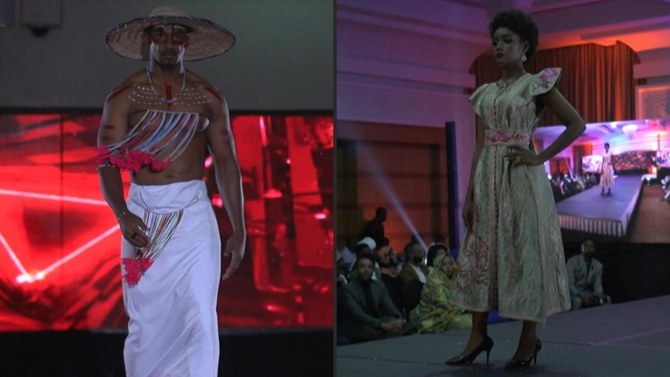
KHARTOUM: In a move that would have been almost unthinkable under ousted president Omar Al-Bashir, Sudanese designers have organised a series of mixed-gender fashion shows to present their new lines.
The shows in upmarket Khartoum hotels saw female and male models parading down the catwalk together for the first time since before Bashir seized power more than three decades ago.
"In the old days, it was very difficult to organise a show like this. One would not dream of getting approval for it from authorities," Sudanese designer Khaled Onsa told AFP.
"We used to face repression instead, but now we are ruled by a system that guarantees public freedoms."
Bashir, a general who seized power in a coup in 1989, ruled Sudan with an iron fist until his ouster in a palace coup in April last year following months of mass protests on the streets.
He imposed a harsh form of Islamic law, criminalising everything from drinking alcohol to women wearing clothes deemed as "revealing".
The transitional government installed after his overthrow has set about dismantling his legacy of repression.
It scrapped Sudan's 1996 public order laws which empowered policemen to take action against people dressed "indecently".
Female designer Nermin Awad Sharif, who organised one of the shows, said there had never been much opposition to such events among the people.
"What we offer are outfits that everyone will accept," she told AFP. "I don't think anyone in Sudanese society would object to them."
Model Barza Mostafa said the show was an opportunity to introduce fashion to the Sudanese people and Sudan to the fashion world.
"We want to introduce the world to our culture," she said. "Previously, people did not understand the idea of a fashion show but now we can see the audience watching and interacting."
Spectator Sawsan Hassan recalled how policemen under Bashir used to stop her for simply not wearing a headscarf.
A decade ago, Hassan had attended a fashion show in Sudan that ended with organisers and models behind bars.
"Some were even flogged," she said.
Designer Hossam Mohamed Ahmed believes the shows are testament to the spirit of change in Sudan.
"I can now show people my designs. It was impossible before," he said.
Mahid Muhammad, who attended one of the shows with his three sisters, proudly showed short video clips he had taken with his mobile phone.
"This is Sudan in its full freedom," he said.


Sudan holds first unisex fashion shows after Bashir ouster
https://arab.news/zdszn
Sudan holds first unisex fashion shows after Bashir ouster

- Spectator Sawsan Hassan recalled how policemen under Bashir used to stop her for simply not wearing a headscarf
- A decade ago, Hassan had attended a fashion show in Sudan that ended with organisers and models behind bars


Georges Chakra presents new couture collection in Paris
- Chakra introduces ‘new Parisienne attitude’
- Top Arab designers also have shows in city
DUBAI: Lebanese designer Georges Chakra has presented his Spring/Summer 2026 couture collection at Paris Haute Couture Week, offering a contemporary interpretation of the house’s established design codes through refined silhouettes and detailed craftsmanship.
Drawing on the heritage of the maison, the collection revisited classic elements of elegance while introducing what the designer described in an Instagram post as a “new Parisienne attitude.”
Soft pastels, ivory and metallic tones defined the palette, moving between pale blue, blush, lavender and gold across the runway.
The show featured a range of sculpted looks, with structured bodices balanced by feathered appliques, floral embroidery and layers of sheer tulle.
Strapless gowns with petal-like embellishments appeared alongside column dresses finished with subtle shimmer, while ruffled sleeves, organza capes and sheer overlays created volume and movement.
White gowns formed a central part of the collection, ranging from minimal silhouettes with clean lines to more elaborate designs incorporating veils, hats and lattice-style embroidery.

Sequins, hand-applied florals and intricate beading appeared throughout the collection. The show concluded with a bridal look featuring sheer embroidery and floral detailing.
After beginning his career in Beirut, where he initially worked at his home studio following his graduation from an institution in Canada, Chakra founded his fashion house in 1985.
He later expanded his atelier to Paris, debuting on the Haute Couture Week calendar in 2002, and has since built an international reputation for couture and eveningwear, dressing a wide range of regional and global figures for major red-carpet appearances.
His designs have been worn by celebrities including Nicki Minaj, Rihanna, Beyonce, Cara Delevingne, Tyra Banks, Jennifer Lopez, Helen Mirren, Molly Sims and Andra Day.
Chakra was among several Arab designers featured during Paris Haute Couture Week this season.
Georges Hobeika and Tony Ward had already presented their Spring/Summer 2026 couture collections earlier in the week, while Elie Saab, Zuhair Murad, Ashi Studio and Rami Al-Ali are scheduled to show later on the official calendar.


