

Swiss say two arrested men were friends of Vienna gunman

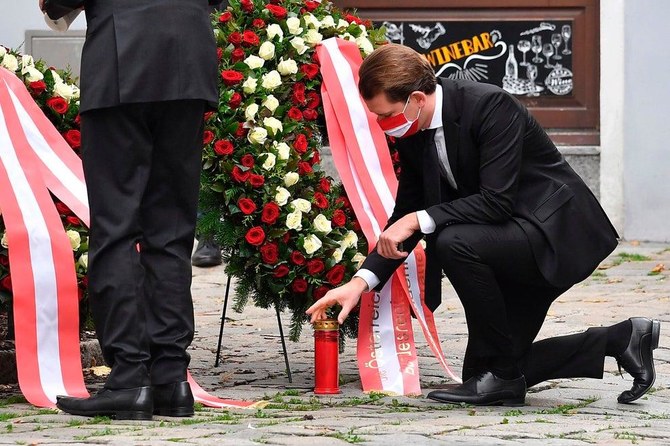
Chancellor of Austria Sebastian Kurz places a candle at the scene of a terrorist attack in Vienna. (AFP)
Short Url
Updated 04 November 2020
Follow

Swiss say two arrested men were friends of Vienna gunman

  • Swiss police arrested two men, aged 18 and 24, on Tuesday in the town of Winterthur, 20 kilometers from the border with Germany
  • Both men, whose names have not been released, are already the subject of two criminal cases being prosecuted by the Swiss attorney general’s office

ZURICH: Swiss authorities confirmed on Wednesday that two men arrested near Zurich were “obviously friends” of a gunman who killed four people in a shooting rampage in Vienna and said police were investigating the full extent of their relationship with him.

Austrian police shot dead the gunman soon after he opened fire on Monday night on crowded bars in the city center. They identified him as Kujtim Fejzulai, 20, a convicted extremist who had dual Austrian and North Macedonian nationality.

Swiss police arrested two men, aged 18 and 24, on Tuesday in the town of Winterthur, which has become a focus of concern over incidents of radicalism in recent years. Austrian police have arrested 14 people as they try to establish whether Fejzulai had any accomplices.

Swiss Justice Minister Karin Keller-Sutter, in a panel discussion shown on the St. Galler Tagblatt newspaper’s website, said the two arrested men were “obviously friends” of the gunman. She said they had met “in person” but did not say when.

“The suspect in Vienna and the two men who were arrested in Winterthur knew each other,” a spokesman for Keller-Sutter’s ministry told Reuters in an email on Wednesday. “Authorities are investigating in close coordination the nature of their relationship.”

Both men, whose names have not been released, are already the subject of two criminal cases being prosecuted by the Swiss attorney general’s office (OAG) and which were opened in 2018 and 2019. The older man is a suspect in one of those cases.

Winterthur, once a prominent industrial center about 20 kilometers from the border with Germany, was the site of a now-shuttered mosque that officials said had attracted preachers who espoused “hate speech.”

Several young people from the Winterthur area who were linked to the mosque traveled to Syria to fight with Daesh. Membership and support of the militant group is outlawed in Switzerland.

In September, a man Swiss media dubbed the “Emir of Winterthur” and described as a leading militant in Switzerland, was sentenced to 50 months in prison for ties to Daesh.

Switzerland has largely been spared extremist violence, but authorities are concerned that the kind of attacks seen in neighboring France, Germany and now Austria could also occur on Swiss territory.

The OAG said on Wednesday that a fatal stabbing of a Portuguese man in September in the town of Morges, in western Switzerland, was still being investigated for a possible “terrorist motive.”
A Swiss-Turkish national has been arrested.


‘Doomsday Clock’ moves closer to midnight over threats from nukes, climate change, AI

Updated 28 January 2026
Follow

‘Doomsday Clock’ moves closer to midnight over threats from nukes, climate change, AI

  • At the end of the Cold War, the clock was as close as 17 minutes to midnight. In the past few years, to address rapid global changes, the group has changed from counting down the minutes until midnight to counting down the seconds

WASHINGTON: Earth is closer than it’s ever been to destruction as Russia, China, the US and other countries become “increasingly aggressive, adversarial, and nationalistic,” a science-oriented advocacy group said Tuesday as it advanced its “Doomsday Clock” to 85 seconds till midnight.

The Bulletin of the Atomic Scientist members had an initial demonstration on Friday and then announced their results on Tuesday.

The scientists cited risks of nuclear war, climate change, potential misuse of biotechnology and the increasing use of artificial intelligence without adequate controls as it made the annual announcement, which rates how close humanity is from ending.

Last year the clock advanced to 89 seconds to midnight.

Since then, “hard-won global understandings are collapsing, accelerating a winner-takes-all great power competition and undermining the international cooperation” needed to reduce existential risks, the group said.

They worry about the threat of escalating conflicts involving nuclear-armed countries, citing the Russia-Ukraine war, May’s conflict between India and Pakistan and whether Iran is capable of developing nuclear weapons after strikes last summer by the US and Israel.

International trust and cooperation is essential because, “if the world splinters into an us-versus-them, zero-sum approach, it increases the likelihood that we all lose,” said Daniel Holz, chair of the group’s science and security board.

The group also highlighted droughts, heat waves and floods linked to global warming, as well as the failure of nations to adopt meaningful agreements to fight global warming — singling out US President Donald Trump’s efforts to boost fossil fuels and hobble renewable energy production.

Starting in 1947, the advocacy group used a clock to symbolize the potential and even likelihood of people doing something to end humanity. 

At the end of the Cold War, it was as close as 17 minutes to midnight. In the past few years, to address rapid global changes, the group has changed from counting down the minutes until midnight to counting down the seconds.

The group said the clock could be turned back if leaders and nations worked together to address existential risks.