

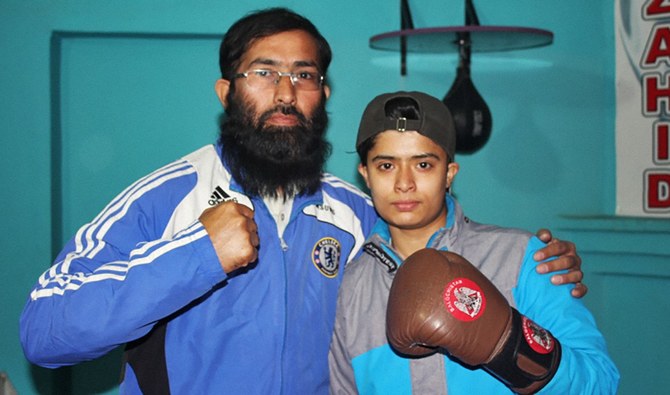

QUETTA: When Malaika Zahid decided she wanted to be a boxer, the only option she initially had was to join a boys training club. Her sights set on becoming one of the top players in the country, and not wanting anything to stand in her way, she soon chopped off her hair.
Zahid grew up in Pakistan’s impoverished southwestern Balochistan province, a region of bone-dry desert and barren hills, where separatists and other militants are active, and women’s lives are highly restricted.
But that has never fazed Zahid.
“I had started my boxing career from a boys club where I was the only girl practicing along with boys, which never deterred me from skipping my passion,” she told Arab News in an interview, wearing a grey baseball cap turned backwards and covering her boyish haircut. “I have knocked out many boys in our club.”
“I wanted to cut my hair,” she added, “but it was my own decision and my father supported me.”
Indeed, Zahid credits much of her success to her unconventional father, Muhammad Zahid, a police constable in Pakistan Railways police. Ever since she was ten years old and first entered a boxing ring, her father’s support has been crucial in helping her become a pioneer of women’s boxing in her impoverished home province.
Now 15, the girl from Quetta city has already won four golds in the lightweight category in interprovincial boxing championships and a silver medal in last year’s National Games in Peshawar. She defended her first major title at age 12, at a boxing tournament for girls in Karachi, the capital of the neighboring Sindh province.
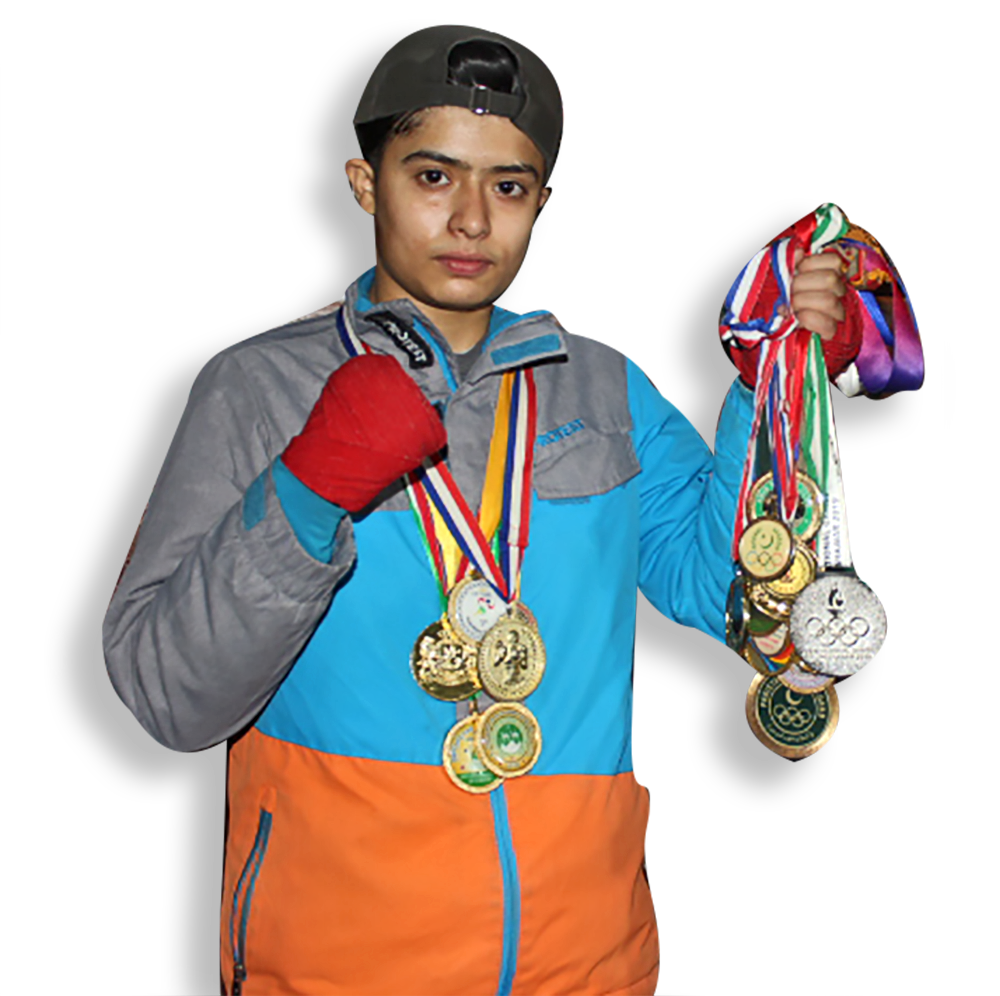
Fifteen-year-old Malaika Zahid poses with her medals in a training room at her home in Quetta, Pakistan, on October 29, 2020. (AN photo by Saadullah Akhter)
Though always into sports, Zahid said the inspiration to become a boxer came from watching a fight by British Pakistani boxing star Amir Khan, a former unified light-welterweight world champion.
“I used to go to sports grounds with my father and cousins and started playing soccer and climbing walls,” she said. “But one day I was watching a boxing match of international boxing player Amir Khan who inspired me and I requested my father that I want to become a boxing player.”
Initially hesitant, the father soon realized that Zahid genuinely loved the sport and had talent.
“When I saw her passion and skills, I took her to one of Quetta’s famous boxing clubs headed by a senior provincial boxer, Atta Muhammad Kakar,” the police constable said.
Kakar, who has coached internationally recognized players, said Zahid soon became one of his best students, even knocking out the boys who trained with her.
“She came to my club with her father and brother at the age of 10,” the coach said. “In a short period, she developed major boxing skills even though she had fights with boys.”
Kakar said he was confident of Malaika’s future success: “My club has introduced two international boxing players: Falcon Muhammad Waseem who fought in Saudi Arabia, South Korea and other countries, and Rasheed Baloch. And I am confident that Malika will follow in their steps.”
This year, Zahid was awarded the Balochistan Star Award by the Balochistan Youth Department, a prize to encourage young talent. Although thrilled by the recognition, the boxer said more needed to be done by the government to support athletes in her home province.
“I have seen international heavyweight boxer Muhammad Waseem, who was from Quetta, complaining about lack of resources and government support which forced many boxers in Balochistan to quit the boxing ring,” Zahid said.
For now, she at least has her own training room at home, set up by her father, where she does two-hour boxing workouts every day.
“In the beginning, Malaika faced hardships ... but she showed steadfastness and continued her practice and has motivated other girls as well,” her father said. “Parents should support their children, particularly girls, if they want to become athletes.”


