AL-MUKALLA: Implementing the Riyadh Agreement was the key to overthrowing the Houthis, foiling Iran’s designs in Yemen, and building an efficient federal system in the country, the Yemeni president said on the anniversary of the historic accord.
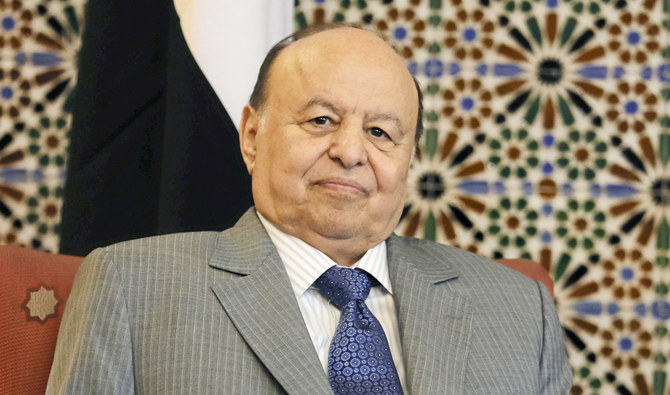
Abed Rabbo Mansour Hadi was speaking during a meeting with his advisers where he updated them about ongoing discussions between different parties over the formation of a new government.
“Our meeting today comes on the eve of the first anniversary of the signing of the Riyadh Agreement, which we continue to perceive as a way for restoring the state, uniting efforts, and ending the Houthi coup,” he said.
Signed in November last year, the Riyadh Agreement was designed to defuse hostilities between the internationally recognized government and the Southern Transitional Council (STC) in the liberated southern provinces and refocus efforts on fighting the Houthis and reviving state institutions.
The deal called for both sides to pull their forces out of Aden and Abyan and redeploy them to reinforce military fighting the Houthis.
Despite naming a new governor and security chief for Aden, the formation of a new government that would include the STC has been slow as some parties have opposed the distribution of ministries.
In Riyadh, Hadi on Sunday repeated his support for Maeen Abdulmalik Saeed, Yemen’s prime minister-designate, in his effort to announce a new government.
Official media said that Hadi told Saeed that his government should live up to the aspirations of Yemenis and work on addressing the worsening humanitarian crisis caused by Houthi military activities throughout the country.
Several government and STC sources last week told Arab News that the prime minister was close to finalizing his government, but on Monday sources in Riyadh revealed that an announcement had been delayed due to some parties, mainly the General People’s Congress and Islah party, that were unhappy with their portfolio of ministries, refusing to name their ministers.
The congress and Islah, two major parties that have dominated the political establishment in Yemen for ages, are demanding better representation in the new Cabinet.
Meanwhile, the commander of the Arab coalition forces in the central province of Marib, Maj. Gen. Yusef Al-Shahrani, on Sunday pledged continued military support to Yemeni army forces and allied tribesmen battling against the Iran-backed Houthis.
During a field trip with Yemeni army chief of staff, Lt. Gen. Sagheer bin Aziz, Al-Shahrani said the coalition would carry on backing the armed forces of Yemen until the Houthis had been defeated and the entire country had been brought back under state control.
Bin Aziz said Yemen’s forces appreciated the coalition’s support, and he vowed to push ahead with military operations until the Houthis had been driven out of areas under their control.
In the densely populated city of Taiz, residents said on Monday that sporadic shelling by the Houthis wounded several civilians, forced students to flee schools, and damaged properties in the eastern part of the city.
For five years, the Houthis, who control the outskirts of Taiz, have imposed a siege on the city and have heavily shelled downtown residential areas in a bid to force government forces to surrender.


![]()

Hadi: Implementing Riyadh accord key to defeating Houthis
Short Url
https://arab.news/zca26
Hadi: Implementing Riyadh accord key to defeating Houthis
- The government should live up to the aspirations of people and work on addressing the humanitarian crisis caused by the Houthis military activities throughout Yemen


Latest updates


Recommended


© 2026 SAUDI RESEARCH & PUBLISHING COMPANY, All Rights Reserved And subject to Terms of Use Agreement.