

Arab coalition commander renews support to Yemen

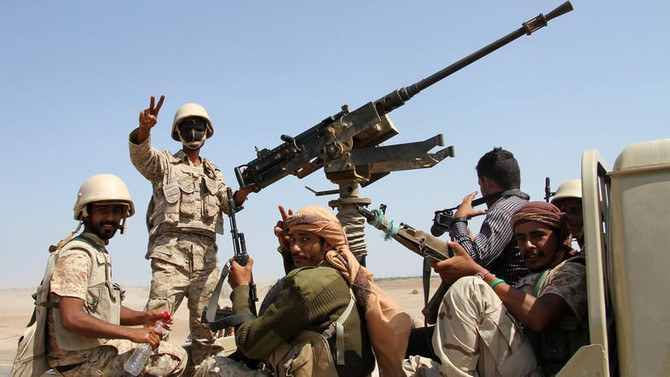
The coalition will continue backing Yemeni military forces fighting the Houthis until the country returns to normal, the commander of Arab coalition forces in the southern city of Aden has said. (AFP/File Photo)
Short Url
Updated 29 October 2020
Follow

Arab coalition commander renews support to Yemen

  • Assurance comes as the governor of Aden thanked it for helping local security authorities intercept a major cargo of drugs at Aden seaport
  • Yemen’s defense minister said on Wednesday that at least 800 Houthi fighters, including senior field commanders, had been killed since the beginning of this month

AL-MUKALLA: The coalition will continue backing Yemeni military forces fighting the Houthis until the country returns to normal, the commander of Arab coalition forces in the southern city of Aden has said.

During a meeting with Aden’s new governor, Ahmed Lamlis, Brig. Gen. Nayef Al-Otaibi said that the coalition would continue its support till Yemen recovered from the war and its state bodies functioned normally, Yemeni state media said on Wednesday.

The coalition’s assurance comes as the governor of Aden thanked it for helping local security authorities intercept a major cargo of drugs at Aden seaport. The governor told the Arab coalition commander that local authorities in Aden were looking forward to receiving more support from the coalition, enabling them to bring back peace and stability to Aden and fix vital services there.

The Arab coalition and local security authorities at Aden seaport recently announced a 500kg cocaine and heroin bust worth millions of dollars. The drugs were hidden inside sugar bags in a large sugar shipment originating from Brazil. There was no information about arrests in connection with the drugs bust but local security officials said that investigations were underway.

Meanwhile, Yemen’s defense minister said on Wednesday that at least 800 Houthi fighters, including senior field commanders, had been killed since the beginning of this month in fighting with government troops or in Arab coalition airstrikes.

Based on Houthi burial statements carried on their media, the rebels have buried more than 600 fighters, including 154 field leaders, since Oct. 1, in different provinces under their control. In the capital, Sanaa, the rebels have arranged funeral processions for 178 dead fighters, including 67 field commanders with different military rankings, the ministry said in a statement on its news site.

Most of the Houthi deaths occurred in the provinces of Marib and Jouf, where rebel forces are engaging in heavy fighting with government forces and allied tribesmen, backed by Arab coalition warplanes.

State media also quoted the governor of Jouf, Ameen Al-Oukaimi, as saying that government forces had inflicted a huge defeat on the Houthis during the latest intense fighting in the province. Yemeni Army commanders said that they foiled Houthis attempts to recapture the liberated Al-Khanjer military base and surrounding areas in Jouf.

In the western province of Hodeidah, the Joint Forces, an umbrella term for three major military units in the country’s western coast, said that a Houthi field military leader, Mohammed Yahya Al-Hameli, was killed during a foiled rebel assault in the province on Wednesday.

Fighting has continued across Yemen despite repeated calls by the UN and western diplomats for Yemeni factions to halt hostilities and focus on approving the UN-brokered peace initiative known as the Joint Declaration. On Thursday, British Ambassador to Yemen Michael Aron called on the internationally recognized President of Yemen Abed Rabbo Mansour Hadi and the Houthis to engage in serious talks to end the war.

“President Hadi and the Houthi leadership must work seriously and urgently with the UN Yemen envoy to end the war in Yemen by concluding the Joint Declaration in order to avert a humanitarian catastrophe,” the ambassador said on Twitter.

The declaration proposes a nationwide truce ahead of the implementation of economic and humanitarian measures. When the fighting stops, the Yemeni parties will be asked to engage in direct talks to discuss postwar political arrangements.


Sudanese paramilitary forces kill at least 28 people in an attack in Darfur, medical group says

Updated 6 sec ago
Follow

Sudanese paramilitary forces kill at least 28 people in an attack in Darfur, medical group says

  • At least 39 people, including 10 women, were wounded in the attack, the medical group said
  • Emergency Lawyers said RSF fighters torched many houses in the town, forcing people to flee to nearby villages

CAIRO: An attack by Sudanese paramilitary forces on a stronghold of a Darfur tribal leader left at least 28 people dead, a doctors group said Tuesday, the latest in a devastating war with no resolution in sight.
The paramilitary Rapid Support Forces on Monday rampaged through the town of Misteriha in North Darfur province, according to the Sudan Doctors Network, which tracks the country’s ongoing war.
The town is a stronghold of Arab tribal leader Musa Hilal who also hails from the Rizeigat Arab tribe as the majority of the members of the paramilitary RSF.
At least 39 people, including 10 women, were wounded in the attack, the medical group said.
There was no immediate comment from the RSF and motives for the attack were not immediately known.


Sudan’s war erupted in 2023 after tensions between the Sudanese army and the rival RSF escalated into fighting that began in Khartoum, the country’s capital, and spread nationwide. The conflict has killed thousands and triggered mass displacement, disease outbreaks and severe food insecurity. Aid workers have been frequently targeted.
The medical group said RSF shelling hit the town’s health care center on Monday, after which the paramilitary fighters assaulted medical staff and detained at least one of them.
The RSF fighters had begun their offensive on the town over the weekend with drone strikes that hit Hilal’s guesthouse. On Monday, they launched a major ground offensive and took over the town.
Emergency Lawyers, an independent group documenting atrocities in Sudan, said RSF fighters torched many houses in the town, forcing people to flee to nearby villages.
The seizure of Misteriha would likely assert RSF control of Darfur. However, it risks escalating tribal tensions in an area long known for violence and war.
Monday’s attack came four months after the RSF overran el-Fasher, the provincial capital of North Darfur after 18 months of siege. The paramilitaries killed more than 6,000 people between Oct. 25 and Oct. 27 in the city. The attack was marked by atrocities that UN-backed experts said bore ” the hallmarks of genocide.”
The war has created the world’s largest humanitarian crisis, with over 14 million forced to flee their homes. It has fueled disease outbreaks and pushed parts of the country into famine that still spreads as fighting shows no sign of abating.
The latest report by the Integrated Food Security Phase Classification earlier this month warned that severe acute malnutrition, the most dangerous and deadly form of malnutrition, is expected to increase to 800,000 cases, up 4 percent from 2025.
Aid groups have long struggled to meet the growing needs of displaced people across the country and called for a ceasefire to secure aid delivery to remote areas in Darfur and Kordofan — another hotbed in the war.
“The main thing that needs to happen is, of course, a ceasefire,” said Zia Salik, interim UK director of Islamic Relief, an aid group working in Sudan. “Ultimately, that is what’s causing the pain and the difficulty for all of the civilians that are caught in the crosshairs.”