Typhoon lashes Philippines as more than 2m affected

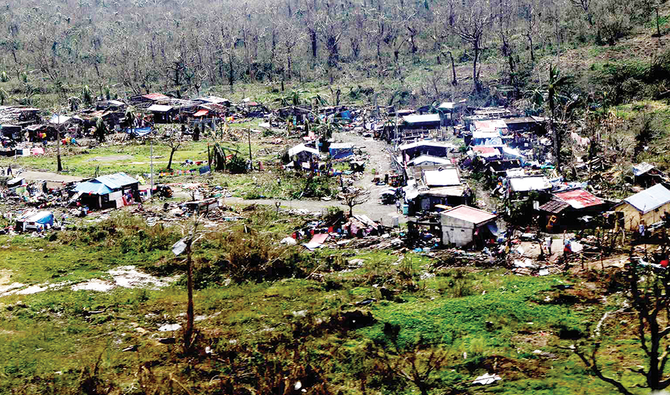
A Philippine Navy Islander (NV312) with an aerial assessment of the damage caused by typhoon Goni in Catanduanes province, Philippines. (Supplied)
Short Url
Updated 03 November 2020
Follow

Typhoon lashes Philippines as more than 2m affected

  • Up to 90 percent of infrastructure damaged in one province alone

MANILA: More than 2 million people have been affected by Typhoon Goni, which barreled through the Philippines at the weekend killing 16 people and destroying thousands of houses, with officials saying on Monday they expected the death toll to rise.

Dubbed the world’s strongest storm of 2020, Typhoon Goni slammed into the southern part of Luzon island before dawn on Sunday, damaging more than 10,000 houses in Catanduanes province, one of the worst-affected areas.

“Based on a partial estimate, 10,000 small houses ... (were) totally washed out along the coastal lines that were hit by the typhoon,” Catanduanes Rep. Hector Sanchez said on Monday.

According to the Office of Civil Defense (OCD), 12 regions and 372,653 families comprising more than 2 million people have been affected by the typhoon. More than 5,000 schools are being used as evacuation centers.

During a media briefing at the National Disaster Risk Reduction and Management Council (NDRRMC) on Monday, Lt. Gen. Hawthorned Binag, Philippine National Police deputy chief for operations, said that officials would be able to gauge the true extent of the damage and fatality count once the communication network was reestablished in
Catanduanes.

“Up to 90 percent of the infrastructure in Catanduanes has been damaged based on (an) initial assessment by police in the province. Power and communication lines were also down,” Binag said.

Super Typhoon Goni brought violent winds and intense to torrential rainfall when it made its first landfall in the Bicol region, with Sanchez saying it rose as high as 5 meters before weakening into a tropical storm.

NDRRMC executive director and OCD administrator Ricardo Jalad said a telecommunications team had been sent to Catanduanes to establish satellite voice and data communication with the province.

Officials later said they were able to establish first contact with the typhoon-ravaged province.

Provincial governor Joseph Cua said 80 percent of electric facilities, including electrical posts and transformers, were damaged, and that there was currently no water supply. Approximately 15,000 families in the province were affected, he added and appealed to telecom companies to help with the “immediate restoration” of communication lines in the province.

Presidential spokesman Harry Roque said the province for now was “fully dependent” on airlifted assistance.

Albay was another province that bore the brunt of the typhoon, with 300 houses reportedly buried in Guinobatan town.

Energy Secretary Alfonso Cusi said authorities were addressing the restoration of power to some 8,500 households, as Bicol was without electricity.

The presidential palace said the government was continuing to mobilize resources to assist the affected population and localities, while the UN and the European Union on Monday committed to helping with relief and recovery efforts.

President Rodrigo Duterte convened a cabinet meeting after visiting some typhoon-hit areas in Bicol.


India’s new budget bets on AI, data centers to sustain growth

Updated 42 min 32 sec ago
Follow

India’s new budget bets on AI, data centers to sustain growth

  • Budget features new Bharat‑VISTAAR AI‑powered platform for agriculture sector
  • It also includes tax holiday until 2047 for foreign companies using Indian data centers

NEW DELHI: India’s latest budget has emerged as one of its most technology-focused, with new measures to utilize artificial intelligence, semiconductor manufacturing, and expand digital infrastructure aimed at offsetting the impact of global tariff wars.

Finance Minister Nirmala Sitharaman presented the 2026-27 budget in parliament on Sunday, saying it would “accelerate and sustain economic growth by enhancing productivity and competitiveness” at a time when India was facing “an external environment in which trade and multilateralism are imperiled and access to resources and supply chains are disrupted.”

New Delhi has yet to secure a trade deal with its largest trading partner, the US, which last year hit it with punitive tariffs of up to 50 percent over India’s purchases of Russian oil. To mitigate their impact, India has been looking for alternative agreements, including last week’s agreement with the EU, cutting duty on 99.5 percent of Indian exports to the bloc.

The new budget prioritizes infrastructure and domestic manufacturing, with a total expenditure estimated at $583 billion.

It offers tariff concessions for products from the marine, leather, and textile industries — all of which have been affected by US tariffs — and provides duty exemptions on materials and goods used to process rare-earth minerals, make lithium ion batteries, solar glass, and components for electric vehicles.

The finance minister also announced doubled spending for semiconductor manufacturing to $4.8 billion and a tax holiday until 2047 for foreign companies providing cloud services using Indian data centers.

The budget also features Bharat‑VISTAAR (Virtually Integrated System to Access Agricultural Resources), a multilingual AI‑powered platform for the agriculture sector to give farmers customized, real‑time advisory on crop management, weather, soil conditions and government schemes in different Indian languages.

“There is a lot of focus on AI and technology. It is to achieve the ambitious target India has already declared — Viksit Bharat 2047. It is very clear that without technology, it would be difficult to achieve that target,” Prof. Pardeep S. Chauhan, Centre for Economic Studies and Planning, Jawaharlal Nehru University, told Arab News, referring to the government’s plan to transform the nation into a fully developed country by 2047 — the 100th anniversary of its independence.

“That was the need of the hour, and the government has taken care of it, focusing on semiconductors, AI, and rare-earth minerals.”

The technology focus also comes against the backdrop of China’s dominance in the global critical minerals supply chains, and last year’s restrictions imposed by Beijing in the wake of escalating trade tensions with the US.

“India lags far behind the US and China, particularly China,” Chauhan said. “India has taken this move to maybe after five, 10, 15 years ... compete up to some extent. Without technology, nobody can think of establishing (their) leadership — whether it’s in the economy, defense or financial infrastructure architecture. Everywhere you need technology.”