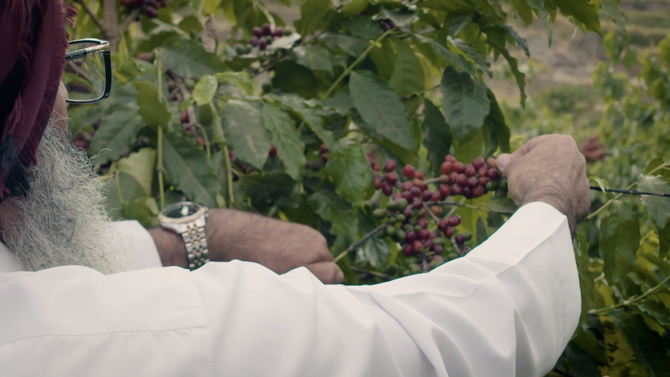
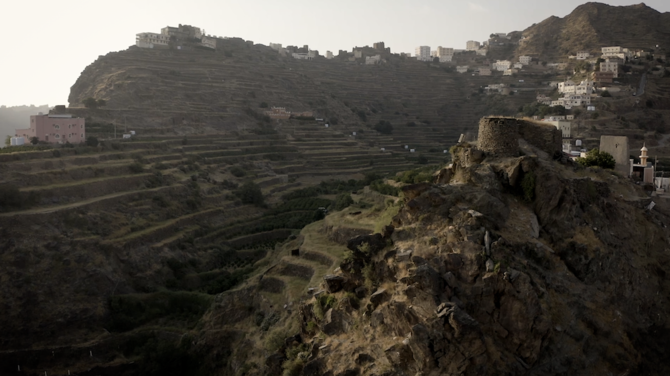


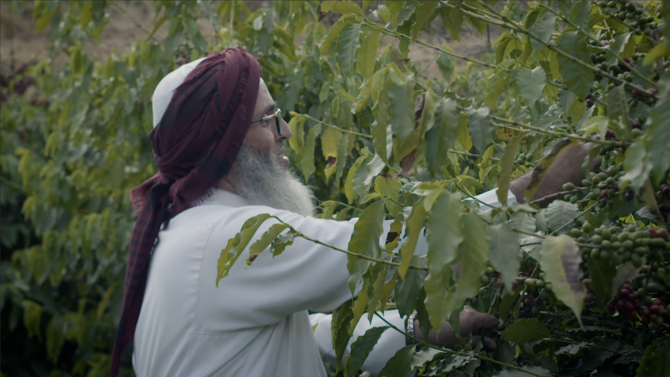


JAZAN, SAUDI ARABIA: Hugging Saudi Arabia’s mountainous southern border with Yemen lies a village with a brand of coffee whose time has come. With its 15,000 coffee trees, Aal Qotail, in the Al-Daair governorate of Jazan region, is the base of Jabaliyah, a Saudi business venture that aims to bring the humble khowlani bean to luxury consumers everywhere.
Growing khowlani beans has long been part of the heritage of this region, but it has only recently matured into a viable industry thanks to a double shot of support from the government and the private sector.
Ali Al-Sheneamer, co-founder of Jabaliyah — the first coffee brand to originate exclusively in Saudi Arabia — told Arab News that although they are only a small team, they have ambitious plans to grow from tall to grande.
“We started this a few years back with Mango Jazan. We believe we created a good brand,” said Al-Sheneamer, referring to their earlier tropical-fruit venture. Now the team has set its sights on the region’s bountiful coffee-growing potential.
“Next is to get Jabaliyah. And there is more to come in the future from the region of Jazan and other regions of Saudi Arabia.”
Coffee beans have been grown in Jazan’s cloud-wrapped mountains for hundreds of years. Until now, it was just a small farming industry serving local consumption. But thanks to government support for local farmers, the region’s agriculture is developing fast.
“Aramco also conducted a great program, educating farmers on the best methods of irrigation, how to improve quality. So, we have seen rapid development over the past five to seven years in growing coffee beans,” Al-Sheneamer said.

Growing khowlani beans has long been part of the heritage of this region, but it has only recently matured into a viable industry thanks to a double shot of support from the government and the private sector. (AN Photo)
The Jabaliyah team has been scouring local crops for a top-quality yield to invest in — one that will generate profits for their brand but also for the farmers themselves.
“We wanted the farmers to create better value,” said Al-Sheneamer. “Most of us are marketeers. We are in the business where if you sell a commodity, you get a return for that. If you sell branded goods, you maximize the value. So, we wanted to maximize the value for the farmers.
“I don’t want to go and negotiate prices with farmers at this stage. I want them to actually make a good return so they can invest to grow their capacity, become more professional, employ more people, and improve quality, so this can become a sizable industry that benefits all of us and the local community as well.”

Coffee beans have been grown in Jazan’s cloud-wrapped mountains for hundreds of years. (AN Photo)
Al-Sheneamer himself comes from a farming family in rural Jazan, so the principle of giving growers a better deal on their produce is close to his heart.
“Most people in villages and small towns are farmers. If you look at the coffee-bean farmers specifically, there are between 600 to 700 farmers today in that line of business,” he said.

Ali Al-Sheneamer
Much as he would like to, Al-Sheneamer cannot buy from every farmer. But with time he wants to help rural communities adapt to the demands of the modern economy, understand shipping and logistics, and to move growers away from traditional farming methods.
“I aspire to work with all of them — I might not be able to — but at least the top 25 to 30 farmers over the coming few years, who would provide the highest percentage of the production of coffee beans in the region,” Al-Sheneamer said. “We not only want to grow Jabaliyah in Saudi Arabia but also want to start exporting that brand to the world.”

According to the Ministry of Environment, Water and Agriculture, the Kingdom today has roughly 125,000 coffee trees, of which 76,000 are producing beans. (AN Photo)
According to the Ministry of Environment, Water and Agriculture, the Kingdom today has roughly 125,000 coffee trees, of which 76,000 are producing beans. Al-Sheneamer expects the market to double in size over the coming two to three years as more trees start producing.
“The government has a vision to increase the number of coffee bean trees in the region to 1 million by 2030. That’s huge by all measures. That’s also challenging, given the difficult terrain of growing and using the mountains, to have more space to grow coffee beans there, but this shows you that there is determination from the government to create this industry and put these Saudi coffee beans, the khowlani beans, on the map.”
Al-Sheneamer admits it will take time for farmers to get used to modern business integration, “moving a farmer who grew up seeing his father farming and his grandfather farming into becoming a more professional farmer, dealing with suppliers, distributors, money — some of whom don’t even have official establishments that can help them start transacting in a B2B manner.”
But Jabaliyah is committed to working with farmers to help them make the transition, because the returns for both the company and rural communities could be huge.

With its 15,000 coffee trees, Aal Qotail, in the Al-Daair governorate of Jazan region, is the base of Jabaliyah, a Saudi business venture that aims to bring the humble khowlani bean to luxury consumers everywhere. (Supplied)
Al-Sheneamer worked a similar miracle with Mango Jazan. A few years ago, during a visit to the region, he noticed an abundance of mango trees — today around 400,000 of them.
“I wrote on Twitter, asking the Jazanian people to consider exporting them to other cities and this was picked up by my partner Abdulrahman Al-Sahily,” he said. “And in a matter of three days he had a website set up and people started putting in orders. He would go to the airport and cargo them to different cities. It was a very hectic operation.”
The partners were soon able to streamline their operation, making Mango Jazan a well-known brand. “Everyone awaits the season of mangoes. And it was recently acquired, or majority share acquired, by a publicly listed company on the stock market to use it as the base to market other local produce, not only from Jazan but from all around the country,” he said.

Agriculture is a booming industry in Saudi Arabia and Al-Sheneamer is glad to see other entrepreneurs following Mango Jazan’s example in Al-Bahah and Al-Jouf. (AN Photo)
“That’s why we are now pivoting from mangoes — being seasonal, i.e. a two-month, three-month period — into coffee beans, which will be year-round. Then we will start introducing new brands as we go, whether they be fruits or honey or other local produce of high value and high quality that people are willing to pay for and buy online versus going to their local grocery store.”
Agriculture is a booming industry in Saudi Arabia and Al-Sheneamer is glad to see other entrepreneurs following Mango Jazan’s example in Al-Bahah and Al-Jouf.
“I just ordered olive oil online from Al-Jouf through one of the startups that actually followed in the footsteps of Mango Jazan. I think Saudis today would love to support and encourage these types of businesses to encourage local farmers.”
----------------------
Twitter: @HussamMayman