

Pakistani pilgrims say feeling 'blessed' as they arrive in Makkah for Umrah

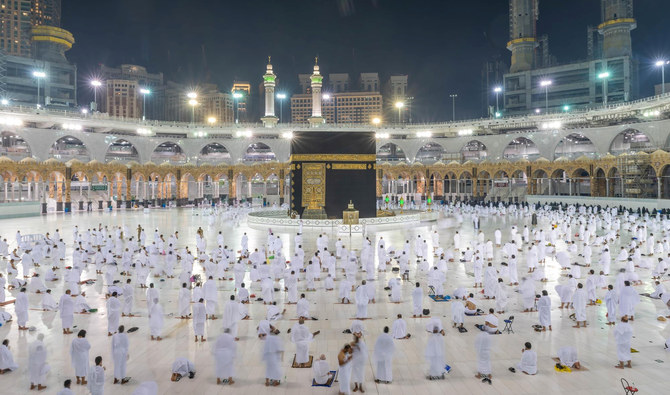
Muslims, keeping a safe social distance, perform Umrah at the Grand Mosque after Saudi authorities ease the coronavirus disease (COVID-19) restrictions, in Makkah on Nov. 1, 2020. (SPA)
Short Url
Updated 02 November 2020
Follow

Pakistani pilgrims say feeling 'blessed' as they arrive in Makkah for Umrah

  • Saudi Arabia has relaxed measures it had taken earlier this year to check the spread of the coronavirus
  • The kingdom closed its borders in February to foreign Umrah pilgrims, and in March stopped its own citizens and residents from taking part

ISLAMABAD: Pakistani pilgrims arriving in Saudi Arabia this week for the Umrah pilgrimage say they feel "blessed" to be among a few hundred foreign pilgrims getting a chance to perform the holy ritual as Saudi Arabia relaxes measures it had taken earlier this year to check the spread of the coronavirus.
Umrah is a pilgrimage that can be performed at any time of the year, in contrast to Hajj which has specific dates according to the Islamic lunar calendar.
In February, Saudi Arabia closed its borders to foreign Umrah pilgrims, and in March stopped its own citizens and residents from taking part in order to curb the spread of COVID-19. In July, it allowed only a limited number of domestic pilgrims to perform the Hajj.
“I am feeling blessed as I was waiting for this moment for the last seven months,” Pakistani pilgrim Umair Mushtaq, who is leading a group of 38 pilgrims, told Arab News via phone from Makkah. He praised the Saudi Hajj and health ministries for the arrangements they had made for pilgrims at the Jeddah airport. 
“Saudi Ministry of Hajj has given us very good protocol,” Mushtaq said. “They are providing us food in the [hotel] room for the first three days, which is the mandatory period of quarantine.”
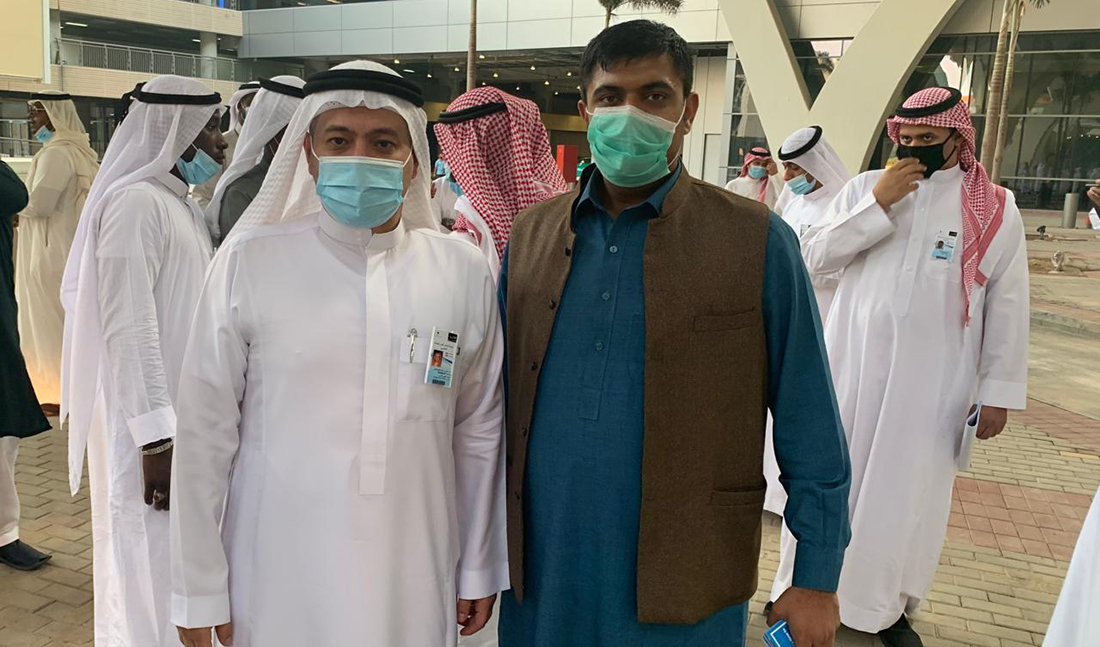


Pakistani pilgrim Umair Mushtaq with Saudi officials at the Jeddah airport on November 1, 2020. (Photo courtesy: Umair Mushtaq)

After three days, pilgrims have to take a coronavirus test before being allowed into the Grand Mosque [Haram] to perform Umrah.
“I am flying very high and feeling out of the world,” Musadaq Malik, a Pakistani from thecity of Lahore, said after arriving in Makkah on the first flight carrying Pakistani pilgrims. “Only a few hundred people got this chance of performing Umrah out of the total 1.5 billion

Muslims in the world. You can better imagine from this how lucky we are and I don’t have words to explain my feelings.”
“I am waiting anxiously for the remaining two days to pass so that we can finally perform Umrah and offer prayers in the Grand Mosque,” the pilgrim said, thanking Saudi authorities for the welcome at the Jeddah airport.
“They have done arrangements according to WHO [World Health Organization] instructions,” he added. 

Sajid Masood, Pakistan’s Director Hajj in Jeddah, said Saudis had changed all protocols so pilgrims could observe coronavirus precautions at airports.
“The arrangements are very impressive and they [Saudis] have given a warm welcome to Pakistani pilgrims at the Jeddah airport,” Masood said. “I myself visited the hotel where Pakistani pilgrims are staying and it is completely sanitized.”
He said authorities had also installed thermal gates at various places to check the spread of the coronavirus. 
“As far as I know, Saudi authorities are trying to enhance the capacity of pilgrims to up to 75 percent by January next year,” he added. 


Pakistan says $50 million meat export deal with Tajikistan nearing finalization

Updated 09 December 2025
Follow

Pakistan says $50 million meat export deal with Tajikistan nearing finalization

  • Islamabad expects to finalize agreement soon after Dushanbe signals demand for 100,000 tons
  • Pakistan is seeking to expand agricultural trade beyond rice, citrus and mango exports

ISLAMABAD: Tajikistan has expressed interest in importing 100,000 tons of Pakistani meat worth more than $50 million, with both governments expected to finalize a supply agreement soon, Pakistan’s food security ministry said on Tuesday.

Pakistan is trying to grow agriculture-based exports as it seeks regional markets for livestock and food commodities, while Tajikistan, a landlocked Central Asian state, has been expanding food imports to support domestic demand. Pakistan currently exports rice, citrus and mangoes to Dushanbe, though volumes remain small compared to national production, according to official figures.

The development came during a meeting in Islamabad between Pakistan’s Federal Minister for National Food Security and Research Rana Tanveer Hussain and Ambassador of Tajikistan Yusuf Sharifzoda, where agricultural trade, livestock supply and food-security cooperation were discussed.

“Tajikistan intends to purchase 100,000 tons of meat from Pakistan, an import valued at over USD 50 million,” the ambassador said, according to the ministry’s statement, assuring full facilitation and that Islamabad was prepared to meet the demand.

The statement said the two sides agreed to expand cooperation in meat and livestock, fresh fruit, vegetables, staple crops, agricultural research, pest management and standards compliance. Pakistan also proposed strengthening coordination on phytosanitary rules and establishing pest-free production zones to support long-term exports.

Pakistan and Tajikistan have long maintained political ties but bilateral food trade remains below potential: Pakistan produces 1.8 million tons of mangoes annually but exported just 0.7 metric tons to Tajikistan in 2024, while rice exports amounted to only 240 metric tons in 2022 out of national output of 9.3 million tons. Pakistan imports mainly ginned cotton from Tajikistan.