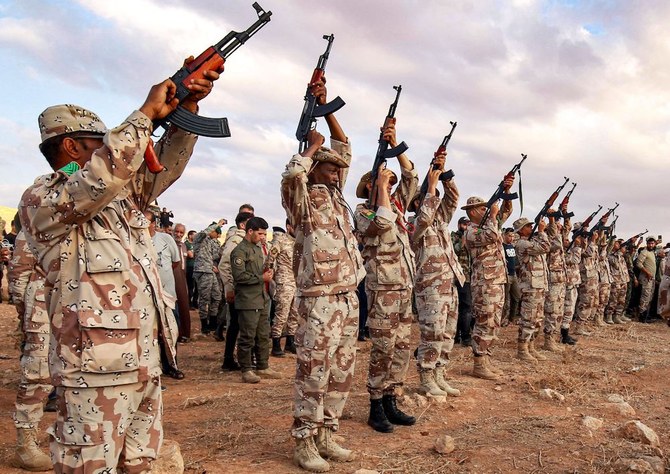
CAIRO: Military leaders from Libya’s warring sides arrived Monday in the oasis town of Ghadames, the United Nations said, for the first face-to-face talks inside Libya since last year’s attack on the capital by the forces of military commander Khalifa Haftar.
The fifth round of talks, brokered by the UN, has come less than two weeks after the two sides inked a permanent ceasefire in Geneva on Oct. 23, a move the UN billed as historic after years of fighting that has split the North African country in two.
The UN mission in Libya said the meetings through Wednesday would discuss implementing and monitoring the cease-fire, along with how to verify possible violations.
The October cease-fire deal included the return of armed groups and military units “to their camps” and that all foreign mercenaries be out of the oil-rich country within three months.
Brig. Gen. Khaled Al-Mahjoub, the head of the mobilization department at Haftar’s self-styled Libyan Arab Armed Forces, said in comments aired by the satellite news channel Al-Arabia that LAAF’s units would return to its camps “in parallel with” the exit of foreign mercenaries.
Thousands of foreign fighters, including Russians, Syrians, Sudanese and Chadians, have been brought to Libya by both sides, according to UN experts.
The two sides also agreed on exchanging prisoners and opening up air and land transit across the country’s divided territory.
Television footage showed the head of the UN support mission for Libya, Stephanie Williams, landing in Ghadames, to attend the talks. The two sides also arrived in Ghadames, a UNESCO World Heritage site known as “the Pearl of the Desert.”
The UN-brokered talks have come ahead of Libyan political talks scheduled Nov. 9 aimed at discussing possible elections.
Libya is split between a UN-supported government in the capital, Tripoli, and rival authorities based in the country’s east. The two sides are backed by an array of local militias as well as regional and foreign powers. The country was plunged into chaos after the 2011 NATO-backed uprising that toppled and killed longtime dictator Muammar Qaddafi.
Haftar’s forces launched an offensive in April 2019 to try and capture Tripoli, the seat of the UN-supported government. But his campaign collapsed in June.
Fighting has since died down amid international pressure on both sides to avert an attack on the strategic city of Sirte, the gateway to Libya’s major oil export terminals, and to start talks aiming at ending the years-long conflict.

Libya’s warring sides discuss implementing ceasefire
https://arab.news/2sajf
Libya’s warring sides discuss implementing ceasefire
- The UN-brokered talks have come ahead of Libyan political talks scheduled Nov. 9 aimed at discussing possible elections.
- Libya is split between a UN-supported government in the capital, Tripoli, and rival authorities based in the country’s east
Israeli soldiers fired 900 bullets during massacre of Palestinian aid workers, investigation finds
- Researchers use visual and audio analysis to reconstruct Gaza ambush of emergency vehicles that left 15 people dead
- Israeli troops executed some victims at close range, according to recordings and witnesses
LONDON: Israeli soldiers fired more than 900 bullets during a massacre of Palestinian aid workers that included “execution-style” killings, a detailed reconstruction of one of the worst atrocities of the Gaza war has found.
The investigation recreated a 3D digital version of the scene of the killings and used audio analysis of recordings to pinpoint how the attack unfolded in March last year.
Fifteen Palestinian aid workers were killed when Israel troops ambushed their vehicles in Tel Al-Sultan, near Rafah, southern Gaza. The victims included ambulance crews from the Palestinian Red Crescent Society, rescue teams from the Palestinian Civil Defense sent to help, and a member of the UN agency for Palestinian refugees UNRWA.
Israel tried to hide evidence of the killings by crushing the vehicles left at the scene and burying them in the sand, along with the victims’ bodies.
The joint investigation published on Monday was carried out by London-based researchers Forensic Architecture and Earshot, an audio analysis agency.
Israeli soldiers “subjected Palestinian aid workers to continuous assault by gunfire for over two hours” in an attack that started shortly after 5 a.m. on March 23, the study found.
Contrary to Israel’s initial claims that events unfolded in a combat zone, “there was no exchange of fire in the area, and no tangible threat to the safety of those soldiers,” the report said.
The researchers documented at least 910 gunshots from three recordings from the scene. At least 844 shots were recorded within a five-and-a-half-minute period in video taken by paramedic Refaat Radwan, one of the victims.
More than 90 percent of the bullets were fired directly toward the emergency vehicles and aid workers during the initial period of the attack, with at least five soldiers firing simultaneously.
The investigation concluded that the emergency lights and markings of the vehicles ambushed would have been clearly visible to the soldiers.
Israeli troops continued shooting as they advanced on the vehicles before carrying out perhaps the most disturbing act of the attack.
“Upon reaching them, they moved through the vehicles and shot several of the aid workers at close range,” the report said.
One of the shots was fired between one and four meters away from paramedic Ashraf Abu Libda and coincided with the last time his voice was heard on recordings, “suggesting that these were the shots that killed him.”
The initial attack started at about 4 a.m. when Israeli forces opened fire on an ambulance sent to the scene of an Israeli airstrike, killing the two crew members inside.
Three more ambulances were sent to search for the missing crew. Once they found the vehicle, they were joined by a Palestinian Civil Defense ambulance and a fire truck.
“All vehicles were clearly marked and had their emergency lights on,” the report said.
Within minutes of the five vehicles arriving at the scene, and as the aid workers approached their fallen colleagues, the Israeli soldiers opened fire.
The driver of a UN Toyota truck that passed the site about an hour later was also killed.
Researchers were able to map the positions and movements of the Israeli troops throughout the attack with the help of echolocation and audio-ballistic analysis.
Opinion
This section contains relevant reference points, placed in (Opinion field)
This enabled them to work out the distance and the direction of the source of the gunshots from the devices making the recordings.
Researchers also detailed the extent of the Israeli military’s efforts to “conceal and disrupt evidence of the attack.”
This included burying the victims’ bodies, burying mobile phones, and crushing and partially burying the victims’ vehicles.
Analysis of satellite images revealed how Israel transformed the site with earth-moving machinery in the hours following the attack.
One of the two survivors of the ambush was detained for more than a month, tortured, and interrogated.
The bodies of 14 of the victims were found in a mass grave near the site on March 30, while the remains of another victim were found a few days earlier nearby.
A forensic doctor who examined some of the bodies told The Guardian newspaper that there was evidence of execution-style killing given the location of the wounds.
Coming during the height of Israel’s two-year war on Gaza that has killed more than 72,000 Palestinians, the massacre of aid workers sparked international outcry.
In the aftermath, Israel gave varying accounts of what happened, initially claiming that its troops thought they were facing an attack.
On April 20, the Israeli military said an inquiry into the attack had identified “several professional failures, breaches of orders, and a failure to fully report the incident.”
A duty commander was dismissed for “providing an incomplete and inaccurate report during the debrief,” but there have been no further measures against those who carried out the attack.


