Libya’s warring sides discuss implementing ceasefire

1 / 2
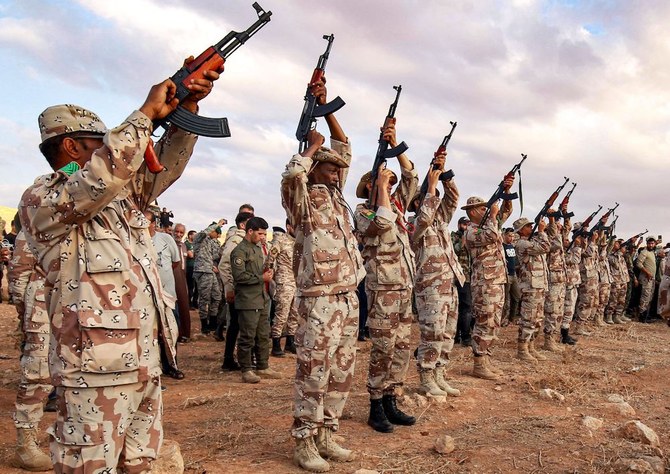
Fighters fire salutatory rounds in the air during the funeral of General Wanis Bukhamada, commander of the "Saiqa" (Special Forces) of the self-proclaimed Libyan National Army (LNA). (AFP)
2 / 2
The fifth round of talks, brokered by the UN, has come less than two weeks after the two sides inked a permanent ceasefire in Geneva on Oct. 23. (File/AFP)
Short Url
Updated 02 November 2020
Follow

Libya’s warring sides discuss implementing ceasefire

  • The UN-brokered talks have come ahead of Libyan political talks scheduled Nov. 9 aimed at discussing possible elections.
  • Libya is split between a UN-supported government in the capital, Tripoli, and rival authorities based in the country’s east

CAIRO: Military leaders from Libya’s warring sides arrived Monday in the oasis town of Ghadames, the United Nations said, for the first face-to-face talks inside Libya since last year’s attack on the capital by the forces of military commander Khalifa Haftar.
The fifth round of talks, brokered by the UN, has come less than two weeks after the two sides inked a permanent ceasefire in Geneva on Oct. 23, a move the UN billed as historic after years of fighting that has split the North African country in two.
The UN mission in Libya said the meetings through Wednesday would discuss implementing and monitoring the cease-fire, along with how to verify possible violations.
The October cease-fire deal included the return of armed groups and military units “to their camps” and that all foreign mercenaries be out of the oil-rich country within three months.
Brig. Gen. Khaled Al-Mahjoub, the head of the mobilization department at Haftar’s self-styled Libyan Arab Armed Forces, said in comments aired by the satellite news channel Al-Arabia that LAAF’s units would return to its camps “in parallel with” the exit of foreign mercenaries.
Thousands of foreign fighters, including Russians, Syrians, Sudanese and Chadians, have been brought to Libya by both sides, according to UN experts.
The two sides also agreed on exchanging prisoners and opening up air and land transit across the country’s divided territory.
Television footage showed the head of the UN support mission for Libya, Stephanie Williams, landing in Ghadames, to attend the talks. The two sides also arrived in Ghadames, a UNESCO World Heritage site known as “the Pearl of the Desert.”
The UN-brokered talks have come ahead of Libyan political talks scheduled Nov. 9 aimed at discussing possible elections.
Libya is split between a UN-supported government in the capital, Tripoli, and rival authorities based in the country’s east. The two sides are backed by an array of local militias as well as regional and foreign powers. The country was plunged into chaos after the 2011 NATO-backed uprising that toppled and killed longtime dictator Muammar Qaddafi.
Haftar’s forces launched an offensive in April 2019 to try and capture Tripoli, the seat of the UN-supported government. But his campaign collapsed in June.
Fighting has since died down amid international pressure on both sides to avert an attack on the strategic city of Sirte, the gateway to Libya’s major oil export terminals, and to start talks aiming at ending the years-long conflict.


Rubio plans to update Netanyahu on US-Iran talks in Israel next week, officials say

Updated 8 sec ago
Follow

Rubio plans to update Netanyahu on US-Iran talks in Israel next week, officials say

WASHINGTON: Secretary of State Marco Rubio plans to travel to Israel next week to update Israeli Prime Minister Benjamin Netanyahu on the US-Iran nuclear talks, two Trump administration officials said.
Rubio is expected to meet with Netanyahu on Feb. 28, according to the officials, who spoke Wednesday on condition of anonymity to detail travel plans that have not yet been announced.
The US and Iran recently have held two rounds of indirect talks over the Islamic Republic’s nuclear program.
Iran has agreed to draw up a written proposal to address US concerns that were raised during this week’s Geneva talks, according to another senior US official who was not authorized to comment publicly and spoke on the condition of anonymity.
That official said top national security officials gathered Wednesday in the White House Situation Room to discuss Iran, and were briefed that the “full forces” needed to carry out potential military action are expected to be in place by mid-March. The official did not provide a timeline for when Iran is expected to deliver its written response.
Officials from both the US and Iran had publicly offered some muted optimism about progress this week, with Iranian Foreign Minister Abbas Araghchi even saying that “a new window has opened” for reaching an agreement.
“In some ways, it went well,” US Vice President JD Vance said about the talks in an interview Tuesday with Fox News Channel. “But in other ways, it was very clear that the president has set some red lines that the Iranians are not yet willing to actually acknowledge and work through.”
Netanyahu visited the White House last week to urge President Donald Trump to ensure that any deal about Iran’s nuclear program also include steps to neutralize Iran’s ballistic missile program and end its funding for proxy groups such as Hamas and Hezbollah.
Trump is weighing whether to take military action against Tehran as the administration surges military resources to the region, raising concerns that any attack could spiral into a larger conflict in the Middle East.
On Friday, Trump told reporters that a change in power in Iran “seems like that would be the best thing that could happen.” He added, “For 47 years, they’ve been talking and talking and talking.”
The Trump administration has dispatched the USS Gerald R. Ford, the world’s largest aircraft carrier, from the Caribbean Sea to the Mideast to join a second carrier as well as other warships and military assets that the US has built up in the region.
Dozens of US fighter jets, including F-35s, F-22s and F-16s, have left bases in the US and Europe in recent days to head to the Middle East, according to the Military Air Tracking Alliance, a team of about 30 open-source analysts that routinely analyzes military and government flight activity.
The team says it’s also tracked more than 85 fuel tankers and over 170 cargo planes heading into the region.
Steffan Watkins, a researcher based in Canada and a member of the MATA, said he also has spotted support aircraft like six of the military’s early-warning E-3 aircraft head to a base in Saudi Arabia.
Those aircraft are key for coordinating operations with a large number of aircraft. He says they were pulled from bases in Japan, Germany and Hawaii.