Pakistan slams New Delhi's reference to Gilgit-Baltistan as part of India

In this photograph taken on Sept. 29, 2015, a Pakistani policeman walks at the bazaar in Sost, the border town of the Hunza valley in northern Pakistan. (AFP/File)
Short Url
Updated 13 November 2020
Follow

Pakistan slams New Delhi's reference to Gilgit-Baltistan as part of India

  • India's remarks came after PM Imran Khan announced that his government would give provisional provincial status to the region
  • Gilgit-Baltistan is the northern and Pakistani-administered self-governed part of larger Kashmir territory

ISLAMABAD: Pakistan on Sunday rejected India's reference to Gilgit-Baltistan as "a part of Indian territory."
India's remarks came after Pakistani Prime Minister Imran Khan announced on Sunday that his government would give provisional provincial status to the region which is the northern and Pakistani-administered part of larger Kashmir.
Indian Foreign Ministry spokesman Shri Anurag Srivastava called the move an "attempt by Pakistan to bring material changes to a part of Indian territory, under its illegal and forcible occupation."
"Pakistan categorically rejects Indian Ministry of External Affairs’ irresponsible and unwarranted statement regarding Gilgit-Baltistan (GB)," the Pakistani Foreign Office said in a press release, responding to Srivastava.
Both Islamabad and Delhi have claimed all of Kashmir since gaining independence 73 years ago, and have fought two wars over it. Both control parts of the territory, which is divided between them by a United Nations-mandated Line of Control (LoC).
"India has no locus standi whatsoever on the issue — legal, moral or historical. For more than 73 years, India has been in illegal and forcible occupation of parts of Jammu and Kashmir. Regurgitation of false and fabricated claims by India can neither change the facts nor divert attention from India’s illegal actions and continuing humanitarian crisis resulting from perpetration of the worst human rights violations in Indian Illegally Occupied Jammu and Kashmir (IIOJK)," the Foreign Office said.
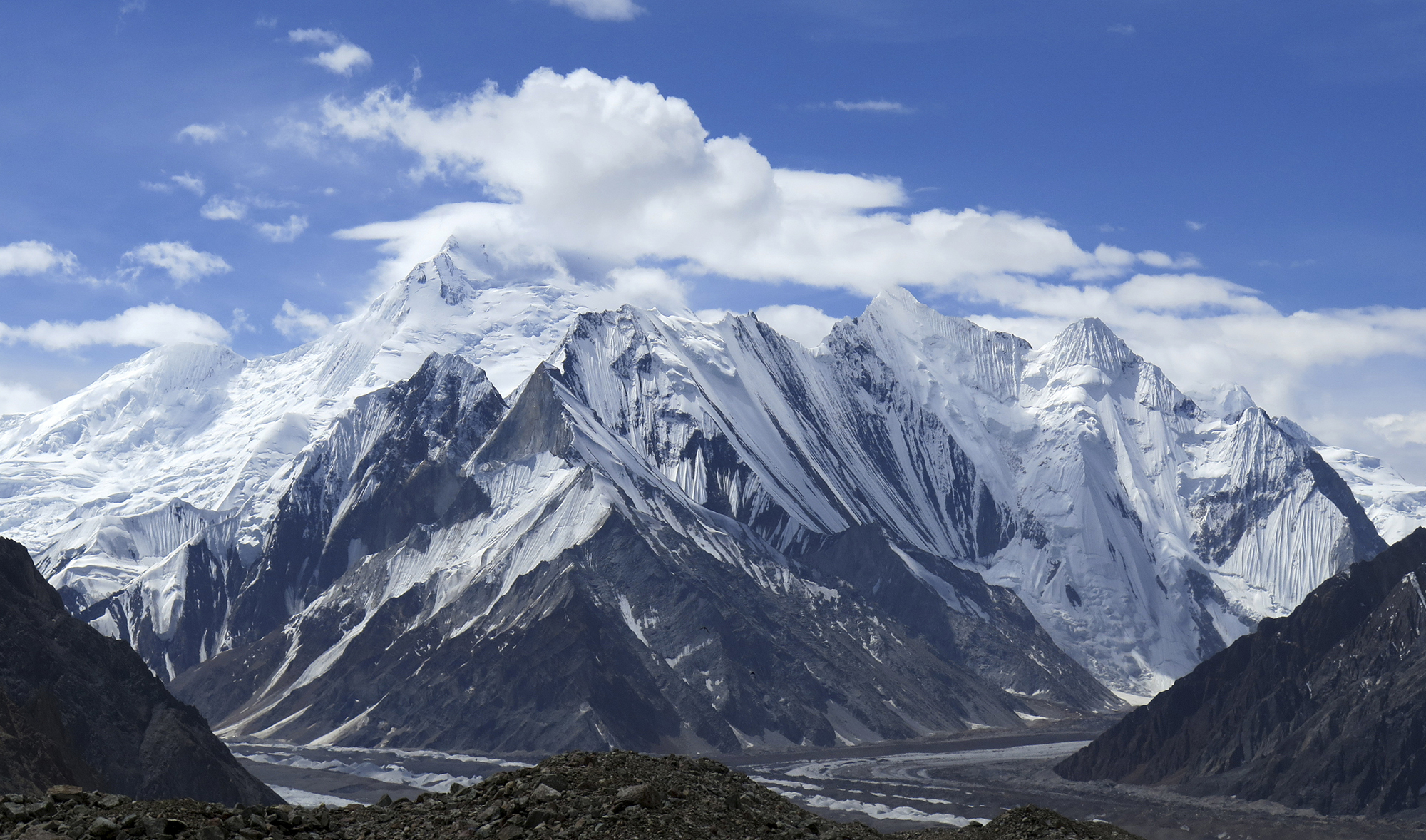


This picture taken on Aug. 15, 2019 shows a view of snow-capped mountains and glaciers from the Concordia camping site in the Karakoram range of Pakistan's mountain northern Gilgit region. (AFP/File)

In August last year, India angered Pakistan when it changed the status of Jammu and Kashmir — the Kashmir part under Indian administration. New Delhi scrapped Articles 370 and 35A of the constitution, which gave the erstwhile state limited autonomy.
Gilgit-Baltistan, once known as Northern Areas, used to be a part of Jammu and Kashmir, but has been under Pakistani control since shortly after Pakistan’s independence in 1947.
In 2009, Pakistan announced a plan aimed at giving more of a say to the people of the region, with a first step being an election for an assembly.
From 2009 to date, Gilgit-Baltistan is governed by an empowerment and self-governance order.
Elections for the new legislative assembly of Gilgit-Baltistan will be held on Nov. 15, with a flurry of political activity underway in the area.
Most of the region's 1.2 million people want their area to be merged into Pakistan and declared a separate province.
Strategically located, the territory borders Afghanistan and China, and is at the heart of the $65 billion China Pakistan Economic Corridor (CPEC) infrastructure development plan.


Pakistan seeks UK action over ‘incitement to violence’ against top military commander

Updated 26 December 2025
Follow

Pakistan seeks UK action over ‘incitement to violence’ against top military commander

  • Move follows a video that purportedly showed a PTI supporter in Bradford referencing violence against the army chief
  • Pakistan’s deputy interior minister says the government has written to the UK, saying the content breaches British law

ISLAMABAD: Pakistan’s State Minister for Interior Tallal Chaudhry said on Friday the government has written a letter to the United Kingdom to express concern over social media content circulating from British territory, which he said amounts to incitement to violence against the Pakistani state.

Speaking to a local news channel, Chaudhry said the government raised the issue after a video clip on social media purportedly showed a protester of former Prime Minister Imran Khan’s Pakistan Tehreek-e-Insaf (PTI) party criticizing Chief of Army Staff Field Marshal Asim Munir and referring to violence against him.

“This is not a political matter, nor is it a question of freedom of expression,” the minister said while speaking to Geo TV. “This is clearly a violation of international law and of Britain’s own laws, including the British Terrorism Act 2006.”

He said the material went beyond political dissent and amounted to incitement to violence, adding that Pakistan had conveyed to British authorities that states are responsible for ensuring that individuals residing on their territory — whether citizens, asylum seekers or others — do not incite rebellion or violence against another sovereign country.

“What is very dangerous is that a very specific act — a car bombing — has been referenced,” he continued. “It has not been generalized.”

A social media post by a Britain-based journalist claimed that the video was recorded during a protest outside Pakistan’s consulate in Bradford, though neither the authenticity of the footage nor the identity of the individual could be independently verified.

Chaudhry said Pakistan’s complaint to the UK was lodged under international law, British law and United Nations principles governing relations between states, stressing that the issue was one of incitement rather than protected speech.

“This is not about freedom of expression. This is about incitement and terrorism, which is against Britain’s own laws,” he said, adding that Islamabad expects British authorities to take action.

Pakistani officials have also previously voiced concerns over social media activity by PTI supporters abroad that they say fuels unrest and hostility toward state institutions.

British authorities have not publicly responded to the letter or Chaudhry’s statement.

PTI has not reacted to either of them as well.