ISLAMABAD: During a visit to Pakistan's mountainous far north, Prime Minister Imran Khan congratulated the people of Gilgit-Baltistan on Sunday after it was announced a day earlier that the region would be provisionally granted provincial status.
On Saturday, Federal Minister for Kashmir Affairs and Gilgit-Baltistan, Ali Amin Gandapur, announced that the federal government had decided to elevate the region’s status to that of a province.
The area, once known as the ‘Northern Areas’ was part of the erstwhile state of Jammu and Kashmir but has been under Pakistani control since shortly after Pakistan’s independence in 1947.
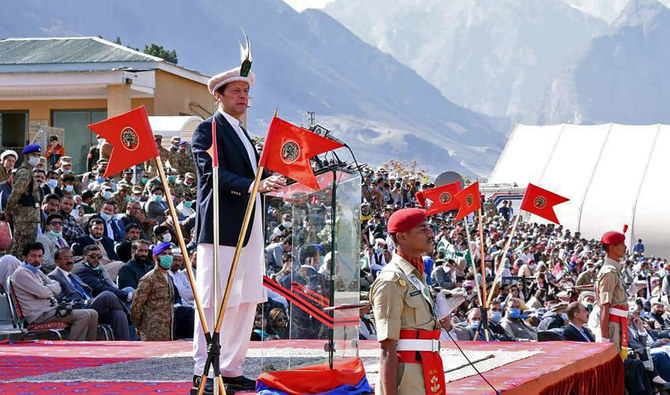
“I want to congratulate the people... we have decided to grant Gilgit-Baltistan provisional provincial status which was their demand,” PM Khan, wearing a Gilgiti feathered wool hat, said to the audience.
“We have taken this decision keeping in mind UN Security Council resolutions,” he said, and added that one of the many reasons Gilgit-Baltistan remained ‘backwards’ was because it was "cut off" from the rest of Pakistan.
Back in August 2009, Pakistan announced a plan aimed at giving more of a say to the people of the strategic region, renamed Gilgit-Baltistan, with a first step being an election for an assembly.
From 2009 to date, Gilgit-Baltistan is governed by an empowerment and self-governance order.
Elections for the new legislative assembly of Gilgit-Baltistan will be held on Nov. 15, with a flurry of political activity underway in the area.
Gilgit-Baltistan is home to five of the world’s fourteen ‘eight-thousander’ mountain peaks. Three of the world's longest glaciers outside the polar regions are also found in the region, with the area heavily dependent on mountain tourism.


![]()

PM Khan congratulates Gilgit-Baltistan for getting provisional provincial status
Short Url
https://arab.news/2vhn7
PM Khan congratulates Gilgit-Baltistan for getting provisional provincial status
- Government took decision keeping UN Security Council resolutions in mind, says PM Khan
- In 2009 government granted ‘Northern Areas’ limited self-rule and renamed the region Gilgit-Baltistan
Latest updates


© 2026 SAUDI RESEARCH & PUBLISHING COMPANY, All Rights Reserved And subject to Terms of Use Agreement.