PARIS: France was under a new virus lockdown on Friday, as the resurgent pandemic hit new heights in the United States with a daily record of more than 90,000 cases, just days before the presidential election.
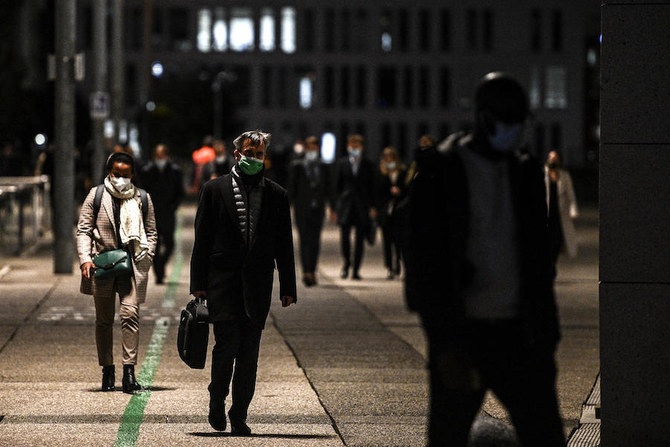
From midnight, France’s 65 million people were largely confined to their homes, needing written statements to leave, in the latest drastic measure to curb a disease that has infected more than 44.5 million people worldwide and killed nearly 1.2 million.
As lockdowns return, oil prices dropped on fears of a slowdown in demand but tech giants Facebook, Amazon and Google parent Alphabet reported strong quarterly earnings, reflecting the economic shifts caused by the global outbreak.
And in the latest bleak warning, the UN’s biodiversity panel said future pandemics could be more frequent, deadly and economically damaging.
The United States, where the coronavirus has overshadowed President Donald Trump’s November 3 re-election bid, announced 91,295 new cases in 24 hours, surging past the 90,000-mark for the first time to a total of almost nine million.
In the French capital Paris, some medics voiced fears that steady traffic and appreciable numbers of people on public transport showed the public was not taking the lockdown as seriously a second time round.
“Crossing Paris this morning looked more like an ordinary day than the first day of a lockdown,” the director of Paris hospitals Martin Hirsch wrote on Twitter.
“We don’t have the choice, we are obliged to live, do our shopping and behave as if it is normal even if there are some safety measures,” said Fabrice Angelique, 18, buying headphones at a books and electronics store in Paris.
Although there were some scenes of people stocking up on essentials, the president of the Intermarche chain, Thierry Cotillard denied there had been any “hysteria” in supermarkets.
According to a poll by Odoxa-Dentsu Consulting for France Info and Le Figaro, seven out of 10 people in France are in favor of the new lockdown, which is scheduled to last a month with bars and restaurants closed until at least December and travel between regions limited.
Factories and building sites will remain open, as will creches and schools — although children aged six and up must wear masks in class.
President Emmanuel Macron has warned that the second wave “will probably be more difficult and deadly than the first” in a country that has already seen 36,000 deaths.
But he insisted this lockdown would be less severe than measures imposed during the first wave in March-April.
Europe is again the epicenter of the pandemic according to the World Health Organization.
Nottingham became the latest of a swathe of cities across central and northern England to enter the highest tier of local restrictions Friday, with the 2.4 million residents of Leeds set to follow next week.
In Germany, Chancellor Angela Merkel has ordered a lighter round of shutdowns from Monday, closing bars, cafes and restaurants, as well as theaters, operas and cinemas.
Spain’s parliament on Thursday approved a six-month extension of a state of emergency, which was declared on Sunday for an initial two weeks.
Sweden, known for its light-touch approach, recorded its highest number of infections for the second day in a row, prompting a warning for people in the capital and the more densely populated south to avoid social interaction.
Russian President Vladimir Putin said he had no plans to introduce a sweeping lockdown, even as the country saw record tolls with reports of ambulance queues at hospitals and medical shortages.
But the Vatican said Pope Francis would resume a remote, live-streamed version of his weekly general audiences with the public, “in order to avoid any possible future risk to the health of the participants.”
EU leaders held a video summit on the crisis, according to European sources the first in a series of such calls to improve coordination.
The European Central Bank meanwhile pledged to bolster its pandemic stimulus in December.
The economic recovery is “losing momentum more rapidly than expected” after the partial rebound seen in the summer, ECB president Christine Lagarde said after a virtual meeting of the 25-member governing council.
But forecasts now show eurozone powerhouse Germany shrinking less than previously expected this year, at 5.5 percent, followed by a 4.4 percent rebound in 2021.
“With the tough and decisive measures we have taken... we have a real chance to achieve this growth,” Economy Minister Peter Altmaier said.
Amongst the welter of bad news, the UN biodiversity panel warned future pandemics could be even worse, adding that they posed an “existential threat” to humanity.
The authors of a special report on biodiversity and pandemics said habitat destruction and insatiable consumption made animal-borne diseases far more likely to make the jump to people in future.


![]()

France back in coronavirus lockdown as US surges to daily record
Short Url
https://arab.news/9egd5
France back in coronavirus lockdown as US surges to daily record
- From midnight, France’s 65 million people were largely confined to their homes, needing written statements to leave
- President Emmanuel Macron has warned that the second wave “will probably be more difficult and deadly than the first”


Latest updates


© 2026 SAUDI RESEARCH & PUBLISHING COMPANY, All Rights Reserved And subject to Terms of Use Agreement.