CHICAGO: Arabs in the Middle East have a direct stake in the outcome of next week’s US presidential election. That was the conclusion reached on Wednesday by the guests who took part in a US radio discussion of a recent YouGov poll, commissioned by Arab News, that asked people across the region for their opinions on the candidates and their policies.
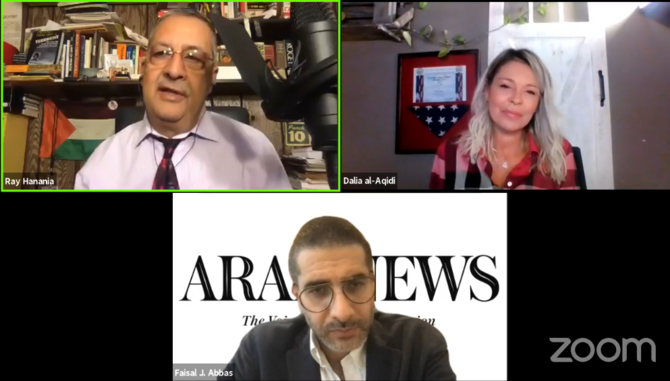
Arab News Editor-in-Chief Faisal Abbas and columnist Dalia Al-Aqidi agreed that one of the key conclusions that can be drawn from the “Election 2020: What do Arabs Want?” survey is that most people in the region believe the election will have an effect on their lives.
About 40 percent of those polled said Democratic challenger Joe Biden is the better choice for the region, compared with only 12 percent who preferred Trump. However, 53 percent said they had opposed the policies of Biden’s former running mate, President Barack Obama, who is currently on the campaign trail to rally support for his former vice president.
“What is very interesting about the study we did this time around is that while the majority thinks that Biden might be better for the region (about half of the respondents) don’t even know who Biden is,” Abbas said during the “The Ray Hanania Show” on WNZK AM 690 Radio in Detroit, which is part of the US Arab Radio Network. “They are voting for a candidate they don’t know just so they don’t vote for Trump.”
Biden’s close association with Obama is seen by many Arabs as a negative factor.
“You cannot separate Joe Biden from Barack Obama,” said Abbas. “Yet even people who said Biden is better for the region, 58 percent of them said that they would want Biden to distance himself from Obama’s policies, and they think Obama left the region in a worse-off situation.”
Al-Aqidi said it is unrealistic to expect that Biden would disregard his personal history with Obama.
“This is impossible — you cannot expect Biden to distance himself from Obama,” she said. “Actually, Obama is helping and trying to save Biden in the past two weeks, campaigning with him.
“Even in Biden’s platform, it always goes back to ‘I was a VP and as a VP I did this.’ It would be extremely hard for Biden to distance himself … if Biden wins, he will be a shadow of Obama.”
The YouGov survey, which was commissioned by the Arab News Research and Studies Unit, asked 3,097 people in 18 Arab countries about their opinions on a number of issues relating to the US presidential election.
The continuation of Washington’s recent tough stance on Iran was one of the top issues that respondents said the winner should focus on. Notably, the war posture adopted against Iran by the Trump administration, and the strict sanctions it has imposed on the regime in Tehran, received strong support from people polled in Iraq (53 percent), Lebanon (38 percent) and Yemen (54 percent), three nations that have been severely affected by the regional activities of the Iranian state.
“This is not a marginal issue for people living in the Middle East,” said Abbas. “You just have to look at countries, any country in the Middle East: where you find destruction, you will find Iranian fingerprints all over.”
The main issue is not religion or differences between Sunnis and Shi’ites, he added, it is Iranian interference in the affairs of other nations.
“As the former ambassador to the US, Prince Khaled, said, Saudi Arabia used to send tourists to Lebanon — Iran sends terrorists,” Abbas said.
“For people who have short-term memories let me remind them it was the Iranians who attacked the US Marines in Beirut. It’s the Iranians who transformed (Beirut) from a tourist destination … today, Lebanon is (experiencing) one of its worst-ever economic crises and it does not look like there is a way out for it.”
Arabs in Lebanon, Syria and Yemen are therefore very supportive of Trump’s tough approach to Iran, he added.
“Nobody is safe from the Iranian tentacles,” Abbas said. “This is a mad regime.”
On another important regional issue, slightly more than half of the Arabs polled said they do not support a bigger role for Washington in the peace process between the Palestinians and Israelis. However, the proportion of Palestinians living in the occupied territories who favor greater US involvement was higher.
“I think the Trump administration succeeded in this issue (pursuing peace between Israel and the Palestinians) more than any other previous administration,” said Al-Aqidi. “The US approach now is extremely different and it is driven by number one, the economy.”
She added that Trump’s strategy of brokering the recent agreements by the UAE and Bahrain to normalize relations with Israel was “the result of a different strategy.”
“The Ray Hanania Show,” which is sponsored by Arab News, is broadcast on WNZK AM 690, on the US Arab Radio Network, from 8 a.m. to 9 a.m. EST on Wednesdays. There is also a live simulcast of the show on the Arab News Facebook page.


![]()

Arabs in Middle East know the US election will affect their lives, experts say
Short Url
https://arab.news/pmf8n
Arabs in Middle East know the US election will affect their lives, experts say
- Editor-in-chief and columnist take part in US radio discussion of Arab News/YouGov survey of opinions on the presidential candidates
- Whether Biden triumphs or Trump wins second term, the poll suggests most people in region want Washington to maintain a tough stance on Iran


Latest updates


© 2026 SAUDI RESEARCH & PUBLISHING COMPANY, All Rights Reserved And subject to Terms of Use Agreement.