

Pakistan’s top religious body approves construction of new Hindu temple in capital

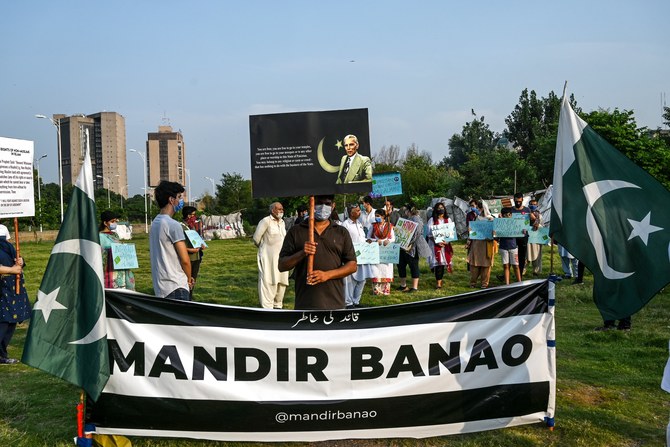
Demonstrators hold placards during a protest in Islamabad on July 8, 2020, as they demand the government to allow the construction of a Hindu temple in the Pakistan's capital. (AFP)
Short Url
Updated 29 October 2020
Follow

Pakistan’s top religious body approves construction of new Hindu temple in capital

  • The pact was signed by the first prime ministers of India and Pakistan to protect religious minorities after independence
  • The Council of Islamic Ideology has asked the government to allow Hindus to use Saidpur temple and let them set up cremation facility, community center

ISLAMABAD: Pakistan's Council of Islamic Ideology on Wednesday cited a 70-year-old agreement between India and Pakistan while responding to an official query regarding the construction of a Hindu temple in Islamabad at state expense.

A constitutional body responsible for providing legal advice on religious matters to the government, the council maintained that the state had not funded private places of worship in the past.

However, it noted that it could financially support minority religious communities since its members were citizens of Pakistan, adding that the community leaders could then decide how they wanted to use the allocated funds.

Apart from the Islamic injunctions and the constitution of the country, the council made its decision in light of the Liaquat-Nehru Pact that was signed in New Delhi by the first Pakistani and Indian prime ministers, Liaquat Ali Khan and Jawaharlal Nehru, in April 1950 to secure the rights of religious minorities in the newly independent states.

The council also recommended the government to let Hindus use an old temple in Saidpur Village, located in the heart of the federal capital, for the purpose of worship and ensure that it remained accessible to the religious community.

Apart from that, it endorsed the community’s request to set up a cremation facility and community center to make sure its members freely performed their religious rituals.

The controversy surrounding the construction of the temple in Islamabad began after Hindus performed the ground-breaking ceremony to build a new place of worship in June.

People belonging to conservative social segments objected to the construction work, and some of them even demolished the boundary wall of the temple.

In the ensuing debate, some people objected to the government's plan to fund the project. Subsequently, the country’s religious affairs ministry referred the matter to the council in July, seeking its advice over the issue.


Pakistan says it is moving toward phased crypto regulation after Binance, HTX approvals

Updated 8 sec ago
Follow

Pakistan says it is moving toward phased crypto regulation after Binance, HTX approvals

  • The country is among the world’s largest crypto adoption markets, with nearly 40 million users
  • Bilal bin Saqib says the government is not promoting crypto but moving to regulate the sector

ISLAMABAD: Pakistan’s top virtual asset regulatory official said on Sunday the country was laying the foundation for a phased and tightly supervised crypto framework after granting conditional approvals to two global exchanges, signaling a shift from years of regulatory ambiguity toward formal oversight of digital assets.

The Pakistan Virtual Assets Regulatory Authority (PVARA) said this week it had issued no objection certificates (NOCs) to global crypto exchanges Binance and Huobi (HTX). Pakistan has also signed a memorandum of understanding with them to explore what the finance ministry described as the “tokenization” of up to $2 billion in sovereign bonds, treasury bills and commodity reserves, an initiative aimed at boosting liquidity and attracting investors.

“The no objection certificate given to Binance and Huobi is the first practical step of this new thinking,” PVARA chief Bilal bin Saqib said at a briefing. “Let me make it clear that this NOC is not a shortcut. This is not a blanket approval.”

He said the approvals marked the start of a risk-mitigated, phased and supervised entry framework, adding that platforms would be subject to strict anti-money laundering and counter-terrorism financing requirements, ownership transparency checks and enforcement-linked licensing timelines.

“This is not a new experiment,” he said, pointing to phased regulatory approaches adopted in financial centers such as Dubai, the United Kingdom and Singapore, where firms are first brought under supervision before being allowed to expand operations.

Pakistan is among the world’s largest crypto adoption markets, with estimates putting the number of users between 30 and 40 million, despite the absence of a comprehensive regulatory framework. Saqib said ignoring the sector was no longer viable, warning that unregulated adoption posed greater risks to the economy and consumers.

“We don’t want to promote crypto,” he said. “We want to regulate crypto. Adoption is already there.”

​He said the framework was designed to prepare Pakistan for longer-term developments in digital finance, including tokenized assets, compliance technology, blockchain analytics and digital payment infrastructure, while ensuring that local talent is channeled into regulated and productive use.

“For the international community, the message is clear,” Saqib said. “Pakistan is not running away from innovation. Pakistan is welcoming innovation. Pakistan is regulating innovation.”