

Pakistan’s top religious body approves construction of new Hindu temple in capital

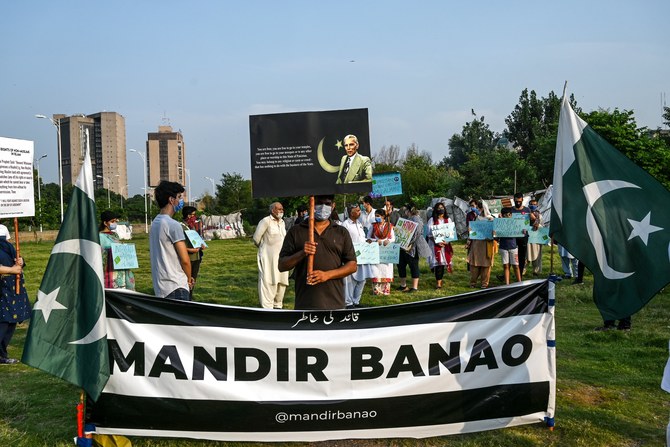
Demonstrators hold placards during a protest in Islamabad on July 8, 2020, as they demand the government to allow the construction of a Hindu temple in the Pakistan's capital. (AFP)
Short Url
Updated 29 October 2020
Follow

Pakistan’s top religious body approves construction of new Hindu temple in capital

  • The pact was signed by the first prime ministers of India and Pakistan to protect religious minorities after independence
  • The Council of Islamic Ideology has asked the government to allow Hindus to use Saidpur temple and let them set up cremation facility, community center

ISLAMABAD: Pakistan's Council of Islamic Ideology on Wednesday cited a 70-year-old agreement between India and Pakistan while responding to an official query regarding the construction of a Hindu temple in Islamabad at state expense.

A constitutional body responsible for providing legal advice on religious matters to the government, the council maintained that the state had not funded private places of worship in the past.

However, it noted that it could financially support minority religious communities since its members were citizens of Pakistan, adding that the community leaders could then decide how they wanted to use the allocated funds.

Apart from the Islamic injunctions and the constitution of the country, the council made its decision in light of the Liaquat-Nehru Pact that was signed in New Delhi by the first Pakistani and Indian prime ministers, Liaquat Ali Khan and Jawaharlal Nehru, in April 1950 to secure the rights of religious minorities in the newly independent states.

The council also recommended the government to let Hindus use an old temple in Saidpur Village, located in the heart of the federal capital, for the purpose of worship and ensure that it remained accessible to the religious community.

Apart from that, it endorsed the community’s request to set up a cremation facility and community center to make sure its members freely performed their religious rituals.

The controversy surrounding the construction of the temple in Islamabad began after Hindus performed the ground-breaking ceremony to build a new place of worship in June.

People belonging to conservative social segments objected to the construction work, and some of them even demolished the boundary wall of the temple.

In the ensuing debate, some people objected to the government's plan to fund the project. Subsequently, the country’s religious affairs ministry referred the matter to the council in July, seeking its advice over the issue.


Pakistan’s Shaheen Afridi out of Big Bash League with knee injury

Updated 30 December 2025
Follow

Pakistan’s Shaheen Afridi out of Big Bash League with knee injury

  • Afridi will return home for rehabilitation ahead of the Twenty20 World Cup starting in February
  • Afridi, on debut in Australian T20 league, took two wickets in four appearances for Brisbane Heat

Pakistan fast bowler Shaheen Shah Afridi has picked up a knee injury ​in Australia’s Big Bash League and will return home for rehabilitation ahead of the Twenty20 World Cup starting in February, his team Brisbane Heat said ‌on Tuesday.

Afridi, ‌25, suffered a ‌knee ⁠cartilage ​injury ‌fielding during Saturday’s win over Adelaide Strikers, Heat said in a statement.

“After consulting with the Pakistan Cricket Board’s medical staff during the past ⁠24 hours, it was agreed that ‌Afridi would ... return ‍home for ‍further treatment,” it added.

Afridi, making ‍his debut in the Australian franchise-based T20 league, took two wickets in four appearances for ​Heat.

“The BBL was everything I had heard it would ⁠be – lots of good, skillful cricket. I have enjoyed the challenge,” Afridi said in a statement shared by the team.

Pakistan will begin their T20 World Cup campaign on February 7 with a group stage game against ‌Netherlands in Colombo.