

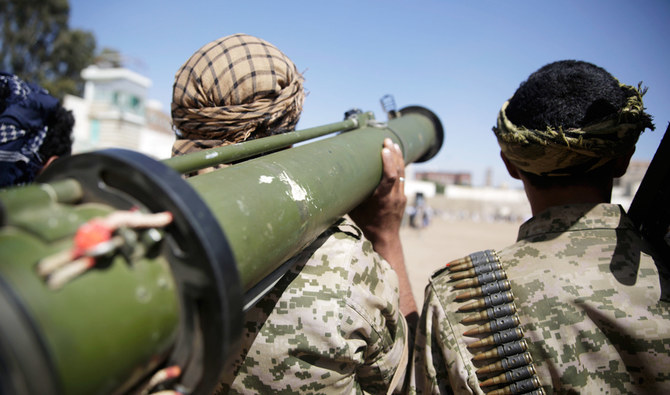

JEDDAH: Houthi militias and their Iranian backers were condemned on Sunday after the Saudi-led coalition intercepted four explosive-laden drones in two attacks launched from Yemen targeting the south of the Kingdom.
Three of the drones were destroyed early on Saturday and a fourth on Sunday. Shrapnel that fell in Sarat Abidah governorate injured a civilian, and damaged five homes and three vehicles, said civil defense spokesman Capt. Mohammed Abdu Al-Sayed.
Iran was increasing its support to the Houthis to undermine efforts for peace, Dr. Hamdan Al-Shehri, the political analyst and international relations scholar, told Arab News.
“They want the Houthis to sabotage all they can in Saudi Arabia, regardless of whether their target is a populated area, oil facilities or even a sacred place. This adds tension to the area, and that is what Iran is working on.”
Iranians want the Houthis to sabotage all they can in Saudi Arabia, regardless of whether their target is a populated area, oil facilities or even a sacred place. This adds tension to the area, and that is what Iran is working on.
Dr. Hamdan Al-Shehri, political analyst and international relations scholar
Al-Shehri said the situation in Yemen would remain the same unless the legitimate government was returned to Yemen, Security Council Resolution 2216 was put into practice and the Houthi militia were removed.
“Without these things, the Yemen crisis will not end and the whole region will remain in tension.”
The Houthis did not differentiate between military sites and civilian locations, he said.
“Their objective is to damage all places they can reach in Saudi Arabia, and their latest attempts to attack a populated area are nothing new.
“They have also targeted airports and some Aramco oil facilities. If the Aramco attack had not been contained, the damage would have affected the whole Eastern region. They have also attempted to target Makkah, where pilgrims and worshippers were performing their rituals.
“They don’t care. If you look back at what the Revolutionary Guards did at the Grand Mosque, you will realize it is not strange that the Houthis are trying to destroy everything in Saudi Arabia. The strange thing is the silence of the world toward what is happening.”


