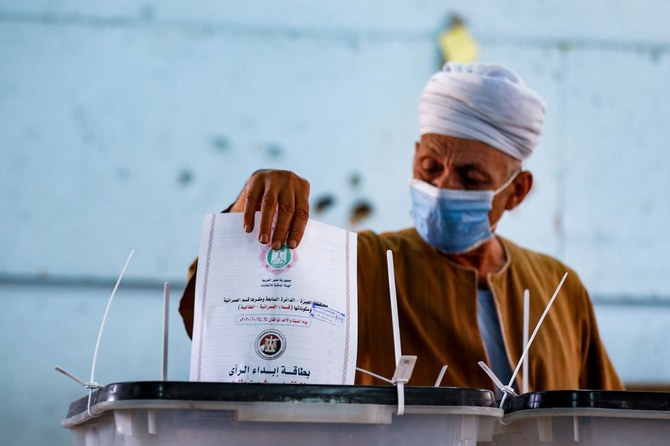
CAIRO: Egyptians on Sunday trickled into polling stations on the second day of voting for the country’s parliamentary election amid a slight uptick in daily recorded coronavirus cases.
The first stage of the vote for the lower chamber of parliament began a day earlier in 14 of Egypt’s 27 provinces, including Giza and the Mediterranean port city of Alexandria.
The second stage the vote is scheduled on Nov. 7-8 in the country’s 13 other provinces, including the capital Cairo and the Sinai Peninsula. The voting concludes with runoff elections.
The vote is likely to produce a toothless House of Representatives packed with supporters of President Abdel-Fattah El-Sisi that further rubber-stamps his policies, leaving the former military general with almost unchecked powers.
A total of 568 seats in the lower chamber are up for grabs, with more than 4,000 candidates running as individuals competing for half of the seats. Prominent, wealthy government-affiliated power brokers have an advantage.
The other half of elected seats in the chamber are reserved for the more than 1,100 candidates running on four party lists. El-Sisi will name 28 seats, or 5 percent, bringing the total number of seats in the lower chamber to 596.
Some 63 million voters are eligible to vote in the Arab world’s most population nation. The new chamber is expected to hold its inaugural session shortly after final results are announced in December.
The election is taking place as Egypt faces a slight increase in coronavirus cases, with authorities warning that a second wave of the pandemic lies ahead.
Face masks are mandatory at polling centers, which were disinfected before and during the vote, authorities said.
Authorities urged Egyptians to take part in the vote in order to show a high turnout and lend legitimacy to the election.
Only 14.23 percent of voters participated in the Senate election in August for the upper chamber, an advisory body with no powers, which was restored following a referendum last year.


Egyptians vote in second day of parliamentary elections
https://arab.news/zbwc5
Egyptians vote in second day of parliamentary elections

- Vote is likely to produce a toothless House of Representatives packed with supporters of President Abdel-Fattah El-Sis


Turkiye ‘closely’ monitoring Kurdish groups as Iran war rages
- “We are closely following PJAK’s activities in Iran and regional developments,” the Turkish defense ministry said
- “Turkiye supports the territorial integrity of neighboring states, not their fragmentation“
ANKARA: Turkiye’s defense ministry on Thursday said it was “closely” following the actions of Kurdish militant groups over concerns they are being drawn into the war, reportedly by US-led efforts to destabilize Iran.
The conflict began on Saturday when US-Israeli strikes hit Iran, which retaliated with strikes across the region, with Tehran on Wednesday saying it had hit Kurdish militant groups based in Iraq.
The move came as reports suggested Washington was looking to arm Kurdish guerrillas to infiltrate Iran — a move that would likely raise hackles in Turkiye.
“We are closely following PJAK’s activities in Iran and regional developments,” the Turkish defense ministry said of an Iran-based Kurdish group which is an offshoot of the outlawed Kurdish militant PKK.
“Activities of groups like the PJAK terrorist organization, which promote ethnic separatism, negatively affect not only Iran’s security but also the overall peace and stability of the region,” the ministry said.
“Turkiye supports the territorial integrity of neighboring states, not their fragmentation.”
On February 22, the PJAK (the Kurdistan Free Life Party) and four other exiled Kurdish groups announced a political coalition to seek the overthrow of the Islamic Republic and ultimately to secure Kurdish self-determination.
Spread across Turkiye, Syria, Iraq and Iran, the Kurds are one of Iran’s most important non-Persian ethnic minority groups and have long supported anti-government protests in the Islamic Republic.
Turkiye has been seeking to end its conflict with the PKK, which formally disbanded last year after four decades of violence that claimed some 50,000 lives.
Although most PKK-linked groups embraced the call to disarm, the PJAK did not, with Ankara concerned any regional unrest could embolden recalcitrant Kurdish separatists.
In late January, following a wave of deadly anti-government protests in Iran, Turkish Foreign Minister Hakan Fidan told his Iranian counterpart Abbas Araghchi that “the complete neutralization of PJAK constitutes an urgent necessity for Iran’s security.”


