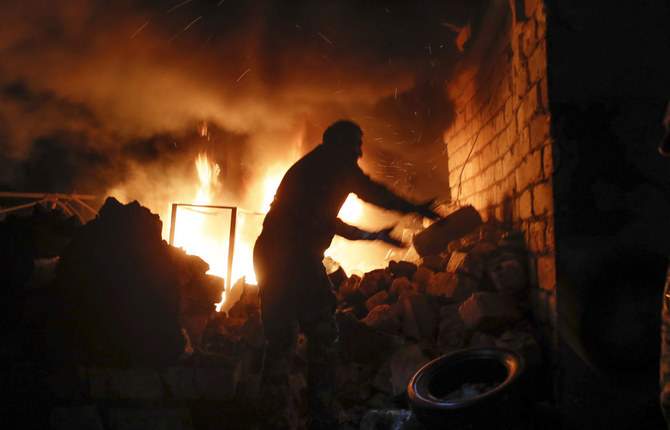
STEPANAKERT, Nagorno-Karabakh: Rocket and artillery barrage hit residential areas in Nagorno-Karabakh on Saturday hours after the United States hosted top diplomats from Armenia and Azerbaijan for talks on settling their decades-long conflict over the region.
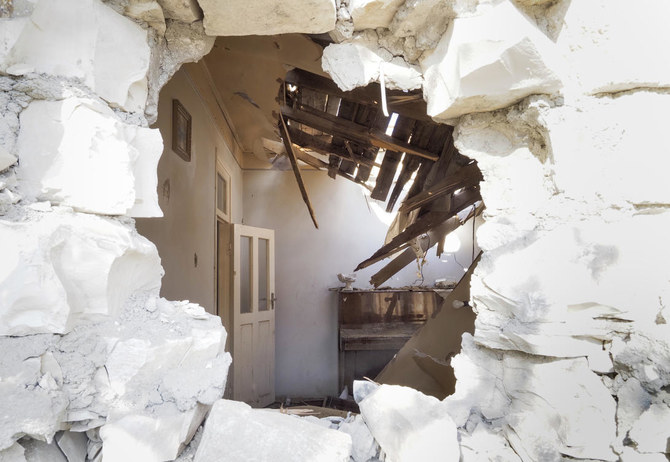
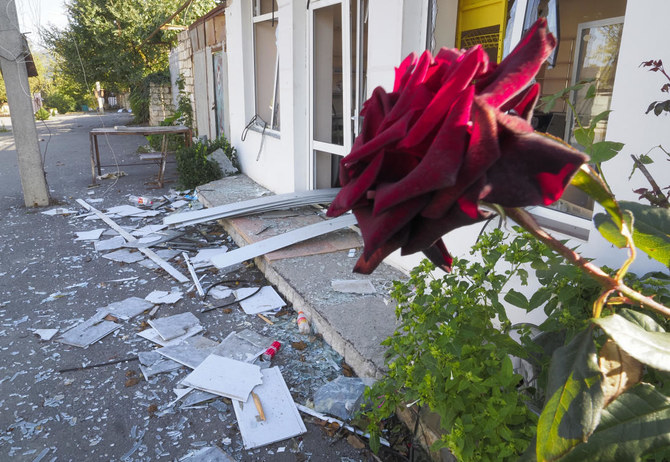
The heavy shelling forced residents of Stepanakert, the regional capital of Nagorno-Karabakh, into shelters, as emergency teams rushed to extinguish fires. Local officials said the city was struck with Azerbaijan’s Smerch long-range multiple rocket systems, a devastating Soviet-designed weapon intended to ravage wide areas with explosives and cluster munitions.
Nagorno-Karabakh authorities said other towns in the region were also targeted by Azerbaijani artillery fire. There was no immediate information about casualties.
Officials in Azerbaijan claimed that the town of Terter and areas in the Gubadli region came under Armenian shelling early Saturday, killing a teenager. They also said 13-year-old boy died Saturday of wounds from an earlier shelling of Ganja, Azerbaijan’s second-largest city.
Nagorno-Karabakh lies within Azerbaijan but has been under the control of ethnic Armenian forces backed by Armenia since a war there ended in 1994. The current fighting that started Sept. 27 marks the worst escalation in the conflict since the war’s end and has killed hundreds, perhaps even thousands, according to official reports.
After two failed attempts by Russia to broker a truce, the US waded onto the scene on Friday, with Secretary of State Mike Pompeo hosting the Armenian and Azerbaijan foreign ministers for separate talks.
“Both must implement a cease-fire and return to substantive negotiations,” Pompeo said in a tweet after the negotiations.
Those words were ignored on the ground.
“Just now a bomb exploded in my garden,” Georgiy, a resident of Stepanakert who only gave his first name amid the war jitters, said after the overnight attack. “If this is the so-called cease-fire, let the whole world see this cease-fire.”
Georgiy, who was born in Stepanakert, said he would stay home despite the fighting.
“This is my motherland, I’m not going to leave it,” he said. “All the people will stand until the last.”
According to Nagorno-Karabakh officials, 963 of their troops have been killed, and 37 civilians also have died. Azerbaijan hasn’t disclosed its military losses, but said that over 60 civilians were killed and about 300 were wounded in the four weeks of fighting.
Russian President Vladimir Putin said Thursday that according to Moscow’s information, the death toll from the fighting was significantly higher than officially reported by the warring parties, nearing 5,000.
Russia, the United States and France have co-chaired the so-called Minsk Group set up by the Organization for Security and Cooperation in Europe to mediate in the conflict, but they haven’t scored any progress after nearly three decades.
Azerbaijani President Ilham Aliyev has said that to end hostilities Armenian forces must withdraw from Nagorno-Karabakh. He has insisted that Azerbaijan has the right to reclaim its territory by force since international mediators have failed.
Turkey has thrown its weight behind Azerbaijan, vowing to support its ally “on the battlefield or the negotiating table.” It has trained Azerbaijani military and provided it with strike drones and long-range rocket systems that gave Azerbaijan a strong military edge on the battlefield.
Armenian officials say Turkey is directly involved in the conflict and is sending Syrian mercenaries in to fight on Azerbaijan’s side.
Turkey has denied deploying combatants to the region, but a Syrian war monitor and Syria-based opposition activists have confirmed that Turkey has sent hundreds of Syrian opposition fighters to fight in Nagorno-Karabakh.

Fighting over Nagorno-Karabakh goes on despite US mediation
Short Url
https://arab.news/mchkg
Fighting over Nagorno-Karabakh goes on despite US mediation
- Nagorno-Karabakh lies within Azerbaijan but has been under the control of ethnic Armenian forces backed by Armenia since a war there ended in 1994
- After failed attempts by Russia to broker a truce, Pompeo hosted the Armenian and Azerbaijan foreign ministers for separate talks
India and Israel: trade, defense and diplomacy
NEW DELHI: Indian Prime Minister Narendra Modi will visit Israel on Wednesday aiming to deepen ties with a key trade and defense partner, while balancing his government’s broader diplomatic interests in the Middle East.
New Delhi has steadily expanded cooperation with Israel across the defense, agriculture, technology and cybersecurity sectors.
One of India’s largest conglomerates, Adani Group, operates the Mediterranean port of Haifa, while Israeli military drone technology played a pivotal role during India’s May 2025 clash with Pakistan.
At the same time, India maintains strong relations with Gulf nations and Tehran, including developing Iran’s Chabahar port — a trade gateway to Afghanistan, where New Delhi has built a relationship with Taliban authorities.
Here’s a closer look at India-Israel ties.
- Trade -
In September 2023, grand plans were unveiled in New Delhi for an India-Middle East-Europe Economic Corridor — to link railways, ports, electricity, data networks and pipelines, including through Saudi Arabia and Israel.
Those plans were stalled by Hamas’s October 7 deadly attack on Israel, which responded with a devastating war in the Gaza Strip.
Trade remains central to the diplomatic relationship with Israel, providing access to products from its advanced tech sector, while India offers a vast consumer market.
Key sectors include agriculture technology, food security, water management, diamonds, dairy, fisheries, and manufacturing.
Bilateral trade reached $3.75 billion in 2024-25, according to Indian figures, though this is understood to exclude arms sales.
Thousands of Indians work in Israel, including those who came to replace the jobs of Palestinian construction workers barred from entering since the October 7 attack and outbreak of war in 2023.
- Defense -
Israel is one of India’s top arms suppliers, dating back to its military support during the 1962 war with China and subsequent conflicts with Pakistan in 1971 and 1999.
Between 2020-24, Israel provided 13 percent of India’s military hardware, making it New Delhi’s third-largest supplier after Russia and France, according to the Stockholm International Peace Research Institute (SIPRI).
India and Israel have launched multi-billion-dollar joint ventures to produce drones, missile systems, radar, cybersecurity technology, naval vessels and firearms.
- Diplomacy -
Full diplomatic relations between the two countries were established in 1992. Ties deepened after Hindu-nationalist leader Modi took office in 2014.
Modi visited Israel in 2017, and Prime Minister Benjamin Netanyahu traveled to India the following year.
Both right-wing leaders have called each other a “friend.”
US President Donald Trump invited India to become a member of the “Board of Peace” that he established after helping negotiate a ceasefire to halt two years of war between Israel and Hamas in Gaza.
New Delhi sent a representative to the board’s inauguration this month, but said its attendance was only in an “observer” capacity.
India in January hosted foreign ministers from Arab League nations, which have heavily criticized the war in Gaza. Modi told them he offered “continued support for the people of Palestine” and “welcomed ongoing peace efforts.”
A free trade agreement with Oman last year reflects India’s push for broader Middle East market access.
- Ancient roots -
Jewish links to India span millennia with India’s Arabian Sea port of Kochi — a key post in the ancient Greco-Roman trade network — home to a Jewish community for centuries.
“Civilizational relations between the countries date back more than two millennia,” India’s foreign ministry says.
The Paradesi Synagogue in Kochi, India’s oldest, was built in 1568 — though barely any Jews remain in the city today.
Many emigrated to Israel after 1948, and more than 100,000 Jews of Indian origin live in Israel today, according to New Delhi.
In India’s northeast Manipur state, thousands from the Bnei Menashe community claim descent from one of the “lost tribes” of Israel.
Some members of the community have moved to Israel and the Israeli government has said it is preparing to resettle thousands more in the next few years.
New Delhi has steadily expanded cooperation with Israel across the defense, agriculture, technology and cybersecurity sectors.
One of India’s largest conglomerates, Adani Group, operates the Mediterranean port of Haifa, while Israeli military drone technology played a pivotal role during India’s May 2025 clash with Pakistan.
At the same time, India maintains strong relations with Gulf nations and Tehran, including developing Iran’s Chabahar port — a trade gateway to Afghanistan, where New Delhi has built a relationship with Taliban authorities.
Here’s a closer look at India-Israel ties.
- Trade -
In September 2023, grand plans were unveiled in New Delhi for an India-Middle East-Europe Economic Corridor — to link railways, ports, electricity, data networks and pipelines, including through Saudi Arabia and Israel.
Those plans were stalled by Hamas’s October 7 deadly attack on Israel, which responded with a devastating war in the Gaza Strip.
Trade remains central to the diplomatic relationship with Israel, providing access to products from its advanced tech sector, while India offers a vast consumer market.
Key sectors include agriculture technology, food security, water management, diamonds, dairy, fisheries, and manufacturing.
Bilateral trade reached $3.75 billion in 2024-25, according to Indian figures, though this is understood to exclude arms sales.
Thousands of Indians work in Israel, including those who came to replace the jobs of Palestinian construction workers barred from entering since the October 7 attack and outbreak of war in 2023.
- Defense -
Israel is one of India’s top arms suppliers, dating back to its military support during the 1962 war with China and subsequent conflicts with Pakistan in 1971 and 1999.
Between 2020-24, Israel provided 13 percent of India’s military hardware, making it New Delhi’s third-largest supplier after Russia and France, according to the Stockholm International Peace Research Institute (SIPRI).
India and Israel have launched multi-billion-dollar joint ventures to produce drones, missile systems, radar, cybersecurity technology, naval vessels and firearms.
- Diplomacy -
Full diplomatic relations between the two countries were established in 1992. Ties deepened after Hindu-nationalist leader Modi took office in 2014.
Modi visited Israel in 2017, and Prime Minister Benjamin Netanyahu traveled to India the following year.
Both right-wing leaders have called each other a “friend.”
US President Donald Trump invited India to become a member of the “Board of Peace” that he established after helping negotiate a ceasefire to halt two years of war between Israel and Hamas in Gaza.
New Delhi sent a representative to the board’s inauguration this month, but said its attendance was only in an “observer” capacity.
India in January hosted foreign ministers from Arab League nations, which have heavily criticized the war in Gaza. Modi told them he offered “continued support for the people of Palestine” and “welcomed ongoing peace efforts.”
A free trade agreement with Oman last year reflects India’s push for broader Middle East market access.
- Ancient roots -
Jewish links to India span millennia with India’s Arabian Sea port of Kochi — a key post in the ancient Greco-Roman trade network — home to a Jewish community for centuries.
“Civilizational relations between the countries date back more than two millennia,” India’s foreign ministry says.
The Paradesi Synagogue in Kochi, India’s oldest, was built in 1568 — though barely any Jews remain in the city today.
Many emigrated to Israel after 1948, and more than 100,000 Jews of Indian origin live in Israel today, according to New Delhi.
In India’s northeast Manipur state, thousands from the Bnei Menashe community claim descent from one of the “lost tribes” of Israel.
Some members of the community have moved to Israel and the Israeli government has said it is preparing to resettle thousands more in the next few years.
© 2026 SAUDI RESEARCH & PUBLISHING COMPANY, All Rights Reserved And subject to Terms of Use Agreement.