

‘My Next Guest’ sees legendary David Letterman mixing it up

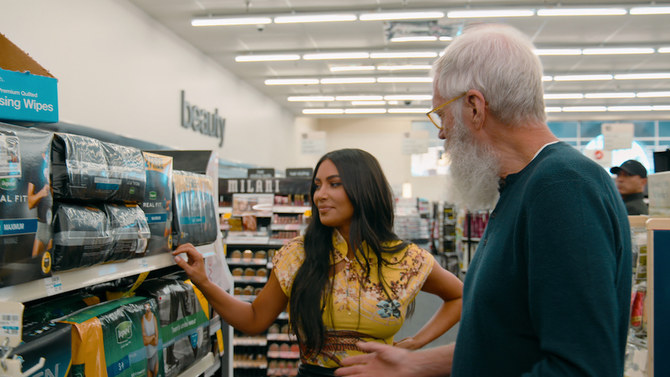
Kim Kardashian West is a guest on the latest season of the show. Supplied
Short Url
Updated 24 October 2020
Follow

‘My Next Guest’ sees legendary David Letterman mixing it up

LONDON: After a well-received first season, the second batch of David Letterman’s Netflix talk show conversations began to show signs that the legendary late-night host was softening in his old age. He was less barbed, less sarcastic and (dare we say it) more fawning than the acerbic agitator who had been a mainstay of US talk shows for more than 30 years.

And while the third season of “My Next Guest Needs No Introduction” undoubtedly sees the 73-year-old comedian taking a slower-paced approach to his interviews (episodes are, after all, nearly an hour, rather than the quick-fire exchanges of his earlier career) there are glimmers of that pointed stare, that quick-witted retort, that unbalancing question that make him such a great interviewer. The guests – Kim Kardashian West, Robert Downey Jr, Dave Chappelle and Lizzo – give Letterman different things to play off. His familiarity with Downey Jr and Chappelle contrasts with his (slightly contrived) old-man schtick in the face of Kardashian West’s social media clout, but with more than a few minutes to play with, there’s time enough for him to ramp up from pleasantries to more serious lines of questioning. And he does, for the most part, take those chances, whether it’s exploring issues of addiction with Downey Jr, comedic excess with Chappelle, or Kardashian West’s relationship with the White House.

It’s interesting to note that Letterman remains quick to play to the crowd. It’s what makes the interviews with Chappelle and Lizzo stand out, filmed as they are at the star’s homes instead of with a studio audience. In the series opener interview with Kardashian West, for example, Letterman appears almost cowed by the star power of his guest, and his questioning turns more grandfatherly than genuinely inquisitive. But every now and again, he throws his guests a curveball, probing with questions that deserve not to be spoiled here. They’re welcome reminders that, when he’s on song, Letterman still has few equals.


‘One in a Million’: Syrian refugee tale wows Sundance

Updated 24 January 2026
Follow

‘One in a Million’: Syrian refugee tale wows Sundance

PARK CITY: As a million Syrians fled their country's devastating civil war in 2015, directors Itab Azzam and Jack MacInnes headed to Turkey where they would meet a young girl who encapsulated the contradictions of this enormous migration.

In Ismir, they met Isra'a, a then-11-year-old girl whose family had left Aleppo as bombs rained down on the city, and who would become the subject of their documentary "One In A Million," which premiered at the Sundance Film Festival on Friday.

For the next ten years, they followed her and her family's travels through Europe, towards Germany and a new life, where the opportunities and the challenges would almost tear her family apart.

The film is by directors Itab Azzam and Jack MacInnes. (Supplied)

There was "something about Isra'a that sort of felt to us like it encapsulated everything about what was happening there," MacInnes told an audience at the Sundance Film Festival in Park City, Utah on Friday.

"The obvious vulnerability of her situation, especially as being a child going through this, but that at the same time, she was an agent.

"She wasn't sitting back, waiting for other people to save her. She was trying to fight, make her own way there."

The documentary mixes fly-on-the-wall footage with sit-down interviews that reveal Isra'a's changing relationship with Germany, with her religion, and with her father.

It is this evolution between father and daughter that provides the emotional backbone to the film, and through which tensions play out over their new-found freedoms in Europe -- something her father struggles to adjust to.

Isra'a, who by the end of the film is a married mother living in Germany, said watching her life on film in the Park City theatre was "beautiful."

And having documentarists follow her every step of the way as she grew had its upsides.

"I felt like this was something very special," she told the audience after the screening. "My friends thought I was famous; it made making friends easier and faster."