

Plasma from recovered COVID-19 cases has ‘no clinical benefit’ for patients

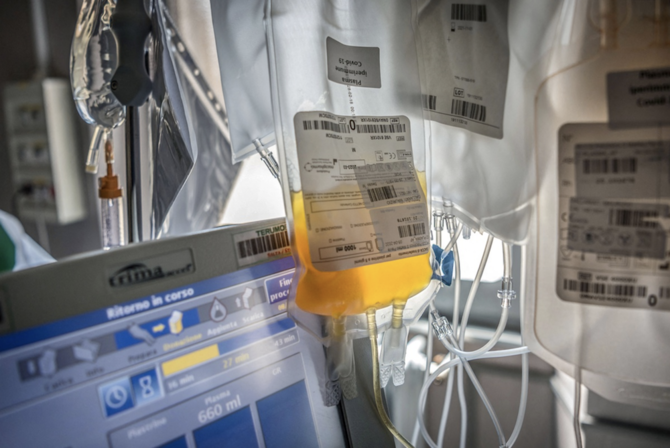
The study of 464 COVID-19 patients in India found that people who received plasma infusions were not less likely to die or progress to a more severe form of the disease. (Reuters/File Photo)
Short Url
Updated 23 October 2020
Follow

Plasma from recovered COVID-19 cases has ‘no clinical benefit’ for patients

  • Avoiding infection remains key message, says professor

LONDON: Plasma infusions do not aid the recovery of COVID-19 patients, according to a new study published in the British Medical Journal.

The study of 464 COVID-19 patients in India found that people who received plasma infusions were not less likely to die or progress to a more severe form of the disease.

This outcome showed that plasma infusions offered “no net clinical benefit to patients.”

Patients who received infusions did, however, experience an improvement in symptoms such as shortness of breath and fatigue.

Ian Jones, a professor of virology at Reading University, said: "The poor performance of convalescent plasma in this trial is disappointing but not entirely surprising. We still do not have enough treatments for the early stage of disease to prevent severe disease and, until this becomes an option, avoiding being infected with the virus remains the key message.”

Despite the slight improvements to fatigue and shortness of breath, Reading University cellular microbiology expert Simon Clarke said these were not enough to improve recovery from the disease.

“In simple terms, there were no clinical benefits to the patients,” he added.

Patients in India and the US have been receiving plasma infusions as part of their treatment, so news that the procedure has little or no effect on recovery is a significant setback.


In South Africa’s affluent Western Cape, farmers lose cattle to drought

Updated 2 sec ago
Follow

In South Africa’s affluent Western Cape, farmers lose cattle to drought

  • Drought in country’s south follows flooding ‌in north
  • Farmers try to adapt but lose livestock
KNYSNA: In South Africa’s most visited and affluent province, Western Cape, one of the worst droughts in living memory is drying up dams, scorching grass and killing livestock, prompting the government to declare a national emergency this month.
Scientists say climate change is causing worsening droughts in the province, which draws tourists to ‌its vineyards, ‌beaches and the lush slopes of ​Table ‌Mountain ⁠above ​Cape Town, ⁠but lies on the edge of the advancing semi-desert Karoo. In 2015, a drought almost dried up the taps in the city; farmers say this one has been even more brutal than a decade ago.
Over the weekend, mixed-race couple Christian and Ilze Pienaar were ⁠distributing feed to keep their hungry cattle alive. ‌One cow had recently ‌starved to death, its bones ​visible through its skin.
“The drought ‌before wasn’t this bad because there was still ... ‌grazing,” Ilze, 40, told Reuters. “Now there’s nothing, the dams are dry ... (and) we’re spending all our money on feed.”
She said she’d lost 16 cattle and 13 sheep since January alone.
The ‌drought, which has also ravaged parts of Eastern Cape and Northern Cape, comes weeks ⁠after ⁠floods blamed on climate change and cyclical La Niña weather washed out the northeastern part of South Africa and killed 200 people across the region.
“The intensity and duration of both droughts and floods in this corner of the world is increasing,” Anton Cartwright, an economist with the African Center for Cities, said.
“Farmers (here) are very good at adapting to weather (but) ... the weather is just becoming much less predictable,” ​he said. “Seasons aren’t occurring, starting, ​ending at the same time of the year. It’s probably going to get worse.”
(Writing by Tim Cocks; editing by ​Philippa Fletcher)